A bypass humidifier suits standard furnaces, while steam fits heat pumps and large spaces. Choosing a whole house humidifier comes down to how your heating system delivers warmth and how much moisture your building envelope loses. Forced air makes the difference.
Winter air dries out indoor spaces when cold outdoor ventilation air enters the home and expands under heating, leading to dry air in a house. Cold air cannot hold substantial water vapor. According to the Environmental Protection Agency (EPA), maintaining ideal indoor humidity between 30 and 50 percent helps protect respiratory passages and reduces static shocks. Dropping below that range creates persistent discomfort.
Ducted humidifiers solve this problem by introducing water vapor directly into your central air stream. Three designs handle this job. Bypass units rely on pressure drops across heating, ventilation, and air conditioning (HVAC) ducts. Fan-powered models use an internal motor to blow air through a wet pad. Steam units boil water with electrical current to generate vapor on demand. Picking the wrong design causes chronic water waste, inadequate humidity, or moisture damage inside exterior walls.
Bypass Humidifiers Depend on Hot Furnace Supply Air
Bypass evaporative humidifiers require hot plenum air from a fuel-burning furnace to evaporate water effectively. They install between your warm supply duct and your cold return duct. A round bypass pipe connects the two trunks. When the furnace blower runs, pressure differences pull hot air through an evaporative pad. The pad stays wet from a small water feed tube at the top.
Evaporation absorbs heat. Turning liquid water into vapor requires energy known as the latent heat of vaporization. Standard gas furnaces produce supply air temperatures between 120 and 140 degrees Fahrenheit according to equipment design specifications published by the American Society of Heating, Refrigerating and Air-Conditioning Engineers (ASHRAE). That high heat evaporates moisture rapidly.
Heat pumps behave differently. An air-source heat pump typically supplies air at 90 to 105 degrees Fahrenheit according to ASHRAE residential application data. Cooler air absorbs moisture slowly. As a result, a bypass unit on a heat pump runs for hours without raising indoor moisture levels, sending unevaporated water down the drain. Water waste is inherent to the flow-through design. To prevent mineral encrustation, the solenoid valve feeds fresh water across the pad continuously while the humidistat calls for moisture. The EPA reports that conventional flow-through evaporative humidifiers discharge approximately 70 to 80 percent of incoming water directly into the drain. That runoff carries away dissolved solids.
Fan-Powered Humidifiers Eliminate the Return Bypass Duct
Fan-powered evaporative humidifiers use an internal electric motor to drive supply air directly across a wet internal pad. They mount onto a single duct trunk. Most installations place the housing on the warm supply plenum just above the furnace heat exchanger. Because the unit contains its own fan, it does not need a bypass pipe routed to the return trunk.
This saves space. Mechanical rooms with narrow clearances or complex duct transitions often leave no room for a bypass connection. A fan-powered unit fits where bypass piping cannot reach. The internal fan also increases total moisture delivery compared to a passive bypass duct. By forcing consistent air volume across the pad, a fan-powered model provides reliable evaporation rates.
It still relies on furnace heat for evaporation. Running the internal fan when the furnace burner is off pushes cool, damp air through your registers. Occupants perceive that unheated airflow as a cold draft. For this reason, controls should interlock the humidifier with active heating cycles instead of general fan circulation. The unit also requires a standard electrical outlet to power the fan motor. Maintenance matches a bypass unit. You must slide the old pad out and install a fresh one every autumn.
Steam Canisters Produce Moisture Independent of Furnace Heat
Steam humidifiers generate atmospheric water vapor inside an internal boiling cylinder to humidify air without depending on furnace temperature. Two submerged metal electrodes pass electrical current through ordinary tap water. Natural minerals in the water resist the current. That electrical resistance creates intense heat and boils the water.
The resulting dry steam travels through an insulated hose to a stainless steel dispersion tube installed in your supply duct. Steam absorbs instantly. Because the moisture is already gaseous vapor, it does not steal heat from the furnace supply air. This makes steam the primary option for homes heated by variable-capacity heat pumps, dual-fuel systems, or geothermal loops.
Output is substantial. Residential steam canisters generate between 12 and 35 gallons of moisture per day according to test standards published by the Air-Conditioning, Heating, and Refrigeration Institute (AHRI). A steam unit can also activate your HVAC blower to humidify your house even when the thermostat does not call for heat. That capability solves winter dryness in tightly insulated homes where furnaces fire infrequently.
The trade-off involves power consumption. Boiling water requires high electric current. Steam models require a dedicated electrical circuit drawing between 11 and 16 amperes of current according to manufacturer electrical specifications filed under National Electrical Code guidelines. Your electrical service panel must have space for this additional breaker.
System Types Dictate Which Whole House Humidifier Succeeds
Matching humidifier technology to your specific heating plant prevents performance failure and excessive water waste. A gas furnace pair works well with a bypass model. Heat pumps need steam. The physical mechanisms of each design determine operating efficiency, space constraints, and equipment compatibility.
| Feature | Bypass Evaporative | Fan-Powered Evaporative | Electrode Steam |
|---|---|---|---|
| Heat requirement | High furnace heat (120 to 140 F) | Moderate furnace heat (105 to 130 F) | Independent of furnace heat |
| Ducting needed | Bypass duct connecting supply to return | Mounts directly to single plenum | Dispersion tube in supply duct |
| Water consumption | Flushes 70 to 80 percent to drain | Flushes 70 to 80 percent to drain | Converts nearly 100 percent to steam |
| Electrical requirement | Low-voltage 24V transformer | Standard 120V outlet for fan | Dedicated 120V or 240V circuit (11 to 16A) |
| Ideal heating system | Natural gas or fuel oil furnace | Gas furnace or high-output heat pump | Heat pumps, geothermal, large homes |
A ducted system is not suitable for houses with hydronic baseboards, radiant floors, ductless mini-splits, or serious air leakage through the building envelope. If your house lacks central supply ductwork, standalone room humidifiers provide targeted moisture without tearing up ceilings. Similarly, in a drafty structure, adding mechanical moisture before air sealing drives humid air into cold exterior walls. Water vapor condenses inside wall cavities when it hits cold sheathing, promoting concealed structural rot. If heat pump designs standardise supply air temperatures above 115 degrees Fahrenheit in future years, evaporative bypass units would become reliable choices for those systems. Until then, low supply air temperatures prevent evaporative pads from delivering their rated capacity on electric heat pumps.
Water Hardness Determines Pad and Canister Replacement Cycles
Mineral concentration in your incoming water supply controls how quickly evaporative pads scale up and steam cylinders fill with sediment. Water supplies carry dissolved calcium and magnesium ions. When liquid water evaporates into duct air, it leaves those minerals behind. On an evaporative pad, minerals form crusty white deposits that choke airflow and force water to track down the edges.
The Water Quality Association (WQA) defines hard water as containing more than 7 grains per gallon of dissolved minerals. In hard water areas, an evaporative pad can clog within two to three months of active winter use. Replacing the pad once or twice each heating season maintains rated evaporation rates.
Electrode steam canisters handle minerals in a different way. The canister acts as a collection vessel for boiling solids. Pure steam leaves the top, while mineral precipitate falls to the bottom of the plastic tank. Electrode systems require dissolved minerals to function. The electric current travels directly through the water, using dissolved salts as conductive pathways. If you feed an electrode canister with distilled or reverse-osmosis water, the unit cannot conduct current and will not boil. When mineral sediment reaches a set depth, internal electronics alert you that the disposable cylinder requires replacement.
Water treated by traditional ion-exchange water softeners replaces calcium with sodium salts. While sodium does not produce hard limescale, high sodium levels create surface foaming during the boiling cycle inside electrode canisters. Foaming triggers false high-water sensor faults and forces the unit to drain water repeatedly according to manufacturer engineering guides. Connect steam humidifiers to unsoftened cold water supplies unless the manufacturer specifically approves softened water for that model.
Outdoor Temperatures Constrain Safe Indoor Humidity Targets
Indoor relative humidity targets must drop as outdoor temperatures decline to protect windows and exterior wall framing from condensation damage. Cold surfaces pull moisture out of indoor air. When warm, humid indoor air touches cold window glass or uninsulated framing members, the air temperature drops to its dew point. Liquid droplets form immediately. Persistent moisture on window sills damages drywall, peels paint, and encourages localized fungal growth.
The EPA recommends indoor relative humidity between 30 and 50 percent for general health and building comfort. However, maintaining 45 percent humidity during sub-zero winter weather will saturate double-pane window glass with condensation on windows. To prevent structural moisture issues, ASHRAE standard handbooks publish sliding humidity targets based on outdoor temperature.
- Outdoor temperature above 40 degrees Fahrenheit: Target 45 percent indoor relative humidity.
- Outdoor temperature between 20 and 40 degrees Fahrenheit: Target 40 percent indoor relative humidity.
- Outdoor temperature between 10 and 20 degrees Fahrenheit: Target 35 percent indoor relative humidity.
- Outdoor temperature between 0 and 10 degrees Fahrenheit: Target 30 percent indoor relative humidity.
- Outdoor temperature below 0 degrees Fahrenheit: Target 20 to 25 percent indoor relative humidity.
- Check your window glass daily during early winter freezes for interior bead formation.
- Lower your humidistat setting five percent if fogging appears along the lower pane edges.
- Mount an outdoor thermistor on the north side of the house if upgrading to an automatic humidistat.
Drainage and Electrical Capacity Limit Installation Feasibility
Duct geometry, electrical panel capacity, and floor drain locations dictate whether your mechanical room can support a ducted humidifier. Every evaporative humidifier discharges runoff water during operation. A continuous downward slope must carry that drain tubing to an open floor drain, laundry sink, or condensate pump. If your furnace sits in a finished area without nearby drainage, running flexible tubing across walkways creates a hazard.
Steam canisters also require drain connections. When a steam cylinder flushes sediment, it discharges scalding water that must mix with tempered cold water before entering drainage plumbing. Electrical supply presents another hurdle. Bypass units run on low-voltage 24-volt power provided by the furnace control board. Fan-powered units plug into a standard 120-volt convenience outlet. In contrast, steam humidifiers require a dedicated electrical circuit wired directly from the main breaker panel.
Seasonal maintenance rounds out ownership duties. If you run an evaporative bypass system, you must close its seasonal damper every spring to prevent air conditioning supply air from recirculating. Failing to close the damper reduces central cooling efficiency and counteracts your whole-house dehumidifier or cooling system. Measure your living area humidity with a standalone hygrometer across several cold days to confirm whether you need a whole house humidifier before purchasing equipment.
What to Buy for This
Each entry below is a specification rather than a single model, because stock and pricing on this equipment change constantly. The products shown are what currently matches that specification. Match the spec, then buy whatever meets it.
Bypass evaporative ducted humidifier with automatic digital humidistat and outdoor temperature sensor
Uses the furnace blower pressure differential to draw warm supply air through an evaporative water panel without needing a secondary fan motor, offering mechanical reliability for standard gas furnaces.
 AprilAire 500 12-gal. Whole-House Small Bypass Evaporative Humidifier with Automatic Digital Control for up to 3,600 sq. ft. + AprilAire Model 5844 Humidifier Installation KitAprilaire
 AprilAire 500M 12-gal. Whole-House Small Bypass Evaporative Humidifier with Manual Control for up to 3,600 sq. ft. + AprilAire Model 5843 Humidifier Installation KitAprilaire
Fan-powered evaporative ducted humidifier with built-in circulation fan and single-plenum mount
Mounts directly to the supply trunk without requiring a return bypass duct run, using its internal motor to push air across the pad to boost moisture output on moderate-temperature heating systems.
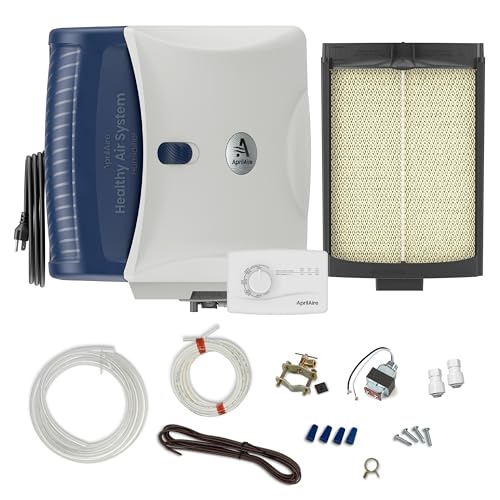 AprilAire 720MKZ Whole-House Fan-Powered Evaporative Humidifier – 21 GPD, Water Saving, Manual Control, Installation Kit, for up to 6,250 Sq. Ft., Part of the AprilAire Healthy Air SystemAprilaire
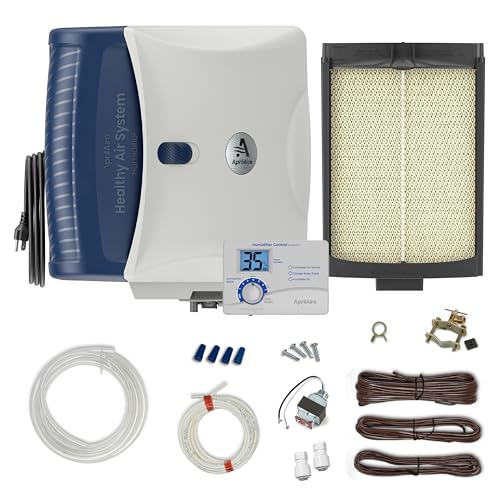 AprilAire 720AKZ Whole-House Fan-Powered Evaporative Humidifier – 21 GPD, Water Saving, Automatic Digital Control, Installation Kit, for up to 6,250 Sq. Ft., Part of the AprilAire Healthy Air SystemAprilaire
Electrode canister steam ducted humidifier with dispersion tube and internal diagnostics
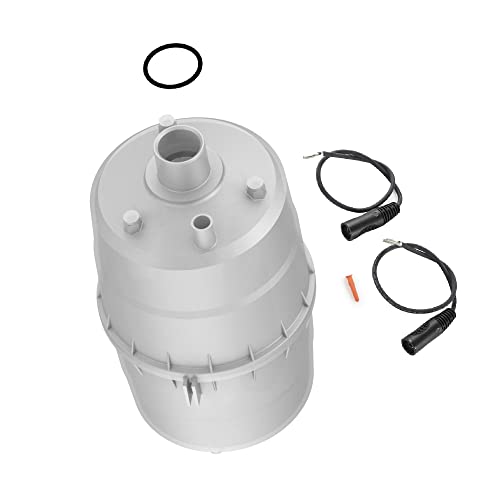
Boils water into atmospheric steam inside a replaceable electrode cylinder, delivering high daily moisture output independently of furnace temperature or runtime.

Prices are not shown here because they change daily and we will not display a stale one. Links open on Amazon, where the current price and availability are live.
Common questions
Can a whole house humidifier cause mold to grow in ductwork?
A ducted humidifier will not cause mold inside ductwork if relative humidity stays within safe limits and air moves continuously. Mold requires elevated relative humidity above 60 percent to germinate on dust inside sheet metal ducts according to the Environmental Protection Agency (EPA). Duct condensation only happens when oversized equipment over-saturates the air, when cold return ducts cool air below its dew point, or when leaky ducts drop below freezing in unconditioned attics.
Can you install an evaporative bypass humidifier on a heat pump?
An evaporative bypass humidifier functions poorly on an electric heat pump because heat pump supply air is too cool to evaporate water rapidly. Heat pumps typically supply air between 90 and 105 degrees Fahrenheit according to ASHRAE data, compared to 120 to 140 degrees from a gas furnace. Under these cooler temperatures, bypass units run for hours while flushing unevaporated water down the drain, making steam humidifiers the preferred choice for heat pump installations.
How much water does a flow-through whole house humidifier waste?
A flow-through evaporative humidifier discharges approximately 70 to 80 percent of its supply water down the floor drain according to the Environmental Protection Agency (EPA). This continuous flushing action prevents calcium and magnesium scale from solidifying across the evaporative water panel. In contrast, steam humidifiers convert nearly 100 percent of supplied water into moisture vapor, flushing only a small volume periodically to purge concentrated mineral sediment.
Why do electrode steam humidifiers require minerals in the water?
Electrode steam humidifiers pass electric current directly through the water between submerged metal electrodes to generate boiling heat. Pure water lacks the dissolved mineral ions needed to conduct electrical current. For this reason, electrode canisters require standard tap water containing naturally occurring minerals and cannot generate steam if supplied with purified water from a reverse osmosis filter.
How often should you replace an evaporative humidifier water panel?
You should replace an evaporative humidifier water panel once per heating season under normal municipal water conditions. In regions with hard water above 7 grains per gallon according to Water Quality Association (WQA) standards, heavy mineral encrustation may require two pad changes per season. Replacing the panel restores airflow and ensures water spreads evenly across the expanded aluminum mesh.
What is the difference between a bypass and a fan-powered humidifier?
A bypass humidifier uses the pressure difference created by the furnace blower to push air through a connecting duct between the supply and return plenums. A fan-powered humidifier mounts directly to a single plenum and uses an internal electric fan to blow air across the evaporative pad. Fan-powered models eliminate the need for bypass ductwork and provide slightly higher daily moisture output.