A hygrometer measures indoor moisture before damp air damages your building. It reports relative humidity (RH) as a percentage. That number tells you whether to run exhaust fans, start a dehumidifier, or leave the air alone. Most consumer models sit on a desk or hang on a wall. They display numbers instantly.
The instrument gives you visibility into unseen water vapor. Without one, you only notice high moisture after condensation drips down window panes or mold stains a baseboard. You might suspect dampness from a heavy odor. You might feel sticky air in summer. Feelings do not provide actionable targets. You need reliable numbers to protect building materials and respiratory health.
Hardware design dictates how well a sensor holds its baseline. The National Institute of Standards and Technology (NIST) notes that uncalibrated consumer sensors can deviate by 5 to 10 percentage points from actual room conditions. A high reading causes people to run cooling equipment unnecessarily. A low reading lets hidden moisture accumulate unchecked. Testing the baseline at home gives you confidence before you adjust mechanical equipment.
Capacitive Digital Sensors Outperform Mechanical Dials Indoors
Digital hygrometers with capacitive polymer sensors provide far better measurement stability than mechanical hair or bimetallic coil dials. A capacitive sensor measures electrical charges between two metal plates separated by a porous polymer film. Water molecules enter that film. As moisture enters, the electrical capacitance changes. An onboard computer chip translates that shift into a digital percentage. The National Institute of Standards and Technology (NIST) documents that capacitive sensors typically maintain an accuracy margin within 2 to 3 percentage points across standard indoor temperatures.
Mechanical dials behave differently. They rely on coiled brass strips or synthetic fibers that expand as moisture climbs. These mechanical linkages suffer from friction. Gears stick. Pivots collect dust. Over several seasons, mechanical springs lose tension and fail to register dry winter air accurately.
- Capacitive polymer chips register shifts in ambient water vapor within minutes of room air changes.
- Solid-state circuitry eliminates physical friction from moving needles.
- Electronic displays record historical peak high and low readings across daily cycles.
- Internal temperature compensation circuits prevent thermal interference with the humidity calculation.
Relative Humidity Tells You How Close Air Is to Condensation
Relative humidity measures the percentage of water vapor present in the air compared to the maximum amount that air could hold at that specific temperature. Temperature dictates holding capacity. Warm air holds substantial water vapor. Cold air holds very little. When room air cools down, the relative percentage climbs even if no extra moisture enters the house.
When warm indoor air cools against a cold surface, relative humidity reaches 100 percent, known as the dew point, according to meteorological data from the National Oceanic and Atmospheric Administration (NOAA). Liquid water then appears. When warm indoor air contacts cold window panes in winter, the localized relative humidity spikes, creating condensation on windows that can rot wooden sills.
The Environmental Protection Agency (EPA) advises keeping indoor relative humidity between 30 percent and 50 percent to avoid condensation problems and retard biological growth. Data published by the Centers for Disease Control and Prevention (CDC) indicates that mold spores germinate when ambient surfaces maintain relative humidity levels above 60 percent for extended periods. ASHRAE Standard 55 establishes that indoor relative humidity should remain below 65 percent to ensure human comfort and minimize allergen accumulation. Keeping air below those benchmarks preserves drywall, framing, and insulation.
Saturated Salt Slurries Provide an Accurate Home Calibration Standard
ASTM International (ASTM) standard E104 confirms that a saturated table salt slurry inside a sealed container creates a stable 75 percent relative humidity reference environment to test sensor accuracy. Chemistry provides this benchmark. Sodium chloride and pure water form a natural chemical equilibrium in still air at room temperature. The salt solution either absorbs or releases moisture until the surrounding air reaches exact equilibrium. You can build this calibration chamber on a kitchen counter. The process requires common household supplies.
- Add standard table salt to a shallow bottle cap until the cap is half full.
- Add several drops of tap water until the salt resembles wet sand without liquid pooling on top.
- Place the cap and your digital sensor inside an airtight plastic food storage container.
- Seal the lid completely and keep the container in a room with steady temperature away from sunlight.
- Allow the sealed container to rest for 24 hours as specified by ASTM standard E104 for vapor stabilization.
Read the screen through the transparent plastic without opening the lid. If your display reads above or below the 75 percent benchmark, note that offset. A unit reading 78 percent runs 3 percentage points high. Some units feature a calibration button to adjust the display directly. Cheaper models lack buttons. You simply remember the correction factor.
Placement Away From Drafts and Exterior Walls Prevents False Spikes
Placing your sensor on an interior wall at eye level provides the most accurate representation of the air you breathe. Location shapes your readings. Place the instrument where room air circulates freely. Avoid direct sunlight. Solar heat warms the dark casing. That localized warmth drives the relative humidity reading down artificially. Keep the instrument away from exterior walls. Cold wall surfaces distort calculations in the opposite direction.
Heating, ventilation, and air conditioning (HVAC) supply vents also skew data. A direct blast of conditioned air produces temporary fluctuations that do not reflect room conditions. Basements present unique placement challenges because cool foundation walls elevate perimeter moisture, which explains why managing humidity in a basement requires central rather than wall-mounted sensor placement. Mount sensors in the center of the room on open shelving to capture true ambient levels.
Indoor Targets Shift to Protect Windows in Cold Weather
Winter humidity targets must drop as outdoor temperatures plummet to prevent moisture from condensing on window panes and inside wall cavities. Cold outdoor air chills window glass. Interior air touching that glass cools instantly. While the ideal humidity in a house hovers around 45 percent during warm seasons, sub-freezing weather requires lower setpoints. The Department of Energy (DOE) recommends lowering indoor relative humidity targets to between 30 percent and 35 percent when outdoor temperatures fall below 20 degrees Fahrenheit to protect building envelopes. Table data outlines these seasonal limits.
| Outdoor Air Temperature | Maximum Recommended Indoor Relative Humidity | Condensation Risk on Double-Pane Glass |
|---|---|---|
| Above 50 degrees Fahrenheit | 50 percent | Negligible risk across standard window assemblies |
| 30 to 50 degrees Fahrenheit | 45 percent | Low risk with adequate room air circulation |
| 20 to 30 degrees Fahrenheit | 40 percent | Moderate risk along aluminum window spacers |
| 10 to 20 degrees Fahrenheit | 35 percent | High risk on single-pane or older insulated units |
| 0 to 10 degrees Fahrenheit | 30 percent | Severe condensation and frost formation on frames |
Sensor Drift and Chemical Exposure Degrade Accuracy Over Time
Consumer humidity sensors drift over time and suffer permanent calibration loss when exposed to airborne volatile organic compounds (VOCs) and household chemicals. Sensors do not last forever. Technical notes published by the National Institute of Standards and Technology (NIST) explain that electronic polymer humidity sensors experience calibration drift between 1 percent and 2 percent annually under standard indoor conditions. Chemicals accelerate this degradation. Solvents, hairsprays, cooking oils, and paint vapors coat the porous polymer membrane. Contamination prevents moisture molecules from moving freely.
Cleaning sprays cause severe damage. Wiping a sensor casing with antibacterial solutions or bleach forces chemical vapors into the intake vents. Never spray cleaners near the housing. Dust also impedes vapor exchange. Blow compressed air across the exterior vents once a year to clear debris. Understanding these sensor limitations is part of learning how to test air quality at home systematically rather than relying on unverified gadget displays.
Structural Water Leaks Require Repairs Instead of More Instruments
A hygrometer identifies moisture symptoms in the air but cannot resolve underlying bulk water intrusions, plumbing leaks, or foundation seepage. Instruments track airborne vapor. They cannot stop liquid water. If rainwater pools against your foundation, digital numbers only confirm what your eyes already see. The Environmental Protection Agency (EPA) emphasizes that eliminating liquid water sources and fixing plumbing leaks within 24 to 48 hours is mandatory to prevent mold colonization, regardless of ambient humidity readings.
Knowing how to lower humidity in a room with basic ventilation works for daily moisture from cooking and showering, but wet foundation walls require physical drainage remediation. Before deciding between a humidifier vs dehumidifier, inspect your plumbing and foundation for active liquid intrusion. Stop buying monitoring gadgets when physical leaks exist. Fix the pipe first. Clear the gutter downspouts. Direct surface water away from the foundation. Measure ambient air again after making structural repairs.
What to Buy for This
Each entry below is a specification rather than a single model, because stock and pricing on this equipment change constantly. The products shown are what currently matches that specification. Match the spec, then buy whatever meets it.
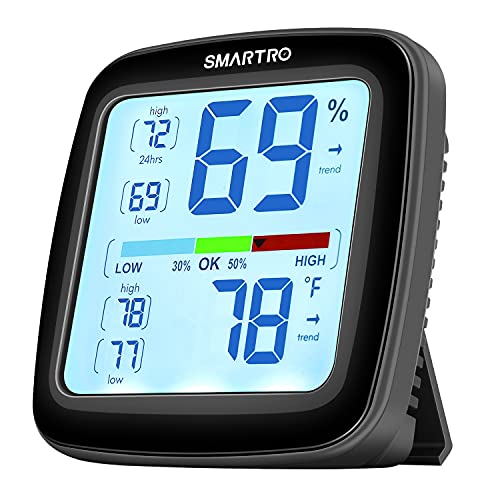
Digital capacitive room monitor with high-contrast display and calibration offset toggle
Clear numbers allow fast reading across the room while manual calibration lets you correct baseline drift after a salt test.

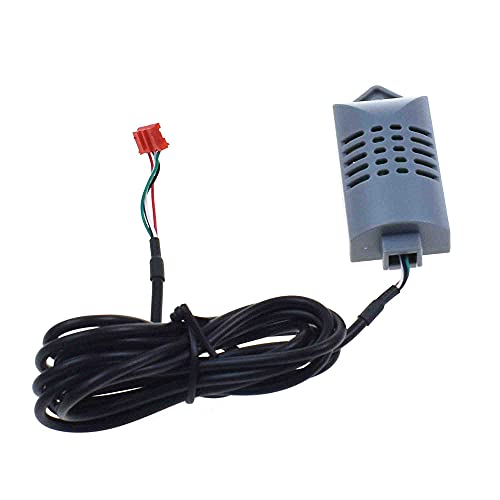
Remote wireless sensor unit with sealed external probe and threshold alert chime
The external probe monitors unconditioned damp air directly while the display remains in comfortable living space.
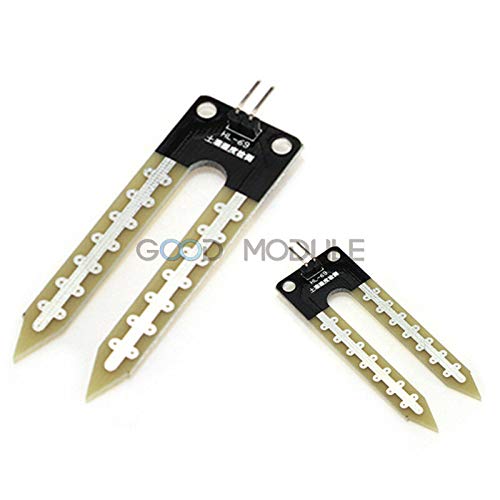
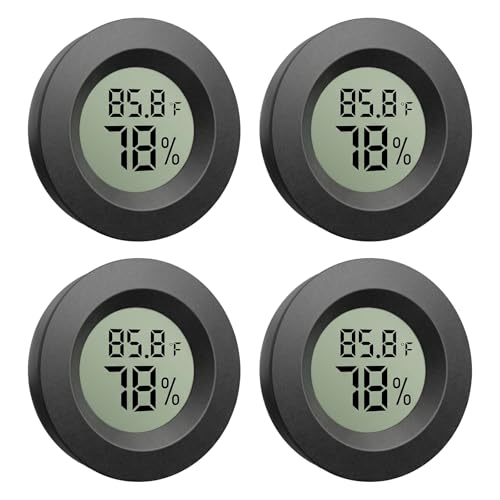
Compact button-cell sensor with manual adjustment screw and high-precision reference rating
Slim housing fits tight storage cases while mechanical adjustment keeps readings aligned with known reference standards.

Prices are not shown here because they change daily and we will not display a stale one. Links open on Amazon, where the current price and availability are live.
Common questions
What is the difference between a hygrometer and a thermometer?
A thermometer measures ambient air temperature, whereas a hygrometer measures the amount of water vapor suspended in that air. Most modern indoor instruments combine both sensors into one housing because temperature directly dictates how much moisture air can hold before reaching saturation. Measuring both metrics together allows you to calculate the dew point and evaluate condensation risks.
How accurate are inexpensive digital hygrometers?
The National Institute of Standards and Technology (NIST) reports that typical consumer capacitive humidity sensors carry an accuracy margin within 2 to 5 percentage points under standard room conditions. Cheaper units often lose accuracy at extreme ends of the scale, particularly below 20 percent or above 80 percent relative humidity, according to calibration guidelines from the National Institute of Standards and Technology (NIST). Running a simple salt test at home lets you determine your specific unit's offset error.
Why do two hygrometers placed side by side show different numbers?
Different manufacturing tolerances, internal sensor aging, and varying response times cause neighboring instruments to report slightly different relative humidity values. Even identical models from the same production batch can vary by 3 to 6 percentage points according to National Institute of Standards and Technology (NIST) baseline evaluations. Calibrating both units inside the same sealed salt container identifies the discrepancy so you can normalize their readings.
Where should you place a hygrometer for the most accurate reading?
Place the instrument on an interior wall at eye level, roughly chest height, where room air circulates naturally. Keep it away from exterior walls, direct sunlight, kitchen cooking steam, bathroom doors, and supply air registers. These localized heat and moisture sources distort readings and fail to represent overall room conditions.
How often should you calibrate or test a home hygrometer?
Test your instrument at least once a year using a sealed salt slurry to check for sensor drift. Technical documentation from the National Institute of Standards and Technology (NIST) shows that consumer electronic sensors can drift between 1 percent and 2 percent annually as their polymer membranes age. Testing before the start of the winter heating season ensures your indoor humidity targets remain accurate when condensation risk peaks.