The best air purifier moves enough clean air to turn over room volume four times every hour. Airflow matters most. A dense filter cannot clean a room if air slips around the frame. You need a fan strong enough to push air through dense media without intolerable motor roar. Selecting the best air purifier requires looking past square-foot marketing claims and calculating the certified clean air delivery rate for your specific room.
Filtration relies on basic mechanical physics. The Environmental Protection Agency reports that indoor air pollutant concentrations can be two to five times higher than typical outdoor levels. Portable cleaners address this load only when their mechanical capacity matches the physical dimensions of the space. Most buyers choose units that are far too small. They run them on low speeds to avoid noise. The room air remains stagnant. Clearing airborne dust, pollen, and combustion particles requires matching fan output to the cubic volume of your room.
Every effective machine shares three design traits. Certified particulate filter media meets standardized efficiency thresholds. An airtight housing forces incoming air through the filter media. A motor calibrated for continuous duty moves air quietly through high-resistance barriers. Missing any of these elements turns an appliance into an expensive room fan.
Clean Air Delivery Rate Dictates Real Room Coverage
The Clean Air Delivery Rate (CADR) measures the cubic feet of clean air a machine produces each minute. Air volume matters. Established by the Association of Home Appliance Manufacturers (AHAM), this metric separates fan power from filter efficiency. Manufacturers often market air cleaners by quoting square-footage numbers based on only one or two air exchanges per hour. That exchange rate is inadequate for active allergy triggers or smoke infiltration. The Association of Home Appliance Manufacturers establishes that a room purifier should deliver a smoke CADR equal to at least two-thirds of the room floor area in square feet, assuming standard eight-foot ceilings.
A room measuring 300 square feet requires a smoke CADR of at least 200 cubic feet per minute. Ceiling height changes the calculation. Calculating your room needs by checking our guide to size an air purifier to a room prevents buying an underpowered machine. Standard CADR tests evaluate three specific pollutant sizes: dust, tobacco smoke, and pollen. Comparing the CADR rating for smoke gives the best indicator of performance against tiny combustion particles.
Air changes per hour define how quickly a machine purges a sudden spike in pollution. Slow airflow leaves smoke lingering. The Centers for Disease Control and Prevention recommends target ventilation rates of at least five air changes per hour for reducing airborne particle counts in occupied indoor spaces. Sizing up protects your indoor air during acute pollution events.
| Room Area | Minimum Smoke CADR | Air Turnover Rate | Target Application |
|---|---|---|---|
| 150 sq ft | 100 CFM | 4 to 5 exchanges per hour | Small bedroom or home office |
| 250 sq ft | 167 CFM | 4 to 5 exchanges per hour | Standard bedroom or nursery |
| 350 sq ft | 233 CFM | 4 to 5 exchanges per hour | Primary suite or dining area |
| 500 sq ft | 333 CFM | 4 to 5 exchanges per hour | Open living room or basement |
True HEPA Media Traps Fine Particles Mechanically
High-Efficiency Particulate Air (HEPA) filters capture fine particles through mechanical separation instead of electrostatic attraction. The Department of Energy standard specifies that a true HEPA filter must capture at least 99.97 percent of particles measuring 0.3 microns in diameter. This size penetrates fibers most easily. Smaller particles bounce around through Brownian motion and strike fibers rapidly. Larger particles crash into fibers through direct impaction.
Marketing terms like 'HEPA-type' or 'HEPA-like' lack legal definitions and standardized performance benchmarks. Manufacturers invent these labels to sell cheap synthetic filters that allow high volumes of fine particles to pass straight through. Our analysis of the true HEPA filtration standard details why loose media fibers degrade air cleaning performance. A certified filter relies on a dense mat of randomly arranged borosilicate glass or synthetic fibers. Depth creates capture opportunities.
Mechanical filters do not lose efficiency as they load with dirt. In fact, trapped particles create a secondary filter cake that can increase particle capture efficiency. The immediate tradeoff is airflow restriction. As filter pores fill, the fan motor works harder to push air through the media. Replacing the cartridge when airflow drops preserves both air turnover rates and fan motor health.
- Inertial impaction captures heavy particles larger than one micron as momentum drives them straight into fibers.
- Interception traps medium particles following air streamlines when their edges brush against a filter strand.
- Brownian diffusion forces sub-micron particles along erratic paths until they contact fibers and stick.
- Electrostatic charge on synthetic media provides temporary capture assistance but degrades as humidity and dust accumulate.
Cabinet Gaskets and Filter Seals Prevent Bypass Leakage
Filter efficiency ratings mean nothing if air travels around the filter instead of through it. Air takes the path of lowest mechanical resistance. If a gap exists between the filter cartridge and the plastic housing, the fan pulls dirty air through that opening. This phenomenon is called filter bypass. In poorly engineered units, up to 25 percent of the air exiting the grille never touches the filter media.
Bypass ruins good filters. You can identify bypass prevention by examining how the filter fits into the chassis. High-performing purifiers use closed-cell foam gaskets or rubber compression seals along the entire perimeter of the filter frame. When you latch the door or tighten the housing, the gasket compresses against the internal frame. This compression creates an airtight mechanical barrier.
Plastic friction fits inevitably fail. Injection-molded plastic parts warp over time with temperature swings and motor vibration. A filter that clicks into place without a soft rubber seal leaves microscopic gaps that widen as the plastic flexes. Commercial cleanrooms mandate sealed filter housings for this reason. A consumer unit must mirror that design principle if you expect reliable particle clearance in your home.
Carbon Bed Thickness Determines Gas and Odor Removal
A HEPA filter stops solid particles, but it cannot capture gases, chemical vapors, or cooking odors. Gases require chemical adsorption. Activated carbon works through adsorption, trapping gas molecules inside microscopic internal pores. The Environmental Protection Agency states that mechanical particle filters do not remove gaseous pollutants like volatile organic compounds or radon decay products.
Most consumer air cleaners skimp on carbon. They use a thin polyester pre-filter lightly dusted with powdered carbon. That dusting weighs only a few ounces. A thin sheet saturates within two to four weeks in a typical home. Saturated sheets capture nothing. For persistent challenges like wildfire and cooking smoke or stubborn pet dander and hair, you need actual granular carbon pellets housed in a dedicated canister.
Weight is the only reliable indicator of carbon longevity. A purifier containing three to fifteen pounds of pelletized activated carbon provides vast internal surface area. Bulk capacity allows the machine to capture heavy molecular compounds over many months of operation. If gas and odor removal is your primary goal, check the actual mass of the carbon insert before evaluating other features.
Activated carbon binds gases through weak physical van der Waals forces. When the carbon bed becomes completely saturated, changes in ambient room temperature or relative humidity can trigger desorption. During desorption, the filter releases trapped volatile organic compounds back into your living space. Replacing carbon beds according to manufacturer schedules prevents your air cleaner from becoming a secondary source of chemical odors.
Operating Sound Levels Govern Actual Daytime Performance
Noise changes human behavior. An air cleaner that delivers high airflow while sounding like a jet turbine will not stay turned on. You will shut it off or turn it down to the lowest setting. The Clean Air Delivery Rate printed on the packaging reflects performance on the highest fan speed. On low speed, CADR output typically plummets by 60 to 80 percent, leaving your room under-filtered.
Acoustic comfort requires strategic sizing. To run a machine quietly while maintaining four air changes per hour, buy a unit rated for a room 50 percent larger than your actual space. Extra fan capacity allows you to operate on medium speed. On medium, high-grade centrifugal fans produce between 30 and 40 decibels of sound. That volume blends into normal background noise.
Look for units with large-diameter backward-curved centrifugal impellers. Small axial fans must spin at high speeds to push air through dense HEPA filters. That rapid spinning creates an irritating high-pitched whine. Larger fans move equivalent volumes of air at much lower rotational speeds, shifting acoustic energy into low, unobtrusive frequencies.
Electronic Purification Additions Create Unnecessary Indoor Byproducts
Many consumer purifiers bundle electronic add-ons like ionizers, plasma generators, photocatalytic oxidation modules, and ultraviolet lamps. These features promise advanced sanitization. In practice, they add little particle removal capability while introducing distinct chemical hazards. Ionizers shoot electrical charges at airborne particles so they stick to nearby walls and furniture. Charged particles stay in the room.
Chemical byproducts present a greater concern. Any electrical device that ionizes air molecules can produce ozone as an unintended byproduct. The California Air Resources Board (CARB) certifies air cleaners for electrical safety and medical ozone emissions, capping allowed ozone concentrations at 0.050 parts per million. Even concentrations below this threshold can react with indoor fragrances to form secondary organic aerosols and formaldehyde.
Ultraviolet light bulbs inside compact air purifiers rarely work as claimed. Inactivating bacteria or mold spores with ultraviolet light requires adequate irradiation intensity and prolonged contact time. Air rushing past a miniature bulb spends only a fraction of a second exposed to the light. That exposure is too brief. The Centers for Disease Control and Prevention notes that physical HEPA filtration reliably captures microbial particles without requiring auxiliary chemical or electronic treatments.
Moisture and Settled Dust Require Actions Beyond Air Filtration
An air purifier is a specialized tool for suspended airborne particulates. It cannot solve problems rooted in building envelopes or surface reservoirs. Clear boundaries save money.
Large dust particles settle out of room air within minutes. Gravity pulls heavy flakes of skin, soil, and textile fibers onto rugs and tabletops before a portable fan can pull them in. Our guide on managing household dust sources explains why source control, damp wiping, and vacuuming with a sealed HEPA vacuum cleaner remain necessary tasks. Running an air purifier will not eliminate the need to dust your bookshelves.
Air cleaners excel at capturing the light, invisible particles that remain suspended in room air for hours. These include combustion soot, wildfire smoke, cat dander, and fine pollen grains. Mechanical filtration handles suspended particles reliably.
- Active mold colonies require eliminating moisture sources, because an air purifier cannot stop mold while damp wallboard or leaking plumbing remains unaddressed.
- Radon gas enters homes from bedrock beneath the foundation and requires dedicated sub-slab depressurization instead of portable room filtration.
- Carbon monoxide from malfunctioning combustion appliances demands immediate outdoor evacuation and working electromechanical detectors instead of mechanical air cleaning.
- High indoor humidity levels above 60 percent promote dust mite propagation and require compressor dehumidification to keep populations in check.
Filter Life Cycles and Pressure Drop Shape Long-Term Maintenance
A filter cartridge operates as a consumable mechanical barrier with a finite service life. Air resistance increases as particles pack into microscopic fiber gaps. This resistance is known as pressure drop. When pressure drop rises, fan throughput drops and motor power consumption increases. Clean filters protect airflow. Waiting until a filter looks visibly black often means you have been operating an air-starved machine for months.
Pre-filters extend the operational life of expensive HEPA stages. A coarse mesh pre-filter captures large hair, lint, and dust bunnies before they reach the delicate primary filter media. Vacuuming or washing this pre-filter every three to four weeks prevents premature loading of the inner core. Routine maintenance saves money. Tracking air quality improvements with an indoor air quality monitor provides objective confirmation that your machine is sustaining adequate particle clearance over time.
Calculate your room volume, confirm the certified clean air delivery rate, and select the best air purifier that meets your target airflow at whisper-quiet speeds.
What to Buy for This
Each entry below is a specification rather than a single model, because stock and pricing on this equipment change constantly. The products shown are what currently matches that specification. Match the spec, then buy whatever meets it.
AHAM Verifide air purifier delivering at least 300 CFM smoke CADR with perimeter-gasketed true HEPA filter and minimum 2-pound activated carbon bed
Moves enough clean air to supply four air changes per hour across 450 square feet while maintaining low motor noise on intermediate fan speeds.


True HEPA room air purifier with smoke CADR between 150 and 200 CFM, certified sound output under 25 dBA on low, and complete display shutoff
Allows light sleepers to achieve three to four air exchanges per hour overnight without sleep disruption from fan noise or bright control panel lights.
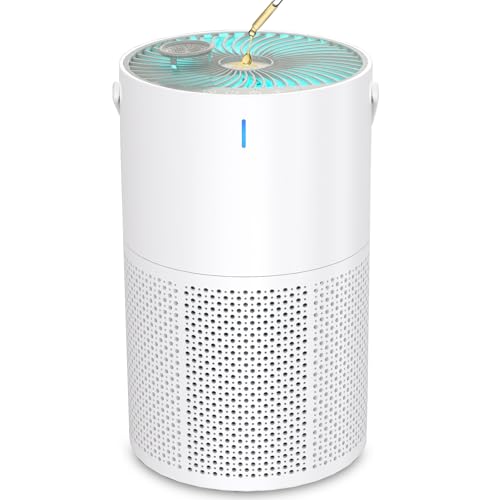

Canister-style air purifier combining true HEPA filtration with a 5-to-15-pound granular activated carbon drum and sealed metal housing
Heavy carbon mass provides thousands of square meters of adsorption surface to trap gaseous combustion pollutants that bypass ordinary thin carbon sheets.

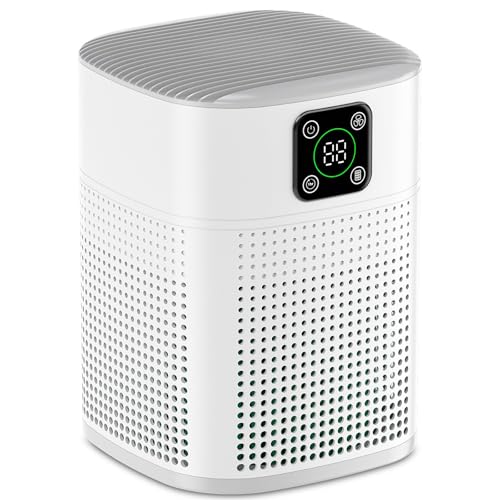
Compact tower air purifier with H13 true HEPA filter, washable fabric pre-filter sleeve, and smoke CADR of 100 to 140 CFM
Provides adequate air turnover for spaces under 150 square feet without consuming excessive floor area or drawing high electrical wattage.

Prices are not shown here because they change daily and we will not display a stale one. Links open on Amazon, where the current price and availability are live.
Common questions
How do you calculate the right size air purifier for a room?
Multiply your room square footage by two-thirds to determine the minimum smoke Clean Air Delivery Rate (CADR) required for standard eight-foot ceilings. A 300-square-foot room needs an air cleaner rated for at least 200 CFM of clean air delivery. Rooms with ceilings over nine feet require multiplying the room cubic volume and dividing by twelve to maintain five air exchanges per hour.
What is the difference between true HEPA and HEPA-type filters?
True HEPA filters meet the Department of Energy standard requiring 99.97 percent capture efficiency for particles measuring 0.3 microns in diameter. HEPA-type is an unregulated marketing label applied to synthetic filters that often capture less than 85 percent of fine particles. True HEPA filters provide certified mechanical protection against combustion soot, mold spores, and fine pollen.
Should an air purifier run continuously all day and night?
Air purifiers should run continuously because indoor particulate pollution accumulates constantly from occupant movement, cooking, and outdoor air infiltration. Turning a machine off allows indoor particle concentrations to return to baseline levels within 30 to 60 minutes. Running a properly sized unit on medium speed maintains steady filtration while keeping electrical draw and noise levels modest.
Can an air purifier eliminate chemical odors and volatile organic compounds?
A standard HEPA filter cannot remove chemical odors or gaseous volatile organic compounds because gas molecules are far smaller than the gaps between filter fibers. Removing gases requires an activated carbon filter containing several pounds of granular carbon pellets. Thin carbon-coated sheets saturate within weeks and cannot handle persistent chemical odors.
Where is the best place to position an air purifier in a room?
Place the air purifier at least two feet away from walls and furniture to ensure unrestricted 360-degree air intake and discharge. Positioning the unit near the center of the room or along an open wall creates optimal air mixing patterns throughout the space. Avoid tucking machines into corners or beneath desks where airflow becomes restricted.
Why do some air purifiers develop a sweet or sour smell after months of use?
A sour or sweet smell indicates that the activated carbon bed has become completely saturated and is desorbing captured volatile organic compounds back into the room. High ambient humidity accelerates this desorption process by competing with organic molecules for binding sites on the carbon. Replacing both the carbon stage and the particulate filter eliminates the odor source.