A mail-in laboratory panel answers safety questions while test strips only screen basic chemistry. Choosing the right water test kit depends entirely on whether your water comes from a municipal utility or a private well.
City water is treated to meet federal baseline standards before it enters distribution mains. Pipes inside the building can still leach heavy metals into that water. Private wells receive no government oversight and require routine homeowner evaluation.
You do not need a kit for every situation. If you receive a utility bill, start by reviewing your annual water quality report before spending money on private testing.
Test Strips Measure Operating Chemistry Rather Than Toxic Contaminants
Colorimetric test strips measure operational water parameters but lack the precision needed to evaluate chronic health hazards.
Paper strips change color when exposed to specific dissolved compounds. You compare the pad against an included reference card. This visual comparison works well for balancing swimming pools or monitoring water softener salt cycles. It fails for toxic metals.
The Environmental Protection Agency (EPA) sets the action level for lead at 15 parts per billion (ppb). A color pad cannot resolve pigment differences at 15 parts per billion. Human eyes cannot distinguish such microscopic increments on a treated cellulose pad. The same physical limit applies to arsenic and pesticides. These chemical contaminants present severe risks at parts-per-billion concentrations. Relying on a five-second paper dip creates false confidence.
A strip reading negative does not prove water is free of heavy metals. You can use strips to check pH and total hardness. Those measurements help protect plumbing equipment and hot water heaters from scale buildup. They do not reveal whether your drinking water meets biological or chemical safety standards.
Paper reagent strips often show detection increments of 50 to 100 parts per billion for heavy metals. The Environmental Protection Agency (EPA) enforces a lead action limit of 15 parts per billion, meaning a strip can report zero while water carries three times the actionable lead concentration.
When a Certified Water Test Kit Beats Rapid Test Strips
A certified laboratory water test kit provides instrumental precision down to fractions of regulatory health limits.
Professional laboratories use mass spectrometry and chromatography instruments. These benchtop systems isolate individual atomic elements in a liquid sample.
A mail-in kit contains specialized collection vials, chemical preservatives, and return shipping materials. You fill the bottles according to strict instructions and mail them directly to the accredited facility. Laboratory technicians check sample temperature and preservation status upon arrival. They run the water through calibrated analytical hardware.
The resulting report gives exact numerical parts-per-million (ppm) or parts-per-billion concentrations for dozens of parameters. Every listed contaminant appears beside its corresponding EPA Maximum Contaminant Level (MCL). You learn the exact margin between your water chemistry and federal thresholds. This quantitative detail is necessary when evaluating complex treatment hardware.
Our comparison of home test kit options details the turn-around timelines and analytical limits across mail-in services. A mail-in test is the only reliable method for diagnosing suspected environmental contamination.
| Diagnostic Method | What It Detects | Sensitivity Limit | Primary Use Case |
|---|---|---|---|
| Colorimetric Test Strips | pH, total hardness, free chlorine | 5 to 50 ppm | Routine pool and water softener monitoring |
| Handheld Conductivity Meter | Total dissolved mineral ions | 1 ppm TDS | Reverse osmosis membrane performance tracking |
| Certified Laboratory Panel | Heavy metals, bacteria, nitrates, VOCs | 0.001 to 0.01 ppm | Drinking water safety and filter sizing decisions |
Municipal Tap Water Requires Testing for Plumbing Leaching
Testing municipal tap water is only necessary for contaminants that enter water after it leaves the public treatment plant.
Water utilities publish annual water quality reports based on thousands of municipal distribution samples. You can read your utility compliance record in your annual water quality report without purchasing equipment.
The utility cannot monitor what happens inside private plumbing networks. Lead service lines, copper pipes with lead solder, and brass fixtures can leach toxic metals directly into standing water. The Environmental Protection Agency (EPA) notes that homes built before 1986 carry the highest risk of lead-soldered plumbing.
If you live in an older home, test the water sitting in your pipes. Order a targeted laboratory test for lead and copper. Do not waste money on broad well water panels that screen for agricultural runoff or coliform bacteria. Disinfected city supplies already manage microbial pathogens through municipal chlorination.
Targeted testing confirms whether your home fixtures degrade otherwise compliant utility water. If plumbing metals exceed federal guidelines, install a certified under-sink water filter rated for heavy metals.
Private Wells Demand Certified Laboratory Microbial and Nitrate Panels
Private well water requires routine laboratory screening because individual well owners bear complete responsibility for sanitation and safety.
Groundwater moves through soil layers, rock formations, and agricultural aquifers. It picks up dissolved minerals, biological agents, and agricultural chemicals along its path.
The Centers for Disease Control and Prevention (CDC) recommends that private well owners test drinking water annually for coliform bacteria and nitrates. Total coliform bacteria indicate surface water contamination or cracked well casings. The presence of Escherichia coli (E. coli) confirms fecal contamination from septic drain fields or animal waste.
Nitrates enter groundwater from agricultural fertilizers and residential septic systems. The Environmental Protection Agency (EPA) enforces a Maximum Contaminant Level of 10 milligrams per liter (mg/L) for nitrate to protect infants from oxygen deprivation.
A complete guide on well water testing schedules outlines seasonal testing requirements for private supplies. Test your well in spring when snowmelt and heavy rains drive surface contaminants into aquifers. If biological contamination appears in laboratory findings, shock chlorination or ultraviolet disinfection becomes mandatory. Never rely on handheld meters or test strips to verify microbiological safety.
What Laboratory Detection Limits Mean for Water Safety Standards
Laboratory detection limits define the lowest contaminant concentration an analytical instrument can reliably measure.
Every measurement method has a physical floor. A certified environmental laboratory lists its Practical Quantitation Limit (PQL) on every report line. If an analytical reading shows non-detect, the contaminant may still exist below that threshold.
The Environmental Protection Agency (EPA) sets regulatory limits based on toxicology, but sets Maximum Contaminant Level Goals (MCLGs) at zero for known carcinogens like lead. Instrumental detection limits must sit well below the regulatory threshold to provide meaningful data. For example, evaluating lead requires instrumentation capable of detecting 1 part per billion. A test with a detection limit of 10 parts per billion provides insufficient safety margin for an infant.
Check the laboratory accreditation before ordering. Ensure the facility holds certification through the National Environmental Laboratory Accreditation Program (NELAP) or state environmental health departments. Accredited facilities follow strict quality assurance protocols, run blind calibration blanks, and document equipment drift. Unaccredited testing services often skip rigorous quality controls to lower overhead.
Matching Filtration Decisions to Verified Laboratory Findings
Water filtration hardware must be selected to target the specific chemical contaminants confirmed by laboratory analysis.
Filtration media operate on distinct physical and chemical mechanisms. Activated carbon adsorbs chlorine, volatile organic compounds (VOCs), and certain pesticides. Carbon does not remove dissolved minerals, nitrates, or heavy metals effectively unless specially modified.
Reverse osmosis membranes separate dissolved inorganic salts, heavy metals, and per- and polyfluoroalkyl substances (PFAS). NSF International (NSF) publishes specific standards verifying filter performance claims. NSF/ANSI Standard 53 verifies reduction of contaminants with health effects like lead and volatile organic compounds. NSF/ANSI Standard 58 covers point-of-use reverse osmosis treatment systems. NSF/ANSI Standard 42 covers aesthetic parameters such as chlorine taste and odor.
Buying equipment before testing leads to misallocated funds and unaddressed contamination. Homeowners often purchase a whole house water filter to remove hardness minerals that require a salt-based ion-exchange softener. Similarly, installing a whole-house carbon tank will not protect against microbiological pathogens in well water. Match your water test results against verified well water filtration systems to build an effective treatment sequence.
How to Collect Samples so That Laboratory Results Remain Valid
Incorrect sampling technique invalidates laboratory results before the vials ever reach an analytical instrument.
The question you are asking dictates the sampling procedure. To test for pipe corrosion, you collect first-draw water. The Environmental Protection Agency (EPA) requires a minimum six-hour water stagnation period for lead and copper sampling under the Lead and Copper Rule. Do not run the tap before filling the bottle. Collect the very first liquid that emerges from the cold faucet first thing in the morning.
To test private well aquifer safety, collect fully flushed water. Remove the aerator screen from the faucet spout. Disinfect the metal rim with an isopropyl alcohol wipe or dilute bleach solution. Run the cold water for five full minutes. This purges sitting water from the pressure tank and distribution pipes. The stream flowing from the faucet then represents fresh groundwater straight from the surrounding aquifer.
For biological testing, never touch the inside of the sterile vial or the inner threads of the cap. Keep the samples chilled with an ice pack and dispatch them via overnight carrier immediately.
Why Handheld Meters Cannot Replace Chemical Laboratory Analysis
A handheld total dissolved solids meter measures electrical conductivity rather than chemical safety or biological purity.
A total dissolved solids (TDS) meter is an electrical conductivity sensor. It passes a tiny current between two metal pins. Dissolved mineral ions like calcium, magnesium, sodium, and chloride conduct that current. The meter converts the conductivity reading into an estimated parts-per-million number.
A TDS meter testing water tells you the general mineral richness of your supply. It cannot detect uncharged synthetic molecules. Pesticides, pharmaceuticals, microplastics, and volatile organic chemicals register as zero on a conductivity probe. Dangerous concentrations of lead at 15 parts per billion are invisible against a natural mineral background of 200 parts per million.
A reading of zero simply indicates low ionic mineral content, not safe water. Similarly, a reading of 300 parts per million usually reflects harmless dissolved calcium carbonate. Use conductivity meters to track reverse osmosis membrane exhaustion. Do not use them as diagnostic tools for toxic contamination.
When Spending Money on Testing Is Unnecessary
Certain water quality scenarios can be resolved through public records or physical inspections without purchasing private testing services.
Municipal utility customers experiencing sudden water cloudiness should first check for aeration. Fill a clear glass with tap water. If the cloudy water clears from the bottom upward within two minutes, the haze is harmless dissolved air from pressurized distribution lines. You do not need laboratory testing for trapped air.
If you notice reddish staining on sinks and toilets, check for iron in your annual municipal report. When moving into a new residence, follow a logical testing triage order to allocate diagnostic funds effectively.
If municipal water suddenly develops a strong sewage smell or brown discoloration following a water main break, call your utility provider immediately. The utility is legally required to issue boil water advisories and perform regulatory sampling during distribution emergencies. Paying an independent lab during an active municipal main break wastes money on an unstable, transient condition. Wait until utility repairs finish and mains are flushed before testing indoor plumbing fixtures.
Order a certified laboratory water test kit tailored to your water source before selecting any home treatment equipment.
What to Buy for This
Each entry below is a specification rather than a single model, because stock and pricing on this equipment change constantly. The products shown are what currently matches that specification. Match the spec, then buy whatever meets it.
Accredited mail-in laboratory testing kit specifically configured for first-draw lead and copper analysis with chain-of-custody documentation
Measures toxic plumbing corrosion products down to 1 part per billion, well beneath the EPA 15 ppb action limit, where paper strips fail

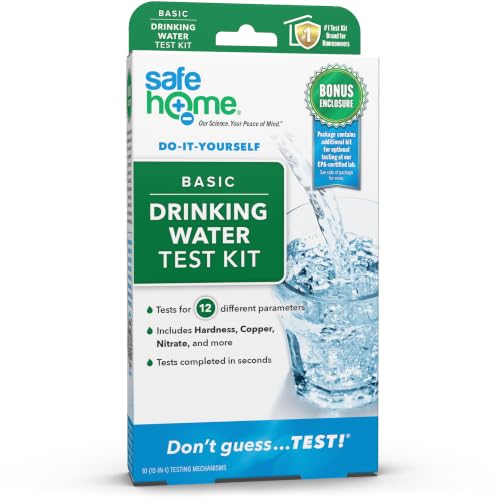
Accredited laboratory well water panel covering total coliform, E. coli, nitrates, nitrites, turbidity, and heavy metals
Fulfills the CDC recommended annual testing protocol for private well safety with verified numerical concentration reports

Direct-dip colorimetric total hardness test strips calibrated in grains per gallon and parts per million calcium carbonate
Provides immediate visual verification of ion-exchange softener operation without the expense of laboratory mail-in services
 Hard Water Test Strip for Breville Oracle, Oracle Touch, Barista Touch, Barista Express BES920XL BES900XL BES980XL BES990, Delonghi Part 5532110300 and Other Domestic Espresso Machines,(Pack of 2)Aquadur
 MacMaxe Hard Water Test Strip for Breville Oracle, Barista Touch, Barista Express BES920XL BES900XL BES980XL BES990, Delonghi Part 5532110300 and Other Domestic Espresso Machines - Pack of 2MacMaxe
Comprehensive laboratory testing panel screening over 100 parameters including volatile organic compounds, heavy metals, pesticides, and inorganic non-metals
Provides the complete quantitative chemical profile required to engineer a multi-stage well water treatment train
Prices are not shown here because they change daily and we will not display a stale one. Links open on Amazon, where the current price and availability are live.
Common questions
Can a home water test kit detect lead accurately?
Direct-read test strips cannot reliably measure lead at the EPA action level of 15 parts per billion. Their visual colorimetric pads lack the resolution needed to distinguish toxic trace quantities. Only a certified mail-in laboratory water test kit using mass spectrometry can verify lead concentrations at parts-per-billion sensitivity.
How often should private well water be tested?
The Centers for Disease Control and Prevention recommends testing private well water at least once every year for total coliform bacteria, nitrates, total dissolved solids, and pH. Additional testing should occur whenever you notice changes in water clarity, taste, or odor, or following localized flooding around the wellhead.
Does a high TDS meter reading mean water is unsafe to drink?
A high total dissolved solids reading does not prove that water is hazardous. Total dissolved solids meters measure electrical conductivity, which is driven by harmless minerals like calcium, magnesium, and sodium. The EPA lists total dissolved solids under secondary aesthetic standards with a guideline of 500 parts per million.
What is the difference between first-draw and flushed water samples?
A first-draw sample captures the initial water sitting inside home pipes after a minimum six-hour stagnation period. This protocol evaluates whether indoor plumbing materials or solder leach metals like lead and copper into drinking water. A flushed sample runs the tap for several minutes to clear internal plumbing, capturing the raw groundwater from the aquifer.
Can a water test kit show if I need a whole house filter?
A quantitative laboratory report identifies exactly which chemical compounds exceed safety or aesthetic guidelines. High levels of sediment, iron, manganese, or hardness minerals throughout the home indicate the need for point-of-entry equipment like softeners or whole-house sediment filters. Contaminants like lead or disinfection byproducts are more efficiently treated at point-of-use drinking taps.