Venting cooking exhaust outside is the primary fix for kitchen ventilation air quality. Unvented burners pollute fast. The Environmental Protection Agency (EPA) states that indoor levels of several air pollutants can reach two to five times outdoor levels during active cooking. Heating cooking oil past its smoke point generates tiny aerosol droplets. These oily droplets float through your halls.
Most recirculating microwave vents do not clean the air. They catch grease. They push the remaining gases and fine particles right back toward your face. The Lawrence Berkeley National Laboratory (LBNL) found that cooking on gas burners without an operating range hood frequently exposes occupants to nitrogen dioxide concentrations that exceed outdoor federal health standards.
Protecting your household means removing these emissions at the pan. Opening a window helps only when wind cooperates. You need an exhaust hood with physical capture space and a dedicated duct path to the outdoors. Good airflow solves the problem.
Gas Stoves Generate High Levels of Nitrogen Dioxide and Carbon Monoxide
Burning natural gas creates nitrogen dioxide (NO2) and carbon monoxide (CO) directly on your cooktop. These gases form when high flame temperatures cause nitrogen and oxygen in ambient air to combine. You cannot see them. You cannot smell them.
The EPA reports that unvented combustion appliances can cause indoor nitrogen dioxide levels to spike well above 100 parts per billion during normal meal preparation. That level exceeds outdoor safety thresholds. You can track these combustion spikes by placing a dedicated air quality monitor nearby to watch how your burner flames change the room.
Carbon monoxide creates an even sharper hazard when burner ports clog or receive inadequate oxygen. The Consumer Product Safety Commission states that incomplete combustion from unvented gas ranges produces high carbon monoxide levels that present severe health risks to occupants. An electric induction cooktop avoids this entire gas byproduct stream. Flames create fumes.
Frying and Searing Release Concentrated Fine Particulate Matter
Electric and gas cooking both generate dangerous amounts of fine particulate matter (PM2.5) whenever food fats reach frying temperatures. Food oils decompose when dropped onto hot metal. This thermal breakdown vaporizes fatty acids into microscopic liquid and solid particles that measure less than 2.5 microns across. You inhale them deeply.
The World Health Organization (WHO) guidelines state that 24-hour average exposure to PM2.5 should not exceed 15 micrograms per cubic meter. A single pan searing a steak can push kitchen PM2.5 concentrations past 300 micrograms per cubic meter according to published data from the National Institute of Standards and Technology. That spike lingers.
High heat also releases acrolein and volatile organic compounds (VOCs) that irritate eyes and throat tissues. You can observe these invisible vapor spikes using a VOC meter while searing meats or stir frying vegetables. Burnt butter produces heavy acrolein emissions.
Recirculating Hoods Capture Grease While Returning Poisonous Gases Indoors
Ductless recirculating range hoods do not remove combustion gases or fine particles from your kitchen. These units draw dirty cooking air through an aluminum mesh pad and a thin pad of activated charcoal before venting the exhaust back into the room. The mesh catches grease. The carbon pad saturates rapidly.
LBNL research shows that typical recirculating hoods capture less than 20 percent of nitrogen dioxide and fine particles generated during stove use. The remaining 80 percent stays inside. Moisture also bypasses these filters entirely.
Every boiling pot dumps water vapor right into your drywall and cabinets, creating moisture that encourages fungal growth. If you cannot vent outside, running a standalone air purifier fitted with a genuine high-efficiency particulate air (HEPA) filter nearby captures some floating particles, though it will not eliminate gas pollutants. Charcoal pads cannot replace exterior pipes.
| Feature | Ducted Exterior Exhaust | Recirculating Ductless Hood |
|---|---|---|
| Removes nitrogen dioxide | Yes, exhausts outside | No, recirculates through room |
| Removes cooking moisture | Yes, exhausts outside | No, deposits into room air |
| Removes fine particulate matter | Captures and vents outdoors | Captures only 10 to 20 percent |
| Requires wall or roof penetration | Yes, rigid metal pipe needed | No, mounts to wall or cabinet |
| Filter maintenance requirement | Wash metal grease mesh periodically | Replace charcoal pads every 3 to 6 months |
Capture Efficiency Depends Heavily on Hood Shape and Placement
A range hood captures cooking fumes effectively only when its physical canopy covers the expanding thermal plume rising from your cookware. Hot air expands as it climbs. A pan on a front burner produces a plume that widens by roughly ten to fifteen degrees outward on each side before reaching cabinet height. Flat shallow hoods miss this plume. The plume spills around the edges.
LBNL research established that range hoods with a deep capture basin capture twice as much exhaust as flat undermount units running at identical motor power. Rear burners sit directly beneath the main suction intake.
Cooking on back burners increases fume capture by twenty to forty percent compared to front burners according to Home Ventilating Institute (HVI) technical bulletins. Cook on the back.
Smooth Rigid Metal Ducts Maintain Proper Exhaust Airflow Rates
Exhaust range hoods require rigid galvanized steel or copper ducting with smooth interior walls to move dirty air out without losing flow. Corrugated flexible foil ducting creates intense air resistance. The ridges inside flexible foil pipes trip moving air into chaotic turbulence that drops blower speed. Grease collects in every spiral ridge. That buildup creates a chimney fire hazard.
The HVI recommends sizing kitchen exhaust runs with smooth metal pipes measuring at least six inches in diameter for fans moving over 300 cubic feet per minute (CFM). Every ninety-degree elbow in your duct run adds the friction equivalent of ten feet of straight pipe according to the Sheet Metal and Air Conditioning Contractors National Association guidelines.
Short, straight duct paths preserve air speed. Long runs with multiple bends starve the fan motor. Keep your exhaust run short.
High-Capacity Exhaust Fans Create Backdraft Risks in Tight Homes
Range hoods that move large volumes of air can depressurize your house and draw toxic combustion fumes down existing chimney flues. When an exhaust fan pulls air out of a sealed home, fresh air must enter to balance the pressure drop. Without an intake path, negative pressure develops. This suction pulls backwards through atmospheric water heaters, gas boilers, and wood fireplaces.
Under the International Residential Code (IRC), any domestic kitchen exhaust system moving over 400 CFM must include an automated makeup air system. That system opens a motorized damper to supply outdoor air directly into the home whenever the fan runs. Depressurization endangers living spaces.
You can track overall air exchange by testing rooms with a CO2 monitor to spot stagnant air. Explore our overview of indoor home spaces to see how negative pressure spreads between levels. Balanced air keeps you safe.
The IRC warns that exhaust fans moving over 400 CFM can pull flue gases from standard gas water heaters back into your living space. Always confirm makeup air provisions when installing high-capacity kitchen exhaust systems.
Renters Can Improve Ventilation Without Altering Existing Walls
Renters facing unvented kitchens can reduce pollutant exposure by combining cross-ventilation with electric countertop cooking appliances. Landlords rarely allow exterior duct installation. You must adapt with portable tools.
Placing a reversible window fan in a nearby kitchen window blowing outward creates negative pressure that draws cooking steam outside. Open a second window across the home to establish a clean sweep of fresh air. Switching from gas burners to a portable induction cooktop eliminates nitrogen dioxide generation at the source.
LBNL indoor air studies show that using electric induction appliances removes natural gas combustion byproducts entirely. We outline additional non-destructive tenant strategies in our guide to apartment air quality. Portable tools protect your lungs.
Operating Habits Determine Actual Exposure Reductions During Cooking
Running your kitchen exhaust fan before you start heating pans establishes an upward airflow draft that captures initial emissions immediately. Turning the fan on late lets hot plumes escape into adjacent rooms. Start the fan early. Set the speed to match the cooking style, choosing higher airflow for searing or frying and lower airflow for simmering liquids.
Keep the fan running for ten to fifteen minutes after turning off the burners. The HVI notes that post-cooking fan operation clears remaining ultrafine particles and moisture that evaporate from hot pans cooling on the stove.
Wash aluminum grease filters monthly in hot soapy water. Clogged filters choke exhaust airflow by up to fifty percent according to HVI engineering manuals. Clean mesh lets air pass. Inspect your existing hood ductwork today and switch to using back burners with the fan running on high to immediately improve your kitchen ventilation air quality.
What to Buy for This
Each entry below is a specification rather than a single model, because stock and pricing on this equipment change constantly. The products shown are what currently matches that specification. Match the spec, then buy whatever meets it.
Under-cabinet range hood with 300 to 400 CFM airflow, stainless steel baffle filters, and minimum two-inch deep capture basin
Provides sufficient capture volume for standard four-burner ranges while staying below the 400 CFM threshold that triggers mandatory makeup air systems under residential building codes.
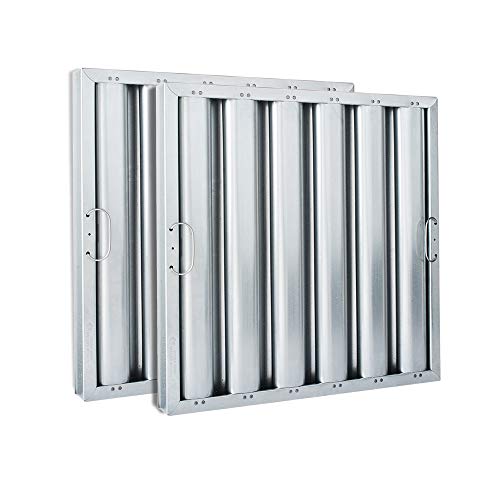

Wall-mounted pyramid canopy range hood with 600 CFM capacity, dishwasher-safe baffle filters, and round eight-inch duct collar
The deep conical canopy gathers expanding smoke and thermal plumes from front burners, but requires a dedicated makeup air damper to prevent house depressurization.


Dual-blade reversible window exhaust fan with built-in rain covers and expandable side panels
Creates mechanical cross-ventilation to exhaust cooking steam and fine particles through an open window without modifying walls or leasehold cabinetry.


Prices are not shown here because they change daily and we will not display a stale one. Links open on Amazon, where the current price and availability are live.
Common questions
Do recirculating range hoods clean kitchen air?
Recirculating hoods do not clean cooking gases from indoor air. They pass exhaust through an aluminum mesh to catch grease and a thin activated charcoal pad to reduce odors, but Lawrence Berkeley National Laboratory research shows they capture less than 20 percent of fine particles and zero combustion gases. The remaining nitrogen dioxide, carbon monoxide, and humidity are blown directly back into your home.
How many CFM do I need for my range hood?
The Home Ventilating Institute recommends a minimum ventilation rate of 100 cubic feet per minute (CFM) for under-cabinet hoods against a wall, or roughly 100 CFM per linear foot of cooktop width. For high-output gas ranges, allow 100 CFM for every 10,000 British Thermal Units (BTU) of total burner capacity. Keep in mind that fans exhausting over 400 CFM require makeup air systems under the International Residential Code.
Why should I use the back burners instead of the front burners?
Back burners sit directly underneath the suction zone of most wall-mount and under-cabinet range hoods. Plumes from front burners expand outward into the room and frequently bypass shallow hoods. Home Ventilating Institute testing data demonstrates that cooking on rear burners improves overall pollutant capture efficiency by 20 to 40 percent compared to front burners.
Does opening a window provide enough ventilation while cooking?
Opening a window helps only if active outdoor breezes create positive cross-ventilation across your stove. Without mechanical assistance or directional wind, opening a window allows cooking gases and fine particulate matter to disperse into adjacent rooms before finding the window opening. A mechanical exhaust fan ducted outside provides reliable directional removal that passive open windows cannot match.
How long should I leave the range hood fan running after cooking?
Leave your range hood fan running on medium or low speed for ten to fifteen minutes after turning off your cooktop burners. Hot cookware, oils, and heating elements continue emitting fine particles and volatile compounds as they cool down. Running the exhaust fan clears lingering airborne aerosols and removes excess moisture before turning off the system.