Laser particle counters and infrared sensors provide reliable home air quality monitor readings.
Most all-in-one desktop units bundle uncalibrated chemical sensors that produce erratic spikes.
These secondary dials cause confusion.
Optical Particle Counters Detect Real Smoke and Dust
Optical particle counters measure particulate matter by focusing an internal laser diode across a sampling chamber and detecting how much light scatters off suspended dust and smoke particles.
A photodiode registers each light flash.
The amplitude of that scattered pulse correlates with the physical diameter of the passing particle.
Cheap consumer monitors often use simple infrared light-emitting diodes instead of focused lasers.
Infrared diodes produce weak beams.
The Association of Home Appliance Manufacturers (AHAM) Standard AC-1 measures particle removal down to 0.09 microns, an optical precision that low-powered infrared diodes cannot match.
Cooking plumes and wildfire smoke flood living spaces with microscopic combustion droplets.
The Environmental Protection Agency (EPA) National Ambient Air Quality Standards set the 24-hour outdoor health benchmark for fine particulate matter 2.5 microns or smaller (PM2.5) at 35 micrograms per cubic meter.
Laser counters track these sudden surges accurately.
Laser-based scattering sensors move ambient air past a focused beam using an internal micro-fan to count distinct particles.
Basic light-emitting diode sensors rely on passive thermal convection that misses rapid changes in room air.
Nondispersive Infrared Sensors Track True Ventilation Rates
Nondispersive infrared (NDIR) sensors measure carbon dioxide by projecting targeted optical energy through a hollow sample tube to calculate absorption by gas molecules.
Carbon dioxide absorbs light specifically at a 4.26 micron wavelength, a physical property documented by the National Institute of Standards and Technology (NIST).
Nothing else absorbs that exact beam.
Outdoor air dilutes indoor contaminants.
The EPA reports that outdoor ambient carbon dioxide concentrations average between 410 and 420 parts per million.
Exhaled human breath contains roughly 40,000 parts per million of carbon dioxide according to published exposure guidelines from the Centers for Disease Control and Prevention (CDC).
When rooms lack fresh airflow, exhaled breath drives room concentrations upward rapidly.
Using a dedicated CO2 monitor lets you see when closed windows choke room ventilation.
American Society of Heating, Refrigerating and Air-Conditioning Engineers (ASHRAE) Standard 62.2 specifies an exchange rate of 7.5 cubic feet per minute per person plus 3 cubic feet per minute per 100 square feet of floor space to keep residential living spaces properly diluted.
Cheap monitors substitute estimated carbon dioxide calculations derived from volatile gas sensors.
These estimated figures are fictions.
Alcohol vapors or opened citrus fruit cause estimated readings to spike artificially.
Metal-Oxide Semiconductor Sensors Drift Without Providing Calibrated Gas Numbers
Metal-oxide semiconductor (MOS) sensors estimate total volatile organic compounds by heating a tin-dioxide chip and recording changes in surface electrical conductivity as ambient gases pass over it.
They cannot identify specific gases.
A puff of perfume, warm cooking oil, or hand sanitizer causes an identical electrical drop across the sensor surface.
Consumer monitor displays show a total volatile organic compounds (TVOC) figure in parts per billion.
That single number is misleading.
The EPA notes that no standardized toxicity metric exists for mixed volatile organic compounds because individual chemicals exhibit wildly different health hazards at identical airborne concentrations.
Metal-oxide sensors also suffer from baseline drift caused by shifting indoor temperature and relative humidity.
Many units reset their baseline automatically.
If your indoor air stays continuously dirty, the chip recalibrates that dirty state as clean outdoor air.
Consulting our guide to VOC meters explains why dedicated photoionization detectors are required when industrial chemical tracing is necessary.
Consumer metal-oxide chips provide directional awareness only.
Use them to observe whether opening a window lowers general chemical odors after painting or cleaning.
| Target Contaminant | Sensor Technology | Primary Failure Mode | Actionable Guidance |
|---|---|---|---|
| Fine Particles (PM2.5) | Laser Particle Scattering | Dust coating on internal lens optics | Run an air purifier or replace furnace filters |
| Carbon Dioxide (CO2) | Nondispersive Infrared (NDIR) | Baseline calibration drift over multiple years | Open fresh air intakes or crack windows |
| Volatile Chemicals (TVOC) | Metal-Oxide Semiconductor (MOS) | Cross-sensitivity to harmless cooking odors and alcohol | Ventilate space until baseline odor drops |
| Carbon Monoxide (CO) | Electrochemical Cell (Dedicated) | Electrolyte depletion over 5 to 10 years | Evacuate building immediately and call emergency services |
Consumer Monitors Cannot Replace Dedicated Life Safety Alarms
Consumer ambient air monitors cannot serve as life safety alarms for toxic gas hazards or explosive conditions.
Carbon monoxide kills quickly.
Underwriters Laboratories (UL) Standard 2034 mandates that certified carbon monoxide alarms sound an audible 85-decibel horn within 60 to 240 minutes when exposed to 70 parts per million of carbon monoxide.
Consumer tabletop monitors lack emergency siren decibel ratings and fail-safe hardware watchdogs.
Software crashes silence desktop apps.
The Occupational Safety and Health Administration (OSHA) sets a legal workplace limit of 50 parts per million for carbon monoxide averaged across an eight-hour shift, an exposure level requiring hardwired or battery-supervised dedicated detectors.
Radon presents an identical structural limitation.
The EPA sets an action limit of 4 picocuries per liter of air for radon gas and urges remediation above that mark.
Consumer multi-monitors do not measure radioactive alpha decay unless equipped with a dedicated pulsed ionization chamber.
Never rely on ambient gadgets when evaluating radioactive basement gas or combustion leaks.
Deploy a certified radon test kit for radioactive gas, and verify that your furnace room carries a dedicated safety alarm.
Similarly, passive settling plates in a mold test kit cannot determine airborne spore concentrations accurately.
Proper Sensor Placement Prevents False Air Quality Monitor Readings
Placing an air quality monitor at seated breathing height away from corners, exterior doors, and supply registers ensures the unit samples representative living air.
Location dictates sensor accuracy.
A monitor placed directly beside an unsealed window reads outdoor drafts rather than internal room pollution.
Keep monitors away from humidifiers.
Ultrasonic humidifiers shatter tap water into tiny droplets containing dissolved minerals.
Optical particle counters cannot distinguish a mineral dust crystal from a toxic soot particle, causing readings to surge past the EPA 24-hour PM2.5 threshold of 35 micrograms per cubic meter within minutes.
Breathing directly onto a sensor distorts carbon dioxide figures instantly.
The EPA indoor air testing protocol recommends positioning sampling equipment between 3 and 6 feet above the floor to match the typical human breathing zone.
That height captures realistic exposure.
- Mount the unit between 3 and 6 feet from the floor to reflect the breathing zone specified by EPA indoor monitoring guidance.
- Maintain at least 3 feet of clear clearance from exterior doorways as recommended by EPA field sampling methods to avoid sampling outdoor wind currents.
- Position the device away from kitchen stoves, where localized frying oils coat optical lenses prematurely.
- Avoid placing the intake grill directly inside the direct discharge plume of an air purifier or supply duct.
Ventilation and Filtration Solve the Problems That Monitors Identify
Opening windows to introduce fresh air and operating standalone mechanical filtration units directly correct the high contaminant readings that monitors display.
Measurement without intervention accomplishes nothing.
When fine particles spike from indoor cooking or wildfire smoke, deploy the best air purifier fitted with a genuine high-efficiency particulate air (HEPA) filter.
True HEPA filtration captures fine combustion soot.
The Department of Energy (DOE) standard defines HEPA filtration as capturing at least 99.97 percent of airborne particles measuring 0.3 microns in diameter.
Running mechanical filtration clears a smoky room within an hour.
Particulate filters do not remove gaseous carbon dioxide.
Only outdoor air exchange purges built-up human exhalation.
ASHRAE Standard 62.1 recommends keeping occupied indoor carbon dioxide levels below 1,000 parts per million to maintain acceptable perceived air quality.
Moisture levels dictate biological growth.
The EPA recommends maintaining indoor relative humidity between 30 and 50 percent to prevent mold colonization and dust mite expansion.
If your monitor shows relative humidity climbing past that threshold in damp seasons, operate the best dehumidifier to extract moisture before fungal spores can germinate.
Standalone Sensors Outperform All-in-One Devices for Diagnostic Testing
Single-purpose diagnostic instruments provide better measurement stability and calibration integrity than bundled multi-sensor desktop consumer devices.
All-in-one gadgets cram conflicting components together.
A heated metal-oxide sensor chip warms the interior housing, distorting nearby temperature and relative humidity thermistors.
Different sensors degrade at different speeds.
According to testing documentation from the EPA Environmental Technology Verification program, laser diodes in optical counters typically operate for 20,000 to 40,000 hours before beam degradation occurs.
Metal-oxide chemical sensors drift within months.
When one component fails in an all-in-one gadget, the entire unit becomes useless.
Separate dedicated monitors allow you to replace an aging particle counter without discarding an operational infrared carbon dioxide bench.
Dedicated tools also permit mobile walk-through triage across different rooms.
Reviewing how to test air quality at home will help you prioritize which hazards to measure first.
Track those physical baselines for two weeks while cooking, sleeping, and ventilating.
Place a dedicated air quality monitor with a laser particle sensor in your main living space to verify that filtration clears cooking plumes and wildfire smoke.
What to Buy for This
Each entry below is a specification rather than a single model, because stock and pricing on this equipment change constantly. The products shown are what currently matches that specification. Match the spec, then buy whatever meets it.
Laser Particle Counter with Dual-Channel PM2.5 and PM10 Digital Readout
An internal optical laser and sample fan deliver rapid particle count updates during cooking and wildfire smoke events, isolating particulate spikes from harmless humidity changes.


Nondispersive Infrared CO2 Monitor with Dual-Beam Optical Sensor
True optical nondispersive infrared hardware detects actual carbon dioxide accumulation from human respiration, avoiding the false spikes that plague cheap estimated-gas sensors.
 GZAIR CO2 Air Quality Monitor with Data Logger, Dual-Channel NDIR Sensor, Tabletop CO2 Meter with Data Export, Temperature and Humidity, 0–5000 ppm Range, Touch Screen DisplayGZAIR
 Temtop CO2 Monitor Indoor air Quality Monitor Portable CO2 Meter, CO2, Temperature, Humidity Home, Office or SchoolTemtop
Combined Laser PM2.5 and NDIR CO2 Monitor with Local Data Logging
Pairing a physical laser particle counter with a dedicated optical carbon dioxide chamber gives you the two most actionable indoor metrics without uncalibrated chemical sensor clutter.
 Amazon Smart Air Quality Monitor, Detects temperature, humidity, carbon monoxide, PM2.5 and VOCs, Get notifications when air quality drops, Works with AlexaAmazon
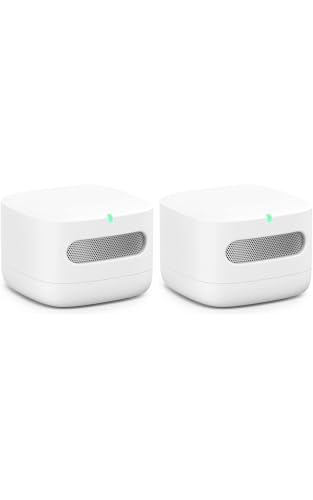 Amazon Smart Air Quality Monitor, Detects temperature, humidity, carbon monoxide, PM2.5 and VOCs, Get notifications when air quality drops, Works with Alexa (2-pack)Amazon
Pulsed Ionization Chamber Continuous Radon Monitor
A pulsed ion chamber samples ambient air every hour to identify radon gas swings above the action threshold set by the Environmental Protection Agency, providing calibrated radiological counts that general air sensors cannot register.


Prices are not shown here because they change daily and we will not display a stale one. Links open on Amazon, where the current price and availability are live.
Common questions
Can an air quality monitor detect mold in your house?
An air quality monitor cannot identify airborne mold spores or verify species toxicity. Optical particle sensors register mold spores simply as generic airborne dust without differentiating fungal matter from pet dander or cooking ash. If you suspect hidden fungal growth behind walls or under subfloors, commission a physical building inspection rather than relying on consumer desktop sensors.
Why do VOC readings spike when you peel an orange or use hand sanitizer?
Metal-oxide semiconductor sensors react to broad chemical families including ethanol and limonene citrus terpenes. The heated metal substrate experiences a drop in electrical resistance whenever volatile organic compounds contact its surface, regardless of whether the vapor is hazardous or benign. These sensors indicate general chemical presence, but they cannot distinguish natural fruit aromas from harmful industrial off-gassing.
How often do consumer air quality monitors require recalibration?
Laser particle counters typically maintain baseline accuracy for several years until dust coats the internal mirrors, while nondispersive infrared sensors require periodic outdoor baseline exposure to stay accurate. The Environmental Protection Agency (EPA) notes that consumer-grade optical sensors lack automated calibration loops, meaning physical cleaning or factory recalibration becomes necessary if the intake fan collects heavy debris.
What is the difference between an NDIR sensor and an eCO2 sensor?
A nondispersive infrared (NDIR) sensor directly measures how much infrared light real carbon dioxide molecules absorb inside a physical chamber. An estimated carbon dioxide (eCO2) sensor uses an inexpensive metal-oxide chip to guess carbon dioxide levels based on hydrogen and volatile gas concentrations. Estimated sensors produce erratic readings whenever indoor chemical odors change, making them unreliable for monitoring actual room ventilation.
Does an air quality monitor warn you about carbon monoxide leaks?
Most ambient air quality monitors do not contain electrochemical carbon monoxide sensors and cannot warn you of a combustion leak. Dedicated life safety alarms certified under Underwriters Laboratories (UL) Standard 2034 are legally required in residential sleeping areas to sound an emergency alarm during furnace or water heater malfunctions. Never rely on a consumer air quality monitor for life-safety protection against lethal carbon monoxide accumulation.
Why does an ultrasonic humidifier cause particle monitor numbers to surge?
Ultrasonic humidifiers vibrate water into fine droplets that carry dissolved mineral solids into room air. As those water droplets evaporate, microscopic calcium and magnesium particles remain suspended where optical sensors mistake them for combustion soot. The Environmental Protection Agency (EPA) recommends filling ultrasonic humidifiers with distilled water or switching to an evaporative wick model to eliminate mineral dust.