You only need a water softener if your supply measures above seven grains per gallon. Scale does minor damage below that line. According to the United States Geological Survey (USGS), hard water contains dissolved calcium and magnesium extracted from rock formations. At high concentrations, those dissolved rocks drop out of solution inside plumbing lines.
Softening protects domestic appliances from premature failure. A water softener vs filter comparison shows that softeners exchange ions instead of trapping chemical toxins. If your local utility already delivers water below four grains per gallon, installing extra machinery adds operating expenses without preserving fixtures. You can confirm your regional figures through our water resources directory.
The pages here cover when mineral density warrants treatment. You will see how ion exchange operates, where scale forms first, and when buying nothing remains your smartest option.
The Seven Grains Threshold Dictates When Softening Pays
Water hardness measures dissolved rock minerals in grains per gallon (GPG) or milligrams per liter. According to the United States Geological Survey (USGS), one grain per gallon equals approximately 17.1 milligrams per liter. The USGS classifies water between zero and 60 milligrams per liter as soft. Supplies ranging from 61 to 120 milligrams per liter are moderately hard. Hard water sits between 121 and 180 milligrams per liter, while anything above 180 is very hard.
The Water Quality Association (WQA) recommends installing treatment equipment once hardness exceeds seven grains per gallon, which is roughly 120 milligrams per liter. Below seven grains, scale develops slowly. Standard soap still lathers reasonably well. Above seven grains, calcium crust coats heating elements and leaves stubborn film on glass. You can read more about mineral thresholds in our guide on what hard water damages.
| Classification | Milligrams per Liter | Grains per Gallon | Recommendation |
|---|---|---|---|
| Soft | 0 to 60 | 0 to 3.5 | No equipment needed |
| Moderately Hard | 61 to 120 | 3.6 to 7.0 | Treatment rarely justified |
| Hard | 121 to 180 | 7.1 to 10.5 | Softening recommended for fixtures |
| Very Hard | Over 180 | Over 10.5 | Softening strongly advised |
Ion Exchange Swaps Mineral Ions for Sodium
Traditional softening systems use ion exchange resin beads to trap dissolved minerals. Negatively charged polystyrene beads fill a tall pressure tank. Positively charged sodium ions coat the surface of every bead. As hard water flows across the resin, calcium and magnesium ions displace the sodium. The mineral ions carry a stronger electrical charge than sodium. They bind tightly to the resin.
Sodium ions release into the flowing stream in equal electrical proportion. Eventually, the resin bed exhausts its supply of sodium ions. The system then initiates a regeneration cycle using concentrated brine from an adjacent salt tank. According to NSF International standard NSF/ANSI 44, certified cation exchange units must remove specific mineral capacities while withstanding home water pressure up to 125 pounds per square inch. The backwash cycle rinses captured minerals down the household drain.
Scale Buildup Destroys Water Heaters and Restricts Pipes
Heating water accelerates the precipitation of calcium carbonate out of the liquid stream. When water temperature rises inside a tank, dissolved minerals crystallize directly onto the hottest surfaces. Electric heating elements and gas burner bottoms gather thick stone shells. The Department of Energy (DOE) notes that mineral buildup on heating surfaces creates thermal resistance that reduces energy transfer efficiency.
Water takes longer to heat. Utility bills rise. Trapped heat overheats the underlying metal tank, causing premature tank rupture. Performing regular water heater flushing removes loose sediment, but it cannot reverse hardened scale crust. Shower heads and aerators also clog as minerals accumulate inside small orifices. Dishwashers leave white cloudy haze across dinner plates and glassware.
- Mineral scale insulates heating elements and accelerates water heater burner burnout.
- Internal pipe diameters narrow as calcium carbonate crystals layer along copper and PEX walls.
- Appliance valves and solenoid switches seize from mineral grit accumulation.
- Detergents bind with free calcium instead of lifting grease from laundry fabrics.
A Water Softener Does Not Filter Drinking Contaminants
A water softener is a mechanical plumbing safeguard rather than a drinking water purifier. The ion exchange process captures calcium and magnesium, but it ignores chemical impurities. According to the Environmental Protection Agency (EPA), municipal tap water often carries trace disinfection byproducts like trihalomethanes that pass right through ion exchange resin. Lead, arsenic, pesticides, and volatile organic compounds (VOC) remain untouched by softening beads.
Furthermore, the softening process adds sodium to your supply. For every grain of hardness removed per gallon, the system adds about eight milligrams of sodium per liter. People on strict sodium restrictions should avoid drinking softened tap water directly. Installing an under-sink reverse osmosis system downstream strips both the sodium and toxic contaminants from your dedicated drinking tap. Softening protects the reverse osmosis membrane from clogging, while the membrane cleans your drinking water.
The American Heart Association notes that individuals on strict sodium-restricted diets must account for softened drinking water. While the added sodium is modest for most adults, water softened from 15 grains per gallon adds roughly 120 milligrams of sodium per liter.
Saltless Conditioners Alter Crystals Without Removing Minerals
Saltless water conditioners use physical media to change how minerals behave without extracting them. Most salt-free systems rely on template-assisted crystallization to transform dissolved calcium ions into microscopic inert crystals. These micro-crystals remain suspended in the water flow. They flow down the drain without binding to plumbing walls.
Because no minerals are removed, testing water from a conditioner shows identical hardness numbers on a titration gauge. The Water Quality Association notes that saltless conditioners do not meet the performance criteria of NSF/ANSI 44 for cation exchange softening. Soap lathering will not improve. Spots still appear on dishes when water evaporates, though the dry powder wipes away more easily. If you want true mineral removal, explore our analysis of whether a hard water filter can replace a mechanical softener.
When You Should Skip Softening Equipment Entirely
You should not buy softening equipment if your water hardness measures under seven grains per gallon. At low hardness levels, the ongoing expense of salt and backwash water exceeds any plumbing savings. Renters living in multi-family buildings generally cannot alter the incoming main line.
Additionally, several municipal water districts in arid states ban salt-based systems because chloride discharge interferes with regional wastewater recycling facilities. If your municipality prohibits chloride discharge, a traditional unit is legally out of bounds. Our verdict would change if a severe drought forces your municipal water utility to switch to a deeper, more mineralized aquifer. A verified jump in tested hardness above eight grains would immediately justify treatment. Otherwise, soft city water requires no intervention.
- Skip softening when your water report confirms hardness levels below seven grains per gallon.
- Skip traditional salt units if municipal wastewater ordinances prohibit residential brine discharge.
- Skip treatment if you only wish to remove chlorine taste, which requires carbon filtration instead.
Testing Supply Chemistry Informs Your Final Purchase
Never purchase equipment based solely on visual symptoms like crusty faucet aerators. Municipal water customers can request an annual Consumer Confidence Report from their local utility to check regional hardness averages. According to the EPA, public utilities must publish these reports annually by July first.
Private well owners must conduct independent testing. Well water chemistry fluctuates across seasons. A calibrated drop-count titration kit from our water test kit guide provides an accurate grain count at home. Testing also identifies dissolved iron, which fouls softening resin rapidly at concentrations above 0.3 milligrams per liter. Once your test confirms mineral levels above seven grains per gallon, request installation quotes for an appropriately sized water softener.
- Pull your utility water quality report or run an independent titration test to establish exact hardness in grains per gallon.
- Check for unchelated iron or manganese, which require dedicated pre-treatment before entering softening resin.
- Calculate daily household water volume by multiplying occupant count by 75 gallons to determine required resin capacity.
What to Buy for This
Each entry below is a specification rather than a single model, because stock and pricing on this equipment change constantly. The products shown are what currently matches that specification. Match the spec, then buy whatever meets it.
Demand-initiated regeneration ion exchange water softener with 32,000 grain capacity, digital metered valve, and NSF/ANSI 44 certification
Metered control valves track exact water usage and regenerate resin only when depleted, reducing salt waste compared to older timer-based valves.

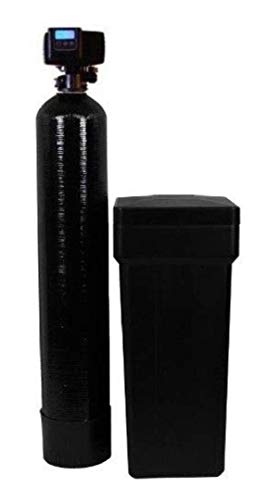
Dual-tank demand-initiated ion exchange water softener with 48,000 to 64,000 grain total capacity and continuous soft water delivery
Twin resin tanks allow one tank to regenerate while the other remains online, guaranteeing that very hard water never enters household pipes during recharge cycles.


Single-cabinet demand-initiated ion exchange water softener with 24,000 grain capacity and integrated brine tank
Enclosing the resin pressure tank inside the brine storage vessel saves floor space in tight basements or utility closets with low ceilings.


Prices are not shown here because they change daily and we will not display a stale one. Links open on Amazon, where the current price and availability are live.
Common questions
Does hard water pose any direct danger to human health?
Hard water is not considered a health hazard by the World Health Organization. Calcium and magnesium are dietary minerals that your body absorbs from food and beverages. The problems caused by hard water are mechanical and cosmetic, affecting plumbing systems, water heaters, skin dryness, and cleaning efficiency.
How much sodium does an ion exchange softener add to drinking water?
The system adds approximately 7.5 to 8 milligrams of sodium per liter for every grain of hardness removed per gallon. If your incoming water has 10 grains of hardness, softening adds around 75 to 80 milligrams of sodium per liter. According to the Centers for Disease Control and Prevention (CDC), standard adult diets contain 2,300 to 3,400 milligrams of sodium daily.
Can you use potassium chloride instead of sodium chloride in the brine tank?
Potassium chloride pellets serve as an effective substitute for sodium chloride in standard ion exchange systems. Potassium regenerates the resin bed identically, releasing trace potassium rather than sodium into softened water. However, potassium chloride dissolves slower in cold water and requires roughly ten percent more material by weight to achieve equivalent regeneration capacity.
How many years does water softener resin typically last?
Standard sulfonated polystyrene resin beads generally last between 10 and 15 years under typical operating conditions. High concentrations of residual chlorine or chloramine from municipal disinfection degrade the bead cross-linking, reducing resin lifespan to under seven years without an upstream activated carbon filter.
Will a water softener remove dissolved iron from private well water?
A cation exchange softener can remove clear-water ferrous iron in small amounts up to roughly two milligrams per liter. Higher concentrations or oxidized ferric iron will permanently coat the resin beads, destroying exchange capacity. Private wells with heavy iron require a dedicated oxidizing iron filter ahead of the softening system.