A whole house water filter cleans utility water but leaves dissolved drinking contaminants behind. Central units excel at catching coarse grit, rust flakes, and municipal disinfectants before distribution through your pipes. They treat every gallon entering the building. Yet treating every gallon creates distinct hydraulic limits. High flow rates prevent dense filtration media from stripping out microscopic chemicals, heavy metals, and dissolved salts.
Understanding this boundary prevents expensive buyer regret. Many people purchase a whole house water filter expecting sterile drinking water at every bathroom faucet. That expectation leads to disappointment. Central filters handle aesthetic problems and plumbing wear. Point of Use (POU) systems handle ingestible toxins. Installing the wrong equipment wastes money and leaves health risks unaddressed.
This guide breaks down mechanical capabilities, flow sizing, and filtration media types. You will see what physical cartridges catch, what bypasses the tank, and when a whole house water filter makes sense for your household.
Sediment and Disinfectants Stop at the Main Entry Point
Point of Entry (POE) systems mount directly to your main water line where supply enters the building. Every drop feeding your water heater, washing machine, toilets, and showers passes through this single manifold. The primary mechanical stage is almost always a sediment filter. These cartridges rely on melt-blown polypropylene or pleated polyester fibers to create an irregular physical web. As water forces its way through the tortuous path, suspended particles collide with fibers and lodge permanently in the matrix.
Size matters here. Standard sediment stages capture particles between 1 micron and 50 microns in diameter. The Environmental Protection Agency (EPA) notes that municipal water mains frequently shed pipe scale, sand, and insoluble ferric iron during pressure fluctuations. Trapping these solids prevents valve erosion, toilet fill valve leaks, and sediment buildup in the bottom of your water heater. Without this basic barrier, grit grinds away at appliance seals and clogs faucet aerators throughout the house.
The second stage targets chemical disinfectants through adsorption. Activated carbon blocks or Granular Activated Carbon (GAC) beds feature microscopic pores that attract non-polar organic molecules. Chlorine, volatile organic compounds, and industrial solvents chemically bind to the carbon surface as water flows past. According to the EPA, public water utilities maintain free chlorine residuals up to 4.0 milligrams per liter to suppress bacterial growth across distribution grids. A carbon bed strips this chlorine completely. The result is shower water that no longer smells like a public swimming pool and reduced vapor inhalation while bathing.
Standard activated carbon removes free chlorine easily through rapid chemical reduction. Chloramine combines chlorine with ammonia, creating a stable disinfectant bond that requires five times more contact time. If your municipal utility uses chloramines, standard carbon cartridges exhaust in weeks. You must specify catalytic carbon media to break that chemical bond effectively.
Dissolved Minerals Pass Straight Through Carbon Media
A whole house water filter is not a water softener. This confusion causes widespread frustration among property owners battling white chalky buildup on shower glass. Mechanical cartridges and carbon blocks have physical pores measuring 1 to 20 microns. Calcium and magnesium ions dissolve entirely into aqueous solution at diameters smaller than 0.001 microns. Dissolved ions pass straight through. The filter matrix cannot physically intercept them.
Hardness is not dirt. It consists of dissolved rock that stays dissolved until changes in temperature or pressure precipitate it out of solution as scale. Removing these minerals requires ion exchange resins that swap calcium ions for sodium or potassium ions. In our guide to water softener vs filter systems, we emphasize that attempting to solve hard water with carbon or sediment cartridges simply ruins the cartridges without softening the water.
The United States Geological Survey (USGS) defines very hard water as any supply containing more than 180 milligrams per liter of calcium carbonate equivalents. If your water exceeds that threshold, a whole house cartridge does nothing to protect your boiler coils, dishwasher elements, or shower doors. You need dedicated softening equipment ahead of or alongside your filtration train.
Toxic Drinking Contaminants Require Dedicated Point of Use Purification
Whole home filters fail to remove the specific chemical threats that worry health-conscious occupants. Lead, arsenic, nitrates, fluoride, and dissolved heavy metals require specialized separation technologies that cannot operate at high whole-home flow rates. A shower head requires 2.0 gallons per minute, while an under-sink filtration stage flows at 0.5 gallons per minute. High flow velocity destroys contact time. Water rushes through whole house housings too quickly for dense media to absorb heavy metal ions.
Lead provides a stark example. The Centers for Disease Control and Prevention (CDC) warns that no safe blood lead level exists for children. Lead enters household water after the main supply line, leaching from aging brass fixtures, lead service lines, and copper pipe solder inside home walls. A central filter at the service entrance cannot protect you from lead added by internal plumbing. For pure drinking water, a dedicated under sink water filter or a multi-stage reverse osmosis system at the kitchen faucet remains necessary.
Per- and Polyfluoroalkyl Substances (PFAS) present an identical engineering challenge. The EPA established legally enforceable Maximum Contaminant Levels of 4.0 parts per trillion for PFOA and PFOS in April 2024. Extracting these synthetic industrial surfactants to single-digit parts per trillion demands high-pressure membrane separation or specialized ion-exchange resins. Installing a targeted PFAS water filter under the kitchen sink delivers true toxic extraction where water is consumed, without the massive expense of treating toilet flush water.
Plumbing Flow Rates Determine Your Minimum Cartridge Diameter
Installing an undersized whole house housing restricts water pressure across your entire building. Every fixture creates hydraulic demand measured in Gallons Per Minute (GPM). If your plumbing demands 10 GPM while your filter housing maxes out at 6 GPM, pressure plummets the moment someone runs a washing machine while another person showers. Water pressure drops immediately.
Standard residential plumbing relies on either 10-inch or 20-inch cartridge housings in standard or wide diameters. Slim housings measuring 2.5 inches in diameter are designed for single appliances, not whole homes. Whole house installations demand heavy-duty housings measuring 4.5 inches in diameter, commonly designated as Big Blue style housings. The wider surface area distributes flow across more media, reducing friction loss and extending operating life.
Friction loss through filter media is measured in Pounds per Square Inch (PSI) of pressure drop. A clean 20-inch by 4.5-inch carbon block typically causes a 1 to 3 PSI drop at moderate flow. A slim 10-inch cartridge placed in the same line can choke pressure by 10 to 15 PSI instantly. Always match the rated GPM of your filtration manifold to the peak simultaneous fixture count of your property.
| Bathroom Count | Peak Demand (GPM) | Minimum Housing Size | Expected Pressure Drop |
|---|---|---|---|
| 1 to 1.5 Baths | 5 to 7 GPM | 10-inch x 4.5-inch | 1 to 2 PSI |
| 2 to 2.5 Baths | 8 to 11 GPM | 20-inch x 4.5-inch | 2 to 3 PSI |
| 3 to 4 Baths | 12 to 16 GPM | Dual 20-inch x 4.5-inch parallel | 2 to 4 PSI |
| 5+ Baths or Large Luxury | 17+ GPM | Commercial 1.5-inch backwashing tank | 3 to 5 PSI |
Private Well Supplies Require Oxidation Ahead of a Whole House Water Filter
Standard cartridge filters fail fast when connected directly to raw private well water. Groundwater contains distinct geological contaminants that municipal treatment plants normally eliminate before delivery. If your well contains clear-water iron, dissolved manganese, or hydrogen sulfide gas, standard sediment and carbon blocks blind within days. Sediment blinds carbon blocks fast.
Clear-water iron exists in a chemically reduced, dissolved state known as ferrous iron. Because it is completely dissolved, it flows through a 5-micron sediment filter without catching on the fibers. Once water hits the air at your bathroom sink or shower, oxygen converts ferrous iron into insoluble ferric iron. Rust stains appear on your porcelain fixtures despite having a whole house unit in the basement. Addressing this issue requires a dedicated well water filter system equipped with air injection or chemical oxidation.
Iron bacteria complicate the job further. These harmless microorganisms feed on dissolved iron and produce a thick, slimy biological sludge. When sucked into cartridge housings, this biological slime coats the media surface and suffocates water flow within forty-eight hours. Well owners must install a specialized iron filter for well water that backwashes automatically to discharge oxidized solids to a drain, rather than trapping them in disposable paper cartridges.
Standard Certification Numbers Reveal Real Media Limitations
Marketing copy on water treatment packaging frequently uses vague language to inflate performance claims. Phrases like laboratory tested or certified components mean very little under regulatory scrutiny. Independent performance verification relies on standards established jointly by the National Sanitation Foundation (NSF) and the American National Standards Institute (ANSI).
NSF/ANSI Standard 42 covers aesthetic effects only. When a whole house system carries this badge, it proves third-party verification for reducing non-health contaminants such as chlorine taste, odor, and visible particulates. It provides zero assurance regarding toxic chemical extraction or heavy metals. Most whole house carbon systems only achieve certification under Standard 42 because their flow rates prevent deeper decontamination.
NSF/ANSI Standard 53 covers health effects, including lead, volatile organic chemicals, and microscopic cysts like Giardia. Very few whole house systems hold complete Standard 53 certification across high flow rates. The dense carbon required to strip lead creates excessive backpressure on whole home plumbing. NSF/ANSI Standard 58 applies strictly to reverse osmosis systems, while NSF/ANSI Standard 401 certifies the reduction of emerging compounds like pharmaceuticals and plasticizers. Always verify which specific standard applies to the exact cartridge you install.
Clogged Filter Cartridges Destroy Downstream Water Pressure
A whole house filter is a consumable wear item that requires regular physical intervention. As the media web intercepts rust, silt, and pipe debris, the spaces between fibers shrink. This loading process increases filtration efficiency for a short window because the accumulated cake traps smaller particles. Eventually, hydraulic resistance overcomes system pressure. Water flow falls to an unusable trickle.
Relying on calendar dates for replacement schedules invites trouble. Our baseline operational advice on how often to change a water filter clarifies that water consumption and incoming particulate volume dictate lifespan, not elapsed months. A vacant summer cottage might run twelve months on a single cartridge, whereas a family of five running well water after a heavy rainstorm can exhaust a sediment stage in two weeks.
Installing differential pressure gauges upstream and downstream of your filter bracket takes the guesswork out of maintenance. When the pressure differential between the two gauges exceeds 10 to 15 PSI under active flow, the cartridge is fully loaded and demands immediate replacement. Neglecting a clogged cartridge risks structural failure. Trapped sediment can blow through damaged pleats, or the housing sump can deform under prolonged differential pressure stress.
Plumbing Configurations Where Central Systems Offer Poor Value
A whole house water filter represents the wrong investment for specific living situations and water profiles. Renters and occupants in managed multi-family buildings rarely have physical access to the building service entrance, making whole house hardware impossible to install. For these spaces, countertop gravity filters, faucet mounts, or pitcher systems provide targeted treatment without plumbing alterations.
Municipal water users with modern cross-linked polyethylene (PEX) plumbing who experience no chemical odor derive almost no measurable benefit from a central filter. If your municipal utility report shows low turbidity and you have no complaints about shower odor, central carbon units simply burn through replacement media while treating water for lawn irrigation and toilet tanks. Treating toilet water with expensive carbon cartridges makes no financial sense.
Biological contamination represents the absolute limit where whole house mechanical filters must be rejected. The CDC warns that standard pore sizes above 1 micron do not reliably catch individual waterborne bacteria or viruses. If a laboratory water test reveals total coliform or Escherichia coli, mechanical cartridges cannot sterilize your supply. You must install a dedicated ultraviolet disinfection system or chemical chlorination setup before considering physical filtration stages.
Collect a verified laboratory sample using an accredited water test kit before purchasing a whole house water filter so you address verified contaminants rather than imaginary ones.
What to Buy for This
Each entry below is a specification rather than a single model, because stock and pricing on this equipment change constantly. The products shown are what currently matches that specification. Match the spec, then buy whatever meets it.
Three-stage 20-inch by 4.5-inch heavy-duty housing bracket featuring a 5-micron melt-blown sediment pre-filter, a kinetic degradation fluxion media cartridge, and a high-capacity coconut shell carbon block rated for 15 gallons per minute
The sequential gradient separates heavy pipe scale before it reaches the carbon block, maximizing disinfectant adsorption while sustaining shower pressure across three simultaneous bathrooms.


Dual-stage 20-inch by 4.5-inch filter system equipped with a pleated washable 10-micron sediment cartridge and a specialized high-density catalytic carbon block cartridge
Catalytic carbon provides the extended chemical reduction capacity necessary to sever the stubborn ammonia-chlorine bond found in municipal chloramines, which standard activated carbon fails to reduce at high flow rates.
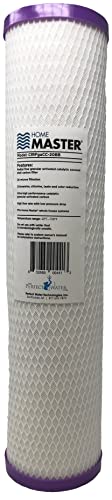 Home Master CfRFgaCC-20BB Replacement Whole House Water Filter, High Flow 20gpm, Radial Flow Granular Catalytic Carbon, 20" x 4.5" Fits Big BlueHome Master
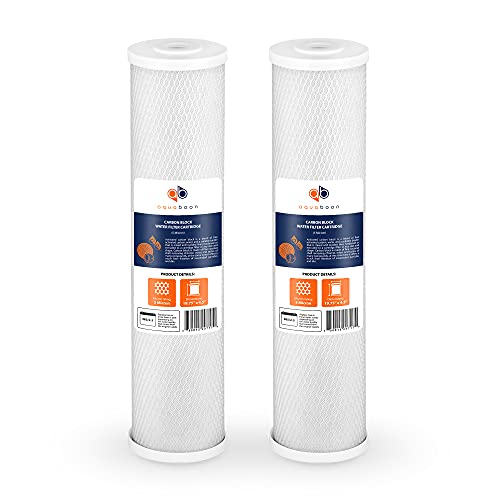 Aquaboon 4,5 x 20 inch Carbon Filter Cartridge - 5 Micron Coconut Shell CTO Big Blue Filter - Whole House Well Water Filtration - Matches DB20P, CTO20BB, Pentek FLOPLUS-20BB, 155312-43 (2 Pack)Aquaboon
Spin-down sediment separator with a 50-micron reusable stainless steel mesh screen, manual bottom blow-down valve, and clear impact-resistant housing sump
Installing this washable stage upstream of disposable cartridges traps coarse sand, shale, and visible grit, saving you from replacing expensive secondary filter cartridges every few weeks.


Single-stage 10-inch by 4.5-inch housing with a dual-gradient 25-micron exterior to 1-micron core spun polypropylene sediment cartridge
The layered fiber density traps coarse debris at the outer rim and microscopic silt near the inner core, delivering substantial dirt-holding capacity inside tight utility closets.


Prices are not shown here because they change daily and we will not display a stale one. Links open on Amazon, where the current price and availability are live.
Common questions
Will a whole house water filter remove hard water scale?
No, a whole house water filter cannot remove hardness minerals. Calcium and magnesium ions are dissolved into aqueous solution at sizes far too small for physical sediment or carbon cartridges to catch. Eliminating limescale requires an ion-exchange water softener that swaps mineral ions for sodium.
Does a whole house filter make tap water 100 percent safe to drink?
No, whole house systems do not eliminate all toxic drinking contaminants. High household flow rates prevent central units from stripping dissolved heavy metals like lead, nitrates, arsenic, or microscopic PFAS chemicals. Safe drinking water purification requires a dedicated reverse osmosis system or certified carbon block at the kitchen tap.
How much does water pressure drop after installing a whole house filter?
A properly sized 20-inch by 4.5-inch Big Blue filter housing causes an initial pressure drop between 1 and 3 PSI when clean. Smaller 10-inch by 2.5-inch housings or severely clogged cartridges can drop household line pressure by 10 to 20 PSI, causing noticeable flow loss at upper-floor showers.
Can I install a whole house water filter outside?
Installing filter housings outdoors is generally discouraged because freezing temperatures will crack the plastic sumps and flood the property. Direct sunlight also encourages algae growth inside clear sumps, while ultraviolet exposure degrades polypropylene housings over time. Outdoor units require weatherproof, insulated, and heated enclosures.
How often do whole house filter cartridges need to be changed?
Most residential sediment and carbon cartridges require replacement every 6 to 12 months, depending directly on water volume and sediment load. Properties with high sediment or private well water may exhaust cartridges within 2 to 3 months. Installing pressure gauges before and after the filter tells you exactly when flow resistance indicates a loaded cartridge.
Do I need a plumber to change the replacement cartridges?
No, changing standard filter cartridges is a straightforward homeowner maintenance task. You isolate the housing using integrated shut-off valves, depress the red pressure-relief button on top of the cap, and spin the sump off using the supplied plastic spanner wrench. Lubricating the rubber O-ring with food-grade silicone grease ensures a leak-free seal upon reassembly.