A basement dehumidifier must remove moisture at low temperatures without freezing into a solid block. Most subterranean spaces stay below 65 degrees Fahrenheit for months at a time. Standard residential machines fail under those conditions. The evaporator coils ice over, airflow drops to zero, and the compressor overheats.
Subterranean rooms present a unique moisture load. Liquid water wicks through porous concrete foundation walls from saturated exterior soils. Warm summer air enters through rim joists, cooling rapidly against chilled masonry. This drop in temperature drives up relative humidity (RH). Without mechanical drying, relative humidity climbs past 70 percent, creating an environment where wood rot and mold spores thrive.
Selecting the right machine requires understanding coil defrost cycles, pint capacity ratings, and drainage configurations. Daily attention is unsustainable. Buying an undersized machine leaves your foundation framing damp and risks compressor burnout from non-stop operation. Sizing the machine correctly and running continuous drain tubing keeps ambient air dry without requiring manual bucket maintenance.
Department of Energy Rules Redefined Pint Capacity Ratings
Older dehumidifier labels mislead buyers who replace units manufactured before 2019. In 2019, the Department of Energy (DOE) altered the test conditions for consumer dehumidifiers to match real subterranean operating environments. The previous testing protocol evaluated moisture removal at 80 degrees Fahrenheit and 60 percent relative humidity (RH). The updated DOE standard measures moisture extraction at 65 degrees Fahrenheit and 60 percent RH. This cooler benchmark reflects actual basement temperatures.
Cool air carries less moisture than warm air. Capacity labels changed overnight. A legacy 70-pint machine became a 50-pint machine under the new test protocol. Legacy 50-pint models dropped to roughly 30 or 35 pints. The Association of Home Appliance Manufacturers (AHAM) verifies these moisture removal rates through standardized laboratory testing. When shopping for equipment today, a 50-pint DOE-rated unit represents the largest common portable residential size.
| Metric | Pre-2019 Standard | Current DOE Standard |
|---|---|---|
| Test Air Temperature | 80 degrees Fahrenheit | 65 degrees Fahrenheit |
| Test Relative Humidity | 60 percent RH | 60 percent RH |
| Large Residential Rating | 70 pints per day | 50 pints per day |
| Medium Residential Rating | 50 pints per day | 30 to 35 pints per day |
| Moisture in Tested Air | Higher moisture mass per cubic foot | Lower moisture mass per cubic foot |
Cold Temperatures Frost Evaporator Coils and Stop Moisture Removal
Basement floors stay cold throughout the entire year. Heat rises. Foundation slabs remain at temperatures between 50 and 62 degrees Fahrenheit. Compressor dehumidifiers chill incoming air across metal evaporator coils to condense water vapor into liquid. When ambient air sits at 58 degrees, the surface of that refrigerant coil drops below 32 degrees Fahrenheit. Moisture freezes onto the aluminum fins.
Coil frost stops airflow. Once ice blocks the gaps between cooling fins, the cabinet fan cannot move air across the heat exchanger. Basic consumer units rely on passive defrost timers. These shut off the compressor while running the fan to melt the frost with room air. If your basement hovers near 55 degrees, room air cannot melt the ice quickly. The machine thaws instead of drying.
Look for units rated for low-temperature operation down to 41 degrees Fahrenheit. Active defrost sensors monitor refrigerant line temperatures continuously. Commercial-grade equipment takes another approach. Some heavy-duty models route hot refrigerant gas straight into the cold coil through a bypass valve to melt frost in two minutes. That keeps condensation flowing without long shutdown periods.
Continuous Drainage Eliminates Overflow Shutoffs and Standing Water
Full collection buckets stop moisture extraction instantly. A 50-pint unit running at maximum capacity pulls more than six gallons of water from the air every 24 hours. Internal buckets hold only one to two gallons. That bucket fills every four to eight hours during humid summer weather. Once the internal float switch trips, the compressor shuts down until someone carries the heavy bucket to a sink.
Gravity drain hoses eliminate manual dumping. Most units include a threaded fitting that accepts standard garden hose connections. Attaching a short hose directs continuous condensate straight to a floor drain or sump pit. Water flows downhill. The hose must slope downward without upward loops or kinks, because standing water inside the line creates airlocks that back water up into the internal bucket.
If your basement lacks a floor drain, gravity drainage cannot lift water up into a utility sink or out through an exterior rim joist. You need an integrated condensate pump or a separate external pump reservoir. Internal pumps push water vertically through thin vinyl tubing up to 15 feet. Inspect this discharge line twice a year to ensure mineral deposits or algae do not clog the internal check valve.
Square Footage Sizing Formulas Fail in Damp Foundation Spaces
Retail sizing charts assume dry living spaces above grade. They frequently recommend a 20-pint unit for an 800-square-foot room. That estimate fails underground. To work out the pints per day your room needs, you must account for uninsulated concrete, damp crawl space openings, and air infiltration. A basement with visible dampness requires roughly 50 percent more removal capacity than an above-grade room of the same square footage.
Unfinished spaces require strong air movement. Porous foundation masonry allows water vapor to enter continuously from saturated backfill soil. High humidity in basement air settles into stagnant corners, behind storage bins, and under stairwells. Stagnant pockets grow mold. You need an internal blower fan rated for at least 150 to 200 cubic feet per minute (CFM) to circulate air across the entire concrete slab.
Running a smaller unit continuously wastes energy. A 50-pint machine pulls moisture down rapidly, allowing the compressor to rest once target humidity levels are achieved. Small units run non-stop without reaching the setpoint. Continuous operation accelerates motor wear. It also dumps waste heat into the room.
Maintaining Target Humidity Prevents Structural Mold and Pest Infestations
Setting the humidistat correctly protects framing lumber and stored belongings. The Environmental Protection Agency (EPA) recommends maintaining indoor relative humidity between 30 percent and 50 percent. Keeping basement air below 50 percent RH denies mold spores the moisture required for germination. Dust mites die below that threshold. Consulting the humidity range that prevents mold and dry air helps you establish safe seasonal targets for subterranean spaces.
Do not trust the digital display mounted on the dehumidifier cabinet. The onboard sensor sits inside the damp intake grille. It reads artificially high. Mount an independent digital hygrometer across the room on an interior wall. Position the sensor at eye level away from exterior doors and dehumidifier exhaust vents.
- Set the machine humidistat to 45 percent RH to keep ambient room air reliably under 50 percent.
- Place an independent digital hygrometer at least ten feet away from the dehumidifier exhaust.
- Elevate stored cardboard boxes and organic materials onto metal or plastic shelving to maintain airflow.
- Inspect ceiling joists and sill plates every month for signs of surface dampness.
Energy Efficiency Metrics Determine Long-Term Operating Costs
Dehumidifiers draw significant electrical power during summer months. The Department of Energy rates dehumidifier efficiency in liters of water removed per kilowatt-hour of electricity consumed (L/kWh). For portable units between 30 and 50 pints, federal standards require minimum efficiencies between 1.30 and 1.80 L/kWh depending on capacity. Energy Star certified models exceed those baselines by roughly 15 percent, based on published EPA criteria.
Continuous operation drives up electric bills. Calculating what a dehumidifier adds to the electricity bill requires multiplying appliance wattage by total daily run hours. A 500-watt machine running 14 hours per day consumes seven kilowatt-hours daily. Clean filters protect efficiency. A dirty intake screen starves the blower fan of air, forcing the compressor to draw higher current while condensing less water.
- Wash the plastic air filter every two to three weeks during peak summer operation.
- Maintain at least twelve inches of open clearance around intake grilles and exhaust louvers.
- Seal leaky rim joists and basement windows to stop outdoor moisture infiltration.
- Ensure cellar doors and bulkheads close tightly with functional weatherstripping.
Structural Water Intrusion Requires Excavation Before Consumer Equipment
A portable dehumidifier cannot solve active bulk water intrusion. If liquid water puddles across the floor slab after rainstorms, consumer equipment will fail. Hydrostatic pressure pushes groundwater through foundation cracks and cold joints. Dehumidifiers pull vapor from air. They do not pump out puddles. Correcting exterior grading, clearing gutters, and installing an interior drainage track with a sump pit must happen before mechanical air drying can work.
Connected dirt crawl spaces also overwhelm portable appliances. Damp earth pumps gallons of water vapor into adjacent basement rooms daily. In those structures, crawl space dehumidifier systems must be paired with complete ground vapor barrier encapsulation. Large basements need different solutions. For expansive, multi-room layouts, a ducted whole-house dehumidifier tied into central heating, ventilation, and air conditioning (HVAC) ductwork distributes dry air far better than scattered portable units.
If foundation walls seep continuously, consult a structural waterproofing contractor before buying consumer drying appliances. Mechanical drying cannot replace structural repairs. When exterior drainage works and walls remain dry to the touch, deploying a 50-pint basement dehumidifier with continuous gravity drainage provides the most reliable protection against structural moisture damage.
What to Buy for This
Each entry below is a specification rather than a single model, because stock and pricing on this equipment change constantly. The products shown are what currently matches that specification. Match the spec, then buy whatever meets it.
50-pint low-temperature compressor dehumidifier with internal condensate pump and auto-defrost sensor
This specification operates down to 41 degrees Fahrenheit without coil freeze-up, while the built-in vertical pump discharges water up into a utility sink or overhead drain line without bucket maintenance.
50-pint high-airflow dehumidifier with continuous gravity drain port and washable high-efficiency air filter
A high-capacity gravity drain unit moves up to 200 cubic feet per minute of air, distributing dry air throughout multi-room layouts and directing moisture continuously into floor drains.


Commercial-grade low-temperature dehumidifier with hot gas bypass defrost and heavy-duty steel housing
Hot gas bypass systems melt evaporator frost in minutes rather than shutting down the compressor, allowing continuous operation in unheated basements down to 33 degrees Fahrenheit.
35-pint compact compressor dehumidifier with auto-restart and rear gravity drainage connection
Smaller subterranean rooms under 400 square feet need moderate moisture removal that fits tight mechanical spaces without consuming excess electrical power.
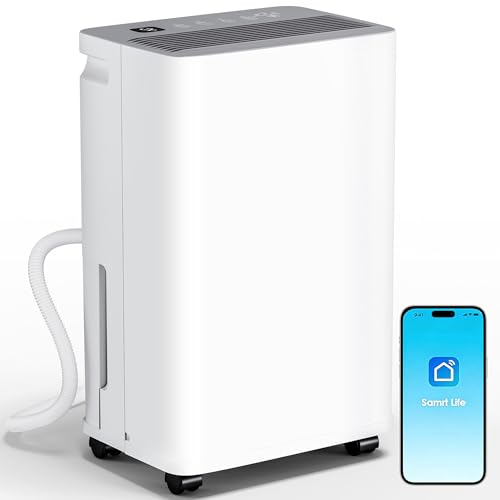

Prices are not shown here because they change daily and we will not display a stale one. Links open on Amazon, where the current price and availability are live.
Common questions
What size dehumidifier is needed for an average basement?
For an average basement between 1,000 and 1,500 square feet with moderate dampness, a 50-pint Department of Energy rated unit provides the ideal balance of extraction capacity and airflow. Smaller 20 or 30-pint models struggle to lower relative humidity during humid summer months, leading to continuous compressor run times and elevated power bills. If foundation walls show active wet spots, step up to a heavy-duty or commercial-grade unit.
Why does my dehumidifier freeze up in the basement?
Evaporator coils freeze because basement air temperatures are frequently cool enough to drop refrigerant coil surfaces below 32 degrees Fahrenheit. When ambient air hovers between 50 and 60 degrees, moisture condenses onto the aluminum fins and turns to ice before it can drip into the drain pan. Units lacking active defrost controls accumulate solid blocks of frost that choke airflow and cause the compressor to overheat.
Can a basement dehumidifier drain into a sump pump pit?
Yes, routing a continuous gravity drain hose directly into a sump pit is one of the most reliable drainage methods. Ensure the discharge hose is secured above the pit water line and slopes downward without upward loops. The sump pump will automatically evacuate the collected condensate once the water level trips the pump float switch.
Where is the best place to position a dehumidifier in a basement?
Place the dehumidifier in the most humid area of the basement with at least twelve inches of clear space around the air intake and exhaust grilles. Keeping the unit away from walls and large furniture ensures unrestricted airflow throughout the room. If possible, place the unit near a floor drain or sump pit to simplify continuous drainage.
Should I run a basement dehumidifier in the winter?
Most basements do not require dehumidification in winter because cold outdoor air carries very little moisture, naturally lowering indoor relative humidity. Running a compressor dehumidifier when room temperatures drop below 50 degrees Fahrenheit often causes coil icing and unnecessary wear. Monitor conditions with an independent hygrometer, and turn the unit off if relative humidity remains below 45 percent.