A carbon dioxide monitor tells you when a room needs fresh outdoor air. Every human breath adds gas to the room. If you feel sluggish in a closed office, stale air is often the cause. Carbon dioxide itself is rarely toxic at normal residential levels. It serves as a tracer for poor ventilation. Stale air traps odors, moisture, and respiratory aerosols together.
Outdoor air sits near 420 parts per million (PPM) of carbon dioxide (CO2), according to the National Oceanic and Atmospheric Administration (NOAA). Two people in a closed room will double that quickly. Numbers climb fast. A reliable sensor shows the problem before your head starts aching. You see when opening a window restores balance. Many combined devices reviewed in our air quality monitor guide use cheap chips that guess at gas levels instead of counting them.
Indoor Levels Rise Because Human Respiration Adds Gas to Sealed Spaces
Indoor carbon dioxide levels rise when human respiration outpaces the rate of outdoor air exchange. Exhaled human breath contains roughly 40,000 PPM of CO2. A sleeping adult adds volume to the room air all night. The gas disperses quickly across the space. Without airflow, the concentration rises until someone opens a door.
Outdoor air sets the baseline floor. That background level sits near 420 PPM across North America, according to the National Oceanic and Atmospheric Administration (NOAA). A room with open windows stays near that level. A sealed room with closed doors can cross 1,200 PPM in two hours. Air exchange dilutes the buildup. Tracking this gas reveals your true ventilation rate. The American Society of Heating, Refrigerating and Air-Conditioning Engineers (ASHRAE) bases indoor ventilation standards on this direct physical relationship.
NDIR Sensors Separate Real Carbon Dioxide From Other Household Gases
A true nondispersive infrared (NDIR) sensor measures light absorption at a specific wavelength where carbon dioxide absorbs energy. An internal lamp shines infrared light down a small optical tube toward a detector. Carbon dioxide absorbs light at 4.26 micrometers. The sensor tracks how much light makes it across the chamber. Less light means more gas is present. Budget monitors skip the optical chamber entirely.
Instead, budget units use metal-oxide semiconductor (MOS) sensors designed to track volatile organic compounds (VOC). These chips generate an estimated carbon dioxide (eCO2) figure from general chemical vapors. Alcohol, cooking steam, and perfumes fool these sensors instantly. That reading is not real carbon dioxide. Photoacoustic spectroscopy (PAS) is a newer alternative that shrinks the physical footprint. A pulsed emitter creates sound waves inside a tiny cell, which an internal microphone measures. While true PAS sensors detect actual CO2, loud background noise and pressure shifts can skew the data. Dual-channel NDIR sensors remain the most reliable choice because a reference light channel corrects for lamp aging over time.
| Sensor Type | Measurement Method | Interference Risks | Typical Lifespan |
|---|---|---|---|
| Dual-Channel NDIR | Optical absorption at 4.26 microns with reference beam | Very low and unaffected by household chemicals | 10 to 15 years |
| Single-Channel NDIR | Optical absorption at 4.26 microns | Low but drifts over time without outdoor recalibration | 5 to 10 years |
| Photoacoustic (PAS) | Acoustic detection of light pulses in micro-chamber | Moderate and affected by loud noise and pressure | 5 to 8 years |
| Metal-Oxide (eCO2) | Chemical resistance change across a heated metal plate | Extreme reaction to alcohol, cooking, and perfume | 2 to 4 years |
High Carbon Dioxide Points to Poor Air Exchange Rather Than Particulate Pollution
Opening a window clears carbon dioxide while a standard particulate filter leaves the gas untouched. Many buyers assume an air purifier solves every indoor air problem. That assumption is wrong. A High-Efficiency Particulate Air (HEPA) filter traps dust, dander, and smoke particles. Gases pass straight through dense filter fibers.
You cannot filter carbon dioxide out of home air with ordinary appliances. Removing the gas chemically requires consumable scrubbers like soda lime, which belong in submarines rather than bedrooms. Fresh outdoor air is the only practical solution in a home. You must move stale air out and bring fresh air in. Running an air purifier will not lower your meter reading by one point. You need an open window, an exhaust fan, or a mechanical intake duct. To measure dust or chemical vapors, read our guide on testing air quality at home to choose the right tool.
The Specific Thresholds That Demand Fresh Outdoor Air
Ventilation becomes inadequate once indoor carbon dioxide climbs past 1,000 parts per million. Public health agencies publish clear benchmarks to help you interpret the numbers. Brief spikes matter less than sustained exposure. Outdoor air hovers near 420 PPM according to data from NOAA. An indoor reading below 800 PPM confirms healthy air exchange.
The Centers for Disease Control and Prevention (CDC) recommends keeping levels below 800 PPM in shared rooms to reduce disease transmission risks. Good ventilation dilutes respiratory droplets quickly. Between 1,000 and 1,500 PPM, cognitive performance starts to decline. The Environmental Protection Agency (EPA) notes that inadequate ventilation leading to these concentrations causes drowsiness, stuffiness, and poor concentration. Headaches become common above 2,000 PPM. The Occupational Safety and Health Administration (OSHA) enforces a workplace limit of 5,000 PPM for an eight-hour shift. Home air rarely hits that number, but closed bedrooms often reach 2,500 PPM by sunrise.
- 400 to 450 PPM: Normal outdoor baseline level reported by NOAA.
- Below 800 PPM: Well-ventilated indoor space recommended by the CDC for classrooms and offices.
- 1,000 to 1,200 PPM: Threshold where ventilation is lagging behind occupancy according to ASHRAE guidelines.
- 1,500 to 2,000 PPM: Stuffiness, cognitive sluggishness, and headaches reported by the EPA.
- Above 5,000 PPM: Workplace exposure limit set by OSHA for an eight-hour shift.
Automatic Calibration Fails in Rooms That Are Constantly Occupied
Automatic baseline calibration distorts readings in rooms that never empty out to fresh outdoor air. Most consumer monitors include an algorithm called Automatic Baseline Calibration (ABC). The software expects the room to sit empty once a week. It grabs the lowest number recorded over eight days and calls that 400 PPM. This logic fails in occupied homes.
If your bedroom never drops below 900 PPM, the sensor resets 900 PPM as its new baseline. Future readings appear 500 PPM lower than reality. You see 600 PPM on the screen while breathing 1,100 PPM air. The sensor hides the problem from you. Dual-channel optical hardware avoids this software trap by using an unabsorbed reference beam to measure optical drift directly. If you own a single-channel device, disable ABC and take the unit outdoors once a month for manual calibration.
Turn off Automatic Baseline Calibration if your sensor stays in an occupied bedroom or nursery. Take the monitor outdoors into clear air for twenty minutes every few weeks to calibrate the baseline manually.
How to Use a CO2 Monitor to Diagnose Ventilation Flaws
Placing a sensor at breathing height away from direct exhales reveals how room air circulates. Keep the monitor away from your face. Breathing straight onto the grill produces artificial spikes past 3,000 PPM. Set the unit on an open shelf three to six feet off the floor. Avoid drafty windows or heating supply vents. You want an accurate reading of mixed room air.
Treat the monitor as a diagnostic tool. Check how high the level rises when you work with the door closed. See if cracking a window two inches keeps the reading under 800 PPM. If your heating or cooling system has a central fan, run it continuously to see whether it mixes air between rooms.
- Step 1: Take the device outside for twenty minutes to confirm it reads near the 420 PPM outdoor baseline.
- Step 2: Place the monitor on an interior shelf at seated breathing height, at least six feet away from where people exhale.
- Step 3: Close doors and windows during your normal routine to record your peak occupancy concentration.
- Step 4: Open a window or switch your ventilation fan on to find the minimum airflow needed to stay below 1,000 PPM.
- Step 5: Check bedroom levels first thing in the morning to see whether sleeping conditions remain under 1,200 PPM.
Who Should Not Buy a Carbon Dioxide Monitor
A carbon dioxide monitor cannot detect chemical fumes, airborne particles, or biological growth. People worried about wildfire smoke need an optical particle sensor instead. The gas sensor ignores particulate matter. If you suspect hidden mold or elevated radon, this instrument will not help you.
Radon demands dedicated testing protocols, which we detail in our radon test kit guide. Chemical off-gassing from new carpeting or furniture requires specialized detection, as explained in our consumer VOC meter review. Renters with sealed windows might also pass on this purchase. A monitor provides little value if you have no way to bring in outdoor air. Start with problems you can solve. Review our testing triage guide to match your budget with your actual household risks.
Mechanical Ventilation Systems Can Make Continuous Monitoring Redundant
Continuous monitoring becomes unnecessary once a balanced mechanical ventilation system delivers verified air exchange to every bedroom. An Energy Recovery Ventilator (ERV) or Heat Recovery Ventilator (HRV) brings in fresh air continuously through dedicated ductwork. A balanced system handles ventilation automatically. You do not need a permanent desktop display if your ventilation rate is fixed and verified by an installer.
Borrowing a meter for a weekend is enough to confirm that the ducts deliver sufficient air under full occupancy. If the system keeps bedrooms below 900 PPM overnight, your ventilation works properly. For homes without mechanical fresh air systems, an active gauge provides essential feedback. Place an NDIR sensor in your main workspace or bedroom to see whether a reliable co2 monitor confirms that your room needs more fresh air.
What to Buy for This
Each entry below is a specification rather than a single model, because stock and pricing on this equipment change constantly. The products shown are what currently matches that specification. Match the spec, then buy whatever meets it.
Dual-channel NDIR carbon dioxide monitor with e-ink display, visual color threshold indicators, and manual outdoor calibration mode
Dual-beam optics eliminate baseline drift without requiring automatic baseline software, making it reliable for continuously occupied rooms.
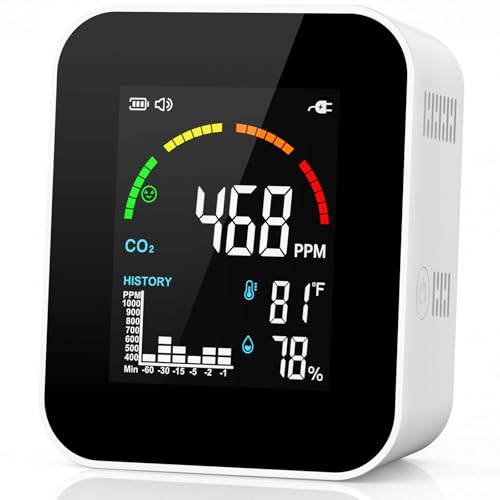

Compact rechargeable NDIR sensor with data logging, internal battery, and adjustable altitude compensation
A small battery-powered unit lets you audit classrooms, hotel rooms, and rental spaces without needing a wall outlet nearby.


NDIR carbon dioxide transmitter with local API or wireless protocol support and external power connection
Allows you to automate fresh air intake dampers, bathroom exhaust fans, or ERV boost modes based on live PPM thresholds.

Prices are not shown here because they change daily and we will not display a stale one. Links open on Amazon, where the current price and availability are live.
Common questions
Can an air purifier lower indoor carbon dioxide levels?
No, a residential air purifier does not reduce carbon dioxide. High-Efficiency Particulate Air (HEPA) filters and activated carbon beds trap particles and some volatile organic chemicals, but carbon dioxide molecules pass directly through them. Lowering carbon dioxide requires introducing fresh outdoor air through an open window, an exhaust fan, or a mechanical ventilation system.
Why does my carbon dioxide monitor read 400 PPM indoors?
A reading of 400 PPM indoors usually means your sensor has an aggressive automatic calibration algorithm that reset itself incorrectly, or the room is wide open to outdoor air. Outdoor air sits near 420 PPM according to data from NOAA. If people are in the room with closed windows, a 400 PPM reading indicates your sensor needs manual calibration.
What is the difference between NDIR and eCO2 sensors?
A nondispersive infrared (NDIR) sensor physically counts carbon dioxide molecules by measuring light absorption at an exact optical wavelength. An eCO2 sensor uses a metal-oxide chip that measures other airborne chemicals and guesses at carbon dioxide levels based on an algorithm. Household activities like cooking, using hand sanitizer, or peeling fruit will trigger false spikes on an eCO2 sensor.
Is carbon dioxide the same thing as carbon monoxide?
No, carbon dioxide (CO2) and carbon monoxide (CO) are entirely different gases with different risks. Carbon monoxide is a lethal, odorless byproduct of incomplete combustion from furnaces, stoves, or vehicle exhaust that requires a dedicated life-safety alarm. Carbon dioxide is a natural byproduct of human respiration used primarily to gauge ventilation rates.
What level of carbon dioxide causes headaches?
The Environmental Protection Agency notes that carbon dioxide levels exceeding 1,500 to 2,000 PPM commonly cause complaints of drowsiness, stuffiness, and headaches. While these levels are not immediately dangerous, they signal poor ventilation that impairs concentration and traps other indoor contaminants.
How often do you need to calibrate a CO2 sensor?
Single-channel NDIR sensors should be calibrated outdoors in fresh air once every month to prevent software drift. Dual-channel NDIR sensors use a reference optical channel to compensate for lamp aging and typically maintain accuracy for several years without manual intervention.