An air purifier reduces airborne pollen and animal dander quickly. It helps much less with dust mites because their waste settles into bedding within minutes. Choosing an air purifier for allergies makes sense when you target triggers that remain suspended in room air.
Allergens behave differently once they enter a room. Tree pollen, grass pollen, and cat dander stay aloft for hours on tiny air currents. That suspension gives a mechanical filter a fair chance to collect them. Heavy particles fall fast. Dust mite feces and cockroach fragments drop straight onto carpets, mattresses, and upholstered chairs before machine circulation can pull them toward an intake grille.
Filtration cannot clean what never reaches the cabinet. Relieving allergy symptoms requires matching the device to the specific airborne trigger troubling your household. You also need structural humidity controls to manage the allergens that live permanently in your soft furnishings.
How an Air Purifier for Allergies Handles Airborne Triggers
Mechanical filtration removes airborne allergens by capturing suspended matter within dense physical media. As indoor air passes across the pleated filter, microscopic fibers trap particles through direct contact. Small pollen fragments and lightweight animal dander snag on these woven strands. Clean air exhausts back into the room. The process runs entirely on mechanical airflow.
Understanding collection mechanisms explains why certain triggers vanish while others linger. Coarse particles slam into filter fibers by impaction because their forward momentum prevents them from curving around obstacles. Intermediate particles touch fibers and adhere through interception. The smallest airborne particles drift in erratic patterns known as Brownian motion, causing them to collide with filter strands through diffusion. A certified High-Efficiency Particulate Air (HEPA) filter captures particles across all three physical behaviors.
Particle Weight Dictates What Reaches the Filter
Particle aerodynamics determine whether an allergen stays suspended long enough to reach a mechanical filter. Floating biological debris behaves according to mass and diameter. The Environmental Protection Agency (EPA) notes that tree, grass, and weed pollen grains typically range from 10 to 100 microns in size. Even at that size, dry pollen grains possess low density. Gentle convective drafts keep them airborne for hours.
Pet allergens float even longer. Microscopic skin flakes from cats and dogs measure between 1 and 5 microns. These tiny protein sheaths remain suspended on subtle household currents created by walking or opening an interior door. Because they stay suspended, an air purifier for pets easily draws them into its intake ports. The story changes completely for settled biological matter.
Dust mite allergens fall out of room air within fifteen minutes. Mite droppings are dense, moist fecal pellets measuring between 10 and 40 microns. The Environmental Protection Agency reports that dust mite antigen levels in air spike during bed-making or vigorous sweeping, then collapse as gravity pulls the waste to the floor. A filter cabinet across the bedroom cannot pull a heavy particle horizontally across ten feet of still air. Most household dust settles into carpet long before an air cleaner can process the volume.
Clean Air Delivery Rate Determines Clearing Speed
The Clean Air Delivery Rate (CADR) measures the cubic feet of filtered air an appliance supplies every minute. Developed by the Association of Home Appliance Manufacturers (AHAM), CADR provides three distinct metrics for smoke, dust, and pollen removal. A consumer evaluating an air cleaner should look directly at the pollen rating. Higher numbers mean faster particle removal.
Room volume dictates the air delivery capacity you require. The Association of Home Appliance Manufacturers establishes that an air cleaner smoke CADR must equal at least two-thirds of the room total square footage. For allergy management, you need higher circulation rates. Sufferers experience faster relief when a unit achieves 4 to 5 complete air changes per hour. That turnover rate flushes outdoor pollen intrusions before they trigger immune responses.
Comparing room size against certified CADR ratings prevents undersizing your equipment. Running an undersized purifier on maximum speed creates noise that disrupts sleep. A larger unit operating on medium speed delivers identical clean airflow with substantially less motor sound.
| Room Area (Square Feet) | Minimum Pollen CADR | Air Changes per Hour (ACH) | Target Clearing Window |
|---|---|---|---|
| 150 (Small Office) | 100 | 4 to 5 ACH | 12 to 15 minutes |
| 250 (Standard Bedroom) | 170 | 4 to 5 ACH | 12 to 15 minutes |
| 350 (Large Bedroom) | 240 | 4 to 5 ACH | 12 to 15 minutes |
| 500 (Living Area) | 340 | 4 to 5 ACH | 12 to 15 minutes |
True HEPA Traps Microscopic Particles Without Creating Ozone
A True High-Efficiency Particulate Air filter captures at least 99.97 percent of particles down to 0.3 microns. That benchmark comes from Department of Energy (DOE) industrial containment specifications. It targets the hardest particle size to trap. Particles larger or smaller collect with higher efficiency. This mechanical media reliably traps plant pollens and animal dander.
Avoid electronic air cleaners that generate ozone as an operational byproduct. Electrostatic precipitators and ionizers charge airborne particles so they stick to collection plates or interior walls. These electrical discharges frequently synthesize ozone gas. The Environmental Protection Agency warns that ozone is a known respiratory irritant that inflames bronchial linings and triggers asthma episodes. The California Air Resources Board (CARB) certifies air cleaners that produce ozone concentrations under 0.050 parts per million. When selecting the best air purifier, verify that the model relies entirely on physical filtration.
The Environmental Protection Agency warns that ozone generators sold as air purifiers produce lung irritation and worsen allergic reactions. Avoid any device using ionization, electrostatic charging, or plasma without verified zero-ozone certification.
Dust Mite Control Demands Humidity Management Instead of Airflow
Lowering indoor relative humidity below 50 percent stops dust mite reproduction and shrinks existing populations. Dust mites have no drinking organs. They absorb water vapor directly from the surrounding air through their cuticles. When ambient humidity drops below their biological threshold, they dehydrate and perish. An air cleaner running across the room cannot remove moisture from the microclimate inside your mattress.
The Centers for Disease Control and Prevention (CDC) recommends maintaining indoor relative humidity between 30 and 50 percent throughout the year. Running a dedicated basement dehumidifier or whole-home system starves dust mite colonies of necessary ambient vapor. Pair humidity management with impermeable allergen covers on pillows and mattresses. Washing bed linens weekly in water heated above 130 degrees Fahrenheit denatures mite proteins, according to the Centers for Disease Control and Prevention. These moisture and sanitation measures address the true source of your allergic reaction.
Relying on air filtration alone for dust mite allergies leaves the primary reservoir untouched. Patients who spend money on purifiers expecting dust relief often remain congested. Mechanical filters clear what floats. Bedding hygiene and dry air clear what crawls.
Room Placement Changes How Much Allergen Enters Your Lungs
Placing an air purifier within six to eight feet of your head delivers clean air directly to your breathing zone. People spend roughly one-third of their lives sleeping. During those stationary hours, respiratory tissues recover from daytime outdoor exposures. If you place the appliance in a distant corner behind heavy curtains, room drafts dissipate the clean air before it reaches your pillow.
Air circulation paths dictate unit positioning. Keep the intake grilles at least two feet clear of walls, nightstands, and bed skirts. Restricted intakes choke motor fans and reduce total air changes. Keep bedroom windows closed during your region peak pollen season. The Centers for Disease Control and Prevention advises keeping windows shut and operating air conditioning or filtration to stop fresh outdoor allergens from replenishing indoor air.
Fan speed settings represent a practical balance between noise and airflow. Running a unit on low speed reduces effective CADR by up to seventy percent compared to high speed. If high speed is too loud for sleep, size up the machine. A larger purifier running on its medium setting moves adequate air quietly.
Maintenance Schedules Prevent Saturated Media from Dropping Airflow
Clogged filter media restricts motor airflow and cuts the effective clean air delivery rate of the purifier. As dust and pet hair pack into the fiber matrix, resistance increases. The fan motor draws more electricity while pushing less air through the pleats. Air bypass occurs when air slips around loose gasket seals instead of passing through dense media. Regular maintenance keeps the unit working properly.
Vacuum or rinse your coarse mesh pre-filter every two to four weeks. The pre-filter traps large hair, carpet lint, and visible fluff. Protecting the primary HEPA element from coarse debris extends its working lifespan. Replace the primary True HEPA filter every six to twelve months depending on indoor conditions. If you live in an agricultural area with heavy crop dust or share your home with multiple shedding animals, inspect the media every quarter.
Air cleaners do not solve every indoor environmental challenge. This equipment is not suitable for households attempting to resolve widespread structural dampness or unmanaged pest infestations. An air cleaner will not eliminate dust mites living in an old mattress or mold colonies growing behind moist drywall. Those conditions require source remediation and active moisture control. If upcoming clinical trials demonstrate that personal desktop purifiers reduce dust mite antigens in settled bedding without fabric encasings, the recommendation to prioritize room dehumidification over air filtration would change. To improve your indoor air tonight, place your air purifier for allergies near your bed, run the fan on medium, and seal your pillows in zippered mite-proof covers.
What to Buy for This
Each entry below is a specification rather than a single model, because stock and pricing on this equipment change constantly. The products shown are what currently matches that specification. Match the spec, then buy whatever meets it.
True HEPA filtration unit with at least 150 pollen CADR and rubber-gasketed cabinet seals
Delivers over four air changes per hour in standard bedrooms while preventing microscopic pollen bypass around the filter edges.
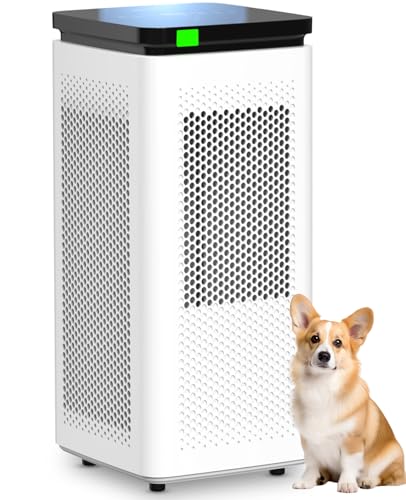

True HEPA air cleaner with washable mesh pre-filter and minimum 250 CADR
The separate pre-filter captures coarse fur and hair, keeping the high-density HEPA fibers clear to collect floating dander proteins.
 YARIKI Air Purifiers for Home Pets Covers Up to 1500 Sq Ft,H13 Hepa Filter with Washable Pre-Filter,Pet Hair Dander Smoke Air Cleaner,22 dB Quiet Sleep for Living Room Bedroom Kitchen,P280 (Black)YARIKI
 Pet Air Purifier for Home Large Room 2500 Sq Ft, H13 HEPA Double-Sided Filter with Washable Pre-filter, Adsorbs Pet Hair Dander Odor Allergies Smoke Dust,PM2.5 Air Quality Monitor,Auto Mode,P358 BlackHEAPETS
Dual-intake True HEPA air purifier rated at 350+ CADR with verified zero-ozone motor certification
Processes large air volumes rapidly across broad floor plans without creating secondary chemical irritants that trigger airway inflammation.
Prices are not shown here because they change daily and we will not display a stale one. Links open on Amazon, where the current price and availability are live.
Common questions
Can an air purifier help with dust mite allergies?
An air purifier provides minimal relief from dust mites because their fecal pellets settle into bedding, rugs, and furniture within fifteen minutes. Mechanical filters only clean particles that remain floating in room air. Controlling dust mites requires zippered allergen barrier covers, hot water laundry, and keeping indoor relative humidity below 50 percent.
Does an air purifier remove pet dander from a room?
A True HEPA air purifier captures microscopic pet dander effectively because animal protein flakes stay suspended in air currents for hours. The unit pulls these floating flakes into fine fibers before they enter your airways. It will not remove dander already embedded in upholstery, carpets, or drapes.
Where should you place an air purifier for allergy relief?
Place the air purifier in your bedroom within six to eight feet of your head, keeping the air grilles unobstructed by walls or furniture. Because people spend eight consecutive hours sleeping in one place, positioning the unit near your breathing zone maximizes exposure to filtered air during respiratory recovery.
Should an air purifier run continuously for allergies?
Running an air purifier continuously on a medium setting maintains low particle counts as doors open and HVAC systems circulate air. Turning a unit off allows outdoor pollen and pet dander to rebuild quickly within an hour. Continuous airflow provides stable indoor air quality.
Why do some air purifiers worsen allergy symptoms?
Electronic air purifiers that use ionizers or electrostatic plates often release small amounts of ozone gas. The Environmental Protection Agency states that ozone irritates sensitive airway tissues and can exacerbate allergic asthma. Units without tight internal seals also leak unwashed air back into the room.