Crawl space moisture stops when you seal the dirt floor and close exterior foundation vents. Running a dehumidifier inside an unsealed crawl space fails. The appliance pulls moisture from outdoor air indefinitely. Warm air enters through open vents, hits cool framing, and drops condensation on wooden joists. Soil beneath the house adds continuous evaporation. You cannot dry the outdoor atmosphere with a residential machine.
Uncontrolled crawl space moisture quickly becomes a whole-house air problem. Air in your crawl space does not stay under your floor. Natural convection pulls sub-floor air directly into your living spaces through plumbing chases, duct gaps, and wiring holes. The Environmental Protection Agency (EPA) notes that up to 50 percent of the air you breathe on the first floor originates in the crawl space or basement. When sub-floor relative humidity (RH) stays high, wood rot and biological growth follow.
Solving the problem requires separating bulk liquid water from airborne water vapor. Liquid puddles from roof runoff demand exterior drainage corrections. Evaporating soil vapor demands heavy ground encapsulation. Sealing the perimeter completes the building envelope. If you skip exterior water management and install a machine first, the equipment runs constantly without drying damp timber.
Open Foundation Vents Bring Humid Air Indoors
Open foundation vents increase crawl space humidity during warm months instead of drying the building framing. Traditional residential building codes once required 1 square foot of vent area for every 150 square feet of crawl space floor area. The original theory assumed cross-ventilation would carry moisture away from structural timber. Building science evaluations published by the Department of Energy (DOE) demonstrated the opposite effect in humid climates. Outdoor air brings outdoor water vapor directly into cold sub-floor spaces.
Warm air holds more moisture than cool air. When outdoor air at 85 degrees Fahrenheit enters a shaded sub-floor cavity at 65 degrees, the air cools down. As the air temperature drops toward its dew point, relative humidity rises toward 100 percent. Cold wood condenses vapor. Water beads form on floor joists, rim joists, and metal air ducts. Open vents actively feed this condensation cycle throughout summer.
- Outdoor summer air cools upon entering the shaded sub-floor cavity.
- Relative humidity spikes as the air temperature approaches the dew point.
- Moisture condenses on floor joists, subflooring, and cold sheet metal ductwork.
- Open foundation vents supply endless water vapor from the outdoor atmosphere.
Bare Soil Pours Gallons of Water Vapor Daily
Exposed dirt floors continuously release moisture into crawl space air through capillary draw and soil evaporation. Soil contains groundwater even when the surface appears powdery and dry. Moisture migrates upward through fine soil pores until it reaches the open air. The Department of Energy (DOE) reports that an uncovered 1,000-square-foot dirt crawl space can release more than 10 gallons of water vapor into the house each day. That moisture moves straight into structural wood and living areas.
Damp soil also accelerates fungal colonization on organic building materials. Spores germinate quickly. When relative humidity at the wood surface exceeds 70 percent, fungal spores colonize floor framing. Exploring mold test kits can identify active colonies, but testing alone does not fix dampness. Soil evaporation must stop before timber dries. Sealing the dirt floor eliminates this daily vapor emission at its physical origin.
The Stack Effect Pulls Crawl Space Moisture Upward
The stack effect draws damp crawl space air up into your living areas as warm indoor air rises toward the roof. Houses act like chimneys. Warm air expands, becomes buoyant, and escapes through attic bypasses, ceiling fixtures, and roof exhaust vents. This escaping air creates negative air pressure at the bottom of the building. Air pulls upward from beneath your floorboards.
Air moves through tiny structural gaps. Unsealed subfloor seams, pipe penetrations, electrical conduits, and heating and cooling duct joints leak air continuously. You end up breathing whatever gases and damp air exist under the floor. Tracking living space conditions with an air quality monitor reveals sudden spikes in indoor humidity whenever outdoor weather shifts. Sealing subfloor penetrations helps, but encapsulating the crawl space fixes the pressure boundary.
Exterior Drainage Must Precede Any Interior Encapsulation
Exterior gutters and ground grading must divert surface runoff away from foundation walls before you seal the crawl space interior. Surface water pools around foundations during heavy rainstorms. Porous concrete masonry units soak up pooling groundwater like a sponge. Capillary action pushes water through foundation walls. Water pools on top of the sub-floor soil.
Interior encapsulation fails if standing water enters the space. Trapped water under a plastic vapor barrier produces foul odors and gas bubbles. The Environmental Protection Agency (EPA) advises extending downspout discharge pipes at least 5 feet away from exterior foundation walls to prevent foundation saturation. Soil must also slope away from the perimeter with a minimum drop of 6 inches over the first 10 feet. Grade the yard first.
| Component | Requirement | Consequence if Ignored |
|---|---|---|
| Roof Gutters | Clean channels and seamless downspout connections | Rain cascades over fascia directly against foundation walls |
| Downspout Extensions | Discharge minimum 5 feet away from foundation | Roof runoff saturates backfill soil and leaks through masonry |
| Perimeter Soil Grade | Slope downward 6 inches across first 10 feet | Surface puddles flow toward stem walls instead of the yard |
| Exterior Subsurface | Perforated pipe in high water table soils | Hydrostatic pressure pushes groundwater under footings |
Encapsulation Requires Continuous Sealed Polyethylene Sheeting
A continuous, heavy polyethylene vapor barrier isolates crawl space air from damp foundation walls and ground soil. Thin plastic sheeting fails quickly. Standard 6-mil clear agricultural polyethylene tears during routine plumbing visits and degrades within a few years. Your installation requires 12-mil to 20-mil woven, reinforced polyethylene sheeting designed specifically for sub-floor encapsulation.
The International Residential Code (IRC) section R408.3 governs unvented crawl space construction. The code mandates that ground vapor retarder seams overlap by a minimum of 6 inches and receive complete sealing with compatible mastic or vapor-barrier tape. Extend the polyethylene sheeting up foundation stem walls to within 3 inches of the wooden sill plate. Fasten the membrane with mechanical masonry anchors and elastomeric adhesive sealant.
The 3-inch gap below the sill plate is critical for pest management. Termite inspectors must see exposed concrete to check for termite mud tubes. Never cover the wooden sill plate or wooden joists with vapor barrier plastic. Trapping moisture behind plastic against wood causes rapid structural decay. Wood must breathe toward the conditioned interior.
Mechanical Drying Requires an Airtight Perimeter to Function
A dedicated crawl space dehumidifier controls residual humidity only after foundation vents and rim joists are completely sealed. In an open crawl space, mechanical dehumidification is pointless. The unit tries to dry the entire neighborhood. Once vents are covered with rigid foam board and expanding foam sealant, the crawl space becomes a closed, conditioned envelope.
Do not install a standard residential dehumidifier in a low crawl space. A basement dehumidifier designed for finished living spaces fails quickly under sub-floor conditions. Standard basement units use vertical air discharge and cooling coils calibrated for rooms above 65 degrees Fahrenheit. A dedicated crawl space dehumidifier operates horizontally in low-clearance areas and incorporates hot gas bypass defrost systems. These specialized coils prevent ice accumulation when crawl space temperatures hover near 50 degrees. Coils stay clear.
The Environmental Protection Agency (EPA) recommends maintaining indoor relative humidity between 30 and 50 percent to inhibit biological growth and dust mites. Connect your dehumidifier to an integrated condensate pump. Route the drain line to the home exterior or a dedicated sump basin so the machine drains automatically without manual bucket emptying. Gravity drainage also works.
Sub-Floor Sump Systems Handle Unavoidable Groundwater
Interior perimeter french drains and sealed sump basins remove rising groundwater before it pushes against the vapor barrier. In areas with seasonal high water tables, water pressure builds beneath the foundation footings. Hydrostatic pressure forces liquid water up through soil seams. A plastic ground sheet cannot hold back pressurized liquid water on its own. Water lifts the plastic.
Excavate a shallow trench along interior foundation perimeter walls. Lay perforated drainage pipe surrounded by washed drain rock, pitching the pipe toward a cast-iron sump pit. The sump basin must feature a sealed, gasketed lid. An unsealed sump basin acts like an open pond and evaporates gallons of water right back into your enclosed crawl space air. Seal the lid tight. Route the sump discharge line outdoors to an approved storm drainage location away from the foundation.
Combustion Safety and Radon Require Verification Before Sealing
Sealing foundation vents alters the air exchange balance of the entire house. If your crawl space houses an atmospheric gas furnace or gas water heater, closing vents can starve those appliances of oxygen. The International Fuel Gas Code (IFGC) requires dedicated makeup air ducts or direct-vent sealed combustion equipment in unvented crawl spaces to prevent dangerous backdrafting of carbon monoxide. Safety comes first.
Radon gas presents a serious health risk. The Environmental Protection Agency (EPA) established an action level of 4.0 picocuries per liter (pCi/L) for indoor radon concentrations. When you seal a crawl space floor, soil gases can concentrate under the membrane. If your living space tests above that threshold, an active sub-membrane depressurization system routes soil gases safely through an exhaust pipe above the roofline. Test your air early.
If you discover active fungal growth on framing members while sealing, treat the timber before covering foundation surfaces. Avoid household bleach on porous framing. Follow the wood-cleaning procedures described in our guide on mold removal sprays. Inspect masonry for settling cracks. Measuring sub-floor relative humidity with a remote hygrometer identifies whether outdoor ventilation or ground soil is your primary source of crawl space moisture.
What to Buy for This
Each entry below is a specification rather than a single model, because stock and pricing on this equipment change constantly. The products shown are what currently matches that specification. Match the spec, then buy whatever meets it.
20-mil reinforced multi-layer polyethylene vapor barrier with internal polyester scrim
Resists punctures during plumbing maintenance and blocks 100 percent of capillary soil moisture vapor.
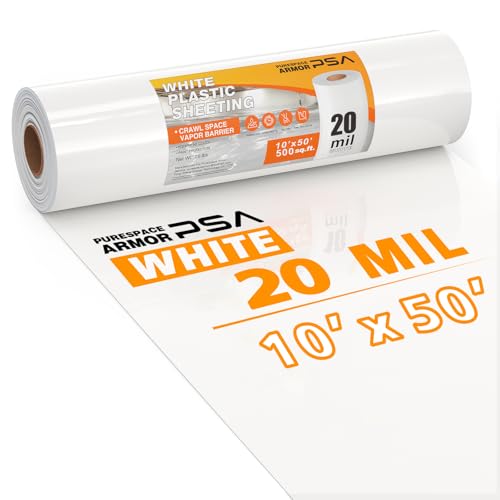 Crawl Space Vapor Barrier, 20 Mil Vapor Barrier, 10'x50', White Plastic Sheeting - Thick Plastic Sheeting, Heavy Duty Polyethylene Film, Drop Cloth Vapor Barrier Covering for Crawl Space, BasementPureSpace Armor
 Whitecap - Woven Vapor Barrier - 20 Mil (12' x 100'), Thick Plastic sheeting, Drop Cloth Moisture Barrier Covering for Crawl Space Encapsulation, Life-Time WarrantyCrawl Space DIY
Low-clearance horizontal crawl space dehumidifier with hot gas defrost and internal condensate pump
Maintains moisture removal at temperatures down to 45 degrees Fahrenheit without freezing evaporator coils.


Remote wireless thermo-hygrometer with sub-floor sensor probe and digital base station
Displays crawl space relative humidity and temperature in your living room without requiring manual entry into the crawl space.

Prices are not shown here because they change daily and we will not display a stale one. Links open on Amazon, where the current price and availability are live.
Common questions
Why does crawl space moisture get worse during summer?
Warm outdoor air holds higher volumes of water vapor than cooler sub-floor air. When that warm air enters open foundation vents, it contacts cool foundation walls, ductwork, and floor joists. As the air temperature drops toward its dew point, moisture condenses on the wood. Summer ventilation increases moisture rather than drying the space.
What thickness of vapor barrier does building code require?
The International Residential Code (IRC) section R408 specifies a minimum 6-mil polyethylene vapor retarder for ground coverage in unvented crawl spaces. However, standard 6-mil plastic tears easily during maintenance work. Building science professionals recommend 12-mil to 20-mil reinforced sheeting for lasting durability and reliable ground isolation.
Can I use a regular basement dehumidifier in my crawl space?
Standard residential basement dehumidifiers fail in crawl spaces because they lack low-temperature defrost mechanisms and horizontal airflow ports. Crawl space ambient temperatures frequently drop below 60 degrees Fahrenheit, so standard dehumidifier coils quickly ice over. Dedicated crawl space units use horizontal airflow, hot gas bypass defrost, and integrated condensate pumps.
Should I remove crawl space ceiling insulation when encapsulating?
You should remove existing subfloor batt insulation if the fiberglass is wet, compressed, or contaminated with mold. Wet fiberglass holds moisture against wooden subflooring and accelerates wood rot. Once the crawl space is encapsulated and conditioned, insulation belongs on the exterior foundation stem walls rather than between the floor joists.
What should you do first if standing water is in the crawl space?
Remove all standing water and correct exterior perimeter drainage before installing an interior vapor barrier. Clear clogged roof gutters, extend downspouts at least 5 feet from foundation walls, and ensure soil slopes away from the perimeter. If high groundwater persists, install an interior perimeter trench and a sealed sump pump system.