Mail-in laboratory tests prove water safety, while electronic monitors track indoor air dynamics. Instant test strips and petri dishes give fast impressions, but they lack the sensitivity required to detect dangerous contaminants at health-based thresholds. Chemical hazards require different detection methods.
A thorough home water and air test kit comparison shows that bundling different diagnostic tools into a single consumer package compromises accuracy. Water testing evaluates stationary chemical compounds and microbial pathogens that require sterile sampling and benchtop mass spectrometry. Air testing evaluates moving targets. Gases and airborne particulates fluctuate constantly based on ventilation rates, occupant activities, outdoor weather, and indoor combustion sources.
Testing requires matching the tool to the target. Before spending money on diagnostics, you must determine whether your primary concern involves chronic chemical ingestion, acute respiratory irritation, or radioactive soil gas. Choosing the wrong diagnostic tool delivers a false sense of security while leaving household hazards unmeasured.
Mail-In Water Kits Deliver Certified Quantities
Certified laboratory analysis is the gold standard for drinking water verification. When you send a sample to an accredited facility, technicians utilize inductively coupled plasma mass spectrometry and gas chromatography. These instruments measure heavy metals, volatile industrial solvents, and synthetic compounds down to trace concentrations. For example, the Environmental Protection Agency (EPA) sets the regulatory action level for lead in public drinking water systems at 15 parts per billion (ppb). Detecting lead at that trace level requires benchtop laboratory instruments that can isolate individual dissolved metal ions.
Physical water samples remain stable when collected according to standard protocols. A laboratory test gives you an exact numerical concentration for each target analyte, comparing your water directly against federal safety limits. If you suspect chemical contamination or lead leaching from aging plumbing, consult our guide on which water test answers your question to select an appropriate laboratory panel.
Laboratory panels do require patience. You must collect cold first-draw water, package the bottles securely, and ship the parcel to the facility. Results typically arrive by email within five to ten business days. This processing delay is the primary tradeoff of laboratory testing. However, the resulting analytical report provides legally defensible data that municipal utilities and filtration specialists recognize.
Rapid Dip Strips Miss Low Contaminant Levels
Colorimetric paper test strips provide immediate visual readings at home, but their sensitivity is severely limited. These strips rely on chemical dye reagents embedded in paper pads that change shade when contacting specific ions. Matching a wet strip against a printed color card involves subjective visual interpretation under inconsistent room lighting.
Paper pads cannot resolve trace concentrations. While a paper strip may signal severe copper corrosion at parts per million (ppm), it frequently fails to show toxic lead at parts per billion (ppb). The Centers for Disease Control and Prevention (CDC) warns that no safe blood lead level exists for children. Relying on a coarse paper strip for drinking water toxicity creates dangerous false negatives.
Cross-reactivity errors are common. High mineral hardness or unusual water pH can suppress the expected chemical reaction on a contaminant pad. Handheld electronic conductivity pens present similar diagnostic limitations. As we explain regarding why a TDS meter is not a safety test, measuring dissolved minerals reveals nothing about toxic synthetic chemicals. Pathogens and synthetic pesticides conduct no electrical current.
- Visual color matching introduces human interpretation errors.
- Detection thresholds sit far above chronic health danger limits.
- Chemical cross-reactivity causes false negative readings.
- Test strips cannot culture or identify live bacterial species.
Digital Monitors Map Real-Time Air Fluctuations
Continuous electronic monitors represent the proper method for tracking indoor air quality. Unlike drinking water, which stays relatively uniform inside pressurized pipes, indoor air is an open and dynamic environment. Pollution levels shift rapidly throughout the day. Particulate concentrations surge during cooking, spike when outdoor traffic increases, and drop when ventilation fans run. A one-time spot test cannot record these transient pollution waves.
Modern consumer air devices use laser scattering to count fine particulate matter (PM2.5). The World Health Organization (WHO) specifies a 24-hour guideline threshold of 15 micrograms per cubic meter for fine particulate matter. Optical sensors draw room air through a dark sensing chamber, pulsing light against passing particles to log concentration trends. Before selecting hardware, review our analysis of which air quality sensors are worth paying for to understand component accuracy.
Electronic monitors also track ventilation performance. Non-dispersive infrared sensors measure ambient carbon dioxide, while metal-oxide sensors track volatile organic compounds. To establish an effective testing routine, follow a practical order for testing air at home rather than purchasing random gadgets. Continuous data logging exposes the specific activities that degrade your indoor breathing environment.
Comparing Water and Air Testing Technologies
Diagnostic tools differ fundamentally in their operational mechanisms, analytical turnaround times, and detection limits. Direct comparison demonstrates that no single test kit can evaluate both water and air hazards. The targets require separate diagnostic approaches.
| Testing Technology | Target Hazards | Turnaround Time | Measurement Precision | Primary Operational Limitation |
|---|---|---|---|---|
| Mail-In Water Laboratory Panel | Heavy metals, synthetic chemicals, nitrates, bacteria | 5 to 10 business days | Certified down to parts per billion | Requires sterile collection and delayed shipping |
| In-Home Water Test Strips | Gross hardness, free chlorine, pH, high iron | Under 5 minutes | Qualitative or semi-quantitative parts per million | Fails to detect toxic contaminants at health limits |
| Continuous Optical Air Monitor | Fine particulate matter (PM2.5), carbon dioxide | Instant real-time stream | Quantitative micrograms and parts per million | Requires regular baseline calibration and power |
| Passive Radon Charcoal Canister | Radioactive radon-222 soil gas | 3 to 7 days including lab analysis | Quantitative picocuries per liter | Sensitive to humidity and temperature fluctuations |
| Petri Dish Settle Plate | Viable environmental mold spores | 48 to 96 hours incubation | Non-quantitative colony growth | Cannot measure spore concentration or total air volume |
Selecting an environmental test requires matching instrument precision to the physical behavior of each hazard. Water contaminants remain dissolved in stable liquid volumes, making them well suited for high-precision chemical extraction in a certified testing facility. Airborne hazards require continuous temporal logging because opening an exterior door or running an exhaust fan changes room air concentrations within minutes.
Settling Plates Cannot Quantify Mold Hazards
Gravity settling petri dishes cannot assess household fungal hazards or indoor air safety. These kits instruct you to leave an open agar plate on a tabletop for an hour, seal the dish, and wait for fungal growth. Within days, fuzzy mold colonies almost always appear.
Mold spores exist naturally in every indoor and outdoor environment. The Environmental Protection Agency (EPA) notes that mold spores are ubiquitous in outdoor air and will settle onto any exposed nutrient gel. Growth on an open agar plate proves only that your room contains ambient air. It reveals nothing about the actual concentration of airborne spores.
Reliable mold investigation requires calibrated volumetric air sampling. Certified industrial hygienists pull a measured volume of air across an adhesive collection slide using a regulated vacuum pump. A qualified laboratory technician then counts the captured spores under a light microscope. As we explain in our review of what a petri dish mold test can and cannot tell you, uncalibrated gravity dishes lack air volume measurement entirely. Heavy spores fall rapidly onto the plate, while dangerous lightweight spores remain suspended. This settling bias skews the sample and produces unwarranted homeowner anxiety.
Radon Detection Requires Extended Exposure Periods
Radon detection follows completely different diagnostic rules than everyday chemical or biological screening. Radon is an odorless, invisible radioactive gas that enters buildings from decaying uranium in underlying rock. The Environmental Protection Agency (EPA) establishes an action level of 4.0 picocuries per liter of air for indoor radon exposure.
Soil gas infiltration fluctuates constantly. Atmospheric pressure drops, heating system operation, and high winds draw varying amounts of gas upward through foundation cracks. A rapid spot check cannot determine true radiological risk. Standard initial screening utilizes activated carbon canisters deployed for two to four days. The Environmental Protection Agency (EPA) specifies that short-term charcoal radon tests must remain deployed undisturbed for 48 to 96 hours under closed-building conditions. The porous charcoal adsorbs radioactive gas, which an accredited laboratory measures using gamma scintillation detectors.
Continuous electronic monitors and long-term alpha-track detectors deliver deeper diagnostic insight. Alpha-track films record microscopic damage tracks left by decaying alpha particles over three to twelve months. To compare these methodologies before testing, consult our breakdown of short-term, long-term and continuous radon testing for proper deployment protocols.
Turnaround Time and Sample Handling Determine Data Quality
Sample handling protocols dictate the analytical validity of any environmental test report. A test result is only as dependable as the preservation of the sample during transport. Microbial drinking water testing requires strict cold-chain handling. Bacteria die quickly in unchilled sample bottles. The Environmental Protection Agency (EPA) mandates a 30-hour maximum hold time between water collection and laboratory incubation for coliform bacteria. Shipping a water sample without ice packs over a warm weekend produces false negative readings.
Chemical water testing demands specialized collection vials. Testing for volatile chemicals requires filling glass bottles with zero headspace to prevent volatile compounds from outgassing into air bubbles.
Electronic air monitors require sensor stabilization. Metal-oxide gas sensors must operate for 24 to 48 hours to reach proper thermal equilibrium. Skipping this initial conditioning phase triggers erratic baseline measurements.
Prioritizing Environmental Tests in a Home
Testing every environmental parameter simultaneously generates unnecessary expense and confusion. You must prioritize hazards by clinical severity. Invisible, odorless threats with chronic health risks deserve your immediate diagnostic focus.
Begin your assessment with drinking water and radon gas. The Environmental Protection Agency (EPA) notes that homes built before the 1986 Safe Drinking Water Act lead ban frequently contain plumbing joined by lead solder. A certified laboratory lead test confirms whether heavy metals leach into your morning drinking water. Deploy a short-term radon test in your lowest living space during the winter heating season. To plan your diagnostic sequence, review our checklist on what to test first when you move into a home for a logical order.
Address moisture and air quality after completing structural chemical tests. The Environmental Protection Agency (EPA) recommends maintaining indoor relative humidity between 30 and 50 percent to inhibit biological growth. A simple digital hygrometer tracks humidity effectively. Pair humidity tracking with a continuous particulate monitor to evaluate everyday cooking and cleaning impacts.
What to Buy for This
Each entry below is a specification rather than a single model, because stock and pricing on this equipment change constantly. The products shown are what currently matches that specification. Match the spec, then buy whatever meets it.
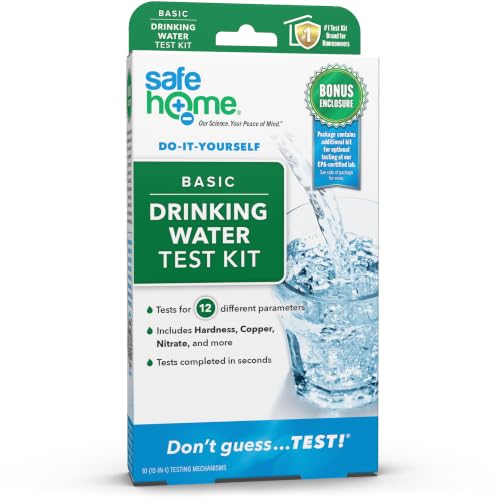
Mail-in drinking water test kit analyzed by an EPA-certified laboratory using standard methods
Certified laboratory analysis detects dissolved heavy metals like lead and biological pathogens at parts-per-billion thresholds that chemical test strips miss completely.

Indoor air quality monitor with laser optical PM2.5 sensor and real-time digital logging
Laser particle counting provides continuous, minute-by-minute measurements of respirable dust and combustion soot rather than non-quantitative settling plates.


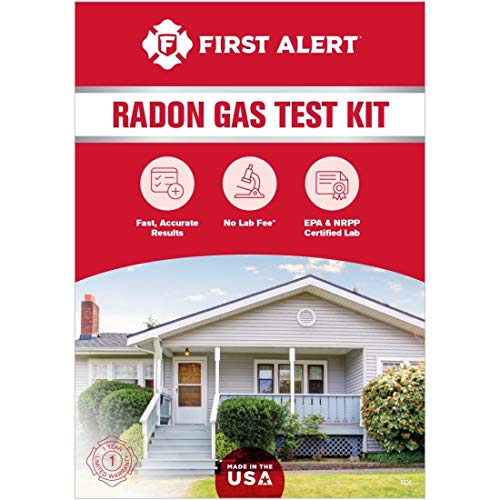
Short-term activated charcoal radon test kit with included laboratory analysis fees
Charcoal adsorption canisters meet EPA measurement protocols for standard 48-hour closed-building screening without requiring electronic sensor calibration.

Prices are not shown here because they change daily and we will not display a stale one. Links open on Amazon, where the current price and availability are live.
Common questions
Can one home test kit check both water and air quality?
No single consumer kit can reliably test both water and air quality. Water testing requires sterile liquid containment and benchtop laboratory mass spectrometry, whereas air testing requires real-time optical or continuous electrochemical sensors. Products claiming to bundle both media into one package rely on inaccurate paper test strips and non-quantitative settle plates.
How accurate are DIY drinking water test strips compared to lab testing?
Home drinking water test strips are qualitative screening tools with low precision compared to certified laboratories. Strips can confirm high water hardness or free chlorine levels, but they fail to detect toxic lead or synthetic pesticides at parts-per-billion safety limits. An accredited environmental laboratory is necessary to verify whether tap or well water meets federal health standards.
How long does an accurate home radon test take?
An initial short-term radon test requires a minimum of 48 to 96 hours under closed-house conditions. The Environmental Protection Agency (EPA) advises that windows and exterior doors remain closed throughout the testing window to prevent false dilution. Long-term alpha-track detectors remain deployed for 90 to 365 days to capture seasonal heating and weather variations.
Are petri dish mold test kits accurate for home testing?
Petri dish mold test kits are inherently inaccurate for evaluating indoor health risks. The Environmental Protection Agency (EPA) notes that mold spores exist in all outdoor and indoor air, meaning viable mold will grow on any exposed agar dish. These gravity settle plates cannot measure airborne spore concentrations or identify whether indoor mold amplification is occurring.
What should I test first in an older house?
In a newly purchased or older house, test for radon gas and drinking water lead first. Both contaminants are completely invisible and odorless, yet both carry severe, well-documented long-term health risks. You can evaluate everyday particulate matter and ventilation levels later with a continuous digital monitor.
What is the difference between a water TDS meter and a contaminant test?
A total dissolved solids (TDS) meter measures electrical conductivity to estimate the total quantity of dissolved mobile minerals in water. It cannot distinguish between beneficial dietary minerals like calcium and toxic heavy metals like lead or arsenic. A water sample can have a low TDS reading and still carry lethal concentrations of lead, pesticides, or microbial pathogens.