The best dehumidifier is the one sized for your room moisture load. Water removal capacity and operating temperature determine performance long before brand names enter the discussion. Buying an undersized machine leaves your space damp while driving up electric bills. Compressors run constantly when capacity falls short.
Indoor air holds moisture based on temperature and local water sources. The Environmental Protection Agency (EPA) recommends keeping indoor relative humidity (RH) between 30 percent and 50 percent to prevent mold germination. High humidity damages wood framing and invites dust mites. The Environmental Protection Agency (EPA) notes that air feels heavy and clammy above 60 percent relative humidity.
Sizing equipment correctly stops moisture damage before spores take hold. Drying requirements center on extraction rate, drainage style, and coil freeze protection. Before spending money, determine whether your dampness comes from everyday air or bulk liquid water leaking through the foundation.
Capacity Standards Changed How Units Are Rated
Testing metrics shifted several years ago. In 2019, the Department of Energy (DOE) updated the portable dehumidifier testing standard to reflect realistic basement conditions. The older Association of Home Appliance Manufacturers (AHAM) baseline measured water extraction at 80 degrees Fahrenheit and 60 percent relative humidity (RH). Basements rarely reach that 80-degree mark.
The updated Department of Energy (DOE) protocol tests equipment at 65 degrees Fahrenheit and 60 percent relative humidity (RH). Because cooler air holds less water vapor, published capacity numbers dropped across every brand category. A machine previously advertised as a 70-pint unit now carries a 50-pint rating under current Department of Energy (DOE) rules.
Old 50-pint models became 35-pint models without any physical change to internal components under those Department of Energy (DOE) testing revisions. Old 30-pint models now list as 20 to 22 pints under Department of Energy (DOE) certification tables. Always verify the rating standard. When sizing a room, make sure you are reading current Department of Energy (DOE) pints per day (PPD) ratings. Consulting our guide on dehumidifier sizing helps translate square footage into these current extraction figures.
| Historical AHAM Rating (80°F) | Current DOE Rating (65°F) | Typical Water Removal Capacity |
|---|---|---|
| 70 Pints Per Day | 50 Pints Per Day | High-capacity extraction for large or wet basements |
| 50 Pints Per Day | 35 Pints Per Day | Moderate capacity for average damp living areas |
| 30 Pints Per Day | 20 to 22 Pints Per Day | Light moisture removal for small bedrooms or laundry rooms |
Match Extraction Rates to Room Size and Moisture Levels
Room size only tells half the story. Moisture entry rates dictate how hard equipment must work. The Association of Home Appliance Manufacturers (AHAM) categorizes residential moisture loads into damp, very damp, wet, and extremely wet conditions. A damp space feels clammy and carries a musty odor only during humid summer weather. An extremely wet room has visible water weeping from concrete walls or standing on the slab.
According to Association of Home Appliance Manufacturers (AHAM) sizing tables, a moderately damp 500-square-foot space requires a machine rated for roughly 10 pints per day. That same 500-square-foot room under extremely wet conditions demands at least 25 pints per day under current Department of Energy (DOE) criteria. Buying larger capacity helps. Larger coils pull water faster.
A 50-pint unit cycles off once the room reaches your target, while an undersized 22-pint unit runs continuously. Shorter run times reduce motor heat and extend component lifespans. Targeting the ideal humidity in your house prevents structural wood decay. If your space only experiences minor seasonal spikes, exploring how to lower humidity in a room using natural ventilation might reduce your capacity requirement.
- Damp conditions: Space feels humid and smells musty only during wet weather.
- Very damp conditions: Musty smells linger constantly and walls feel cool and clammy.
- Wet conditions: Moisture beads visibly on cold surfaces and floors show dark water stains.
- Extremely wet conditions: Standing water or floor seepage remains present after rain storms.
How to Choose the Best Dehumidifier for Cold Spaces
Cold air complicates refrigeration cycles. Standard compressor dehumidifiers cool internal metal coils below the surrounding air temperature. Water vapor condenses on those chilled surfaces and drips into a reservoir. When room temperatures drop below 65 degrees Fahrenheit, coil temperatures dip below freezing according to Department of Energy (DOE) test data.
Frost forms on the coils. According to the Department of Energy (DOE), ice buildup restricts airflow and halts moisture collection entirely. Basic units shut down the compressor while running the fan to melt coil ice. This passive defrost cycle wastes electricity while extracting zero moisture.
Cold spaces demand active defrosting. Hot gas bypass routes hot refrigerant vapor directly back into the evaporator coil. Ice melts in seconds. The compressor keeps working. For subgrade living areas and utility zones, choosing a specialized basement dehumidifier with low-temperature capability prevents ice lockup.
Running a basic warm-weather unit in a 55-degree basement causes solid ice blocks to form across the evaporator fins, according to Department of Energy (DOE) appliance guidelines. The compressor overheats because restricted airflow starves the refrigeration loop, risking early motor burnout.
Drainage Methods Determine Daily Maintenance Requirements
Water needs an exit. Every pint of vapor pulled from indoor air becomes liquid water inside the machine cabinet. Portable units provide three ways to manage this collected liquid: internal buckets, gravity hoses, and integrated condensate pumps.
Internal collection buckets hold between 0.8 and 2.0 gallons of water, according to Association of Home Appliance Manufacturers (AHAM) consumer appliance data. According to Association of Home Appliance Manufacturers (AHAM) run-time metrics, a 50-pint unit operating in a saturated basement fills a two-gallon bucket in less than ten hours. Full buckets trip shutoff switches. Dehumidification stops until a human dumps the bucket.
Gravity drainage bypasses the bucket using standard garden hose threading. Water flows naturally downward into a floor drain or sump pit. The hose cannot slope upward. Any rise in the hose causes water to back up into the internal pan.
Units equipped with internal condensate pumps push water vertically through small-diameter plastic tubing. The Department of Energy (DOE) notes that continuous drainage maintains target moisture levels without interruption. Pumps overcome elevation hurdles. They discharge water into overhead plumbing, utility sinks, or through exterior rim joists. Managing condensation directly prevents humidity in basements from rebounding overnight.
Operating Costs Depend on Efficiency Metrics
Electricity consumption adds up quickly. A portable dehumidifier running continuously pulls between 400 and 700 watts of electrical power, based on Department of Energy (DOE) appliance testing. Efficiency is rated using the Integrated Energy Factor (IEF). The Department of Energy (DOE) measures the Integrated Energy Factor (IEF) in liters of water removed per kilowatt-hour (L/kWh) of electricity consumed. Higher numbers mean lower utility bills.
Under federal standards established by the Department of Energy (DOE), portable units removing 50 pints or less must achieve an Integrated Energy Factor (IEF) of at least 1.57 liters per kilowatt-hour. High-capacity units removing more than 50 pints per day must reach an Integrated Energy Factor (IEF) of at least 1.90 liters per kilowatt-hour according to Department of Energy (DOE) rules. Large units run more efficiently. Because large coils provide more surface area for condensation, they pull more liquid per watt. Reviewing dehumidifier running costs reveals that running an efficient 50-pint model often costs less than running a strained 20-pint model.
When Equipment Cannot Fix the Underlying Moisture Problem
Mechanical extraction has clear limits. A dehumidifier removes moisture from indoor air, but it cannot fix exterior water intrusion. If your foundation leaks during rainstorms, running consumer equipment is like bailing a boat with an open hull breach. Groundwater seepage introduces gallons of liquid every hour. No portable unit can keep up with active slab flooding.
Open dirt crawl spaces also evaporate huge volumes of ground moisture into the framing above. According to building science research cited by the Environmental Protection Agency (EPA), an unsealed dirt crawl space can release up to 10 gallons of water vapor daily into a home. In those environments, a standard portable unit burns out while electric bills climb. Completing crawl space encapsulation and pairing it with a dedicated crawl space dehumidifier seals out earth moisture before mechanical drying begins.
Equipment cannot replace plumbing repairs. This machinery will not solve active pipe leaks, unmanaged roof runoff, or missing downspouts. Fix exterior grading before spending money on machines. If ambient room temperatures drop below 45 degrees Fahrenheit for extended periods, standard compressor dehumidification fails according to Department of Energy (DOE) refrigeration data. At those sustained cold temperatures, desiccant wheel systems become necessary because they absorb water chemically without condensing it on metal coils.
Proper Placement and Maintenance Maintain Airflow
Airflow dictates moisture capture. A dehumidifier cannot dry air that never passes across its coils. Most equipment manuals following Association of Home Appliance Manufacturers (AHAM) guidelines specify leaving at least 12 to 18 inches of open clearance around intake grills and exhaust ports. Shoving a cabinet against a wall restricts airflow and starves the fan. Stagnant air pockets form in far corners.
Pairing equipment with a separate digital hygrometer allows you to confirm that relative humidity stays uniform across the room. Place the sensor away from the dehumidifier exhaust to measure true room conditions. Maintenance keeps coils clean. Air filters trap household dust, pet hair, and lint before particles reach wet evaporator fins.
According to Association of Home Appliance Manufacturers (AHAM) maintenance recommendations, washable intake screens require cleaning every two to three weeks during active use. A clogged filter reduces airflow, raises coil temperature, and drops the water extraction rate. Wash the screen with warm water and mild soap. Allow the mesh to dry completely before reinserting it into the cabinet.
According to Association of Home Appliance Manufacturers (AHAM) equipment guidelines, checking the drain hose every six months prevents blockages. Flushing the line with a diluted vinegar solution clears out algae buildup. Measuring your room dimensions and moisture severity gives you the baseline to select the best dehumidifier specification for your home.
What to Buy for This
Each entry below is a specification rather than a single model, because stock and pricing on this equipment change constantly. The products shown are what currently matches that specification. Match the spec, then buy whatever meets it.
50-pint portable dehumidifier with built-in condensate pump and low-temperature auto-defrost
A 50-pint capacity under current Department of Energy (DOE) ratings handles heavy moisture loads up to 1,200 square feet. The internal condensate pump pushes water through vertical tubing to a sink or overhead drain line, eliminating manual bucket emptying. Auto-defrost keeps coils clear when ambient basement temperatures drop toward 50 degrees Fahrenheit according to Department of Energy (DOE) operational criteria.


35-pint portable dehumidifier with continuous gravity drainage and multi-speed quiet fan
A 35-pint capacity meets Department of Energy (DOE) standards for moderately damp spaces up to 800 square feet. Lower fan speeds keep motor sound manageable in living rooms or home offices while maintaining air circulation. A standard threaded gravity port allows continuous discharge into a nearby floor drain without pump noise.

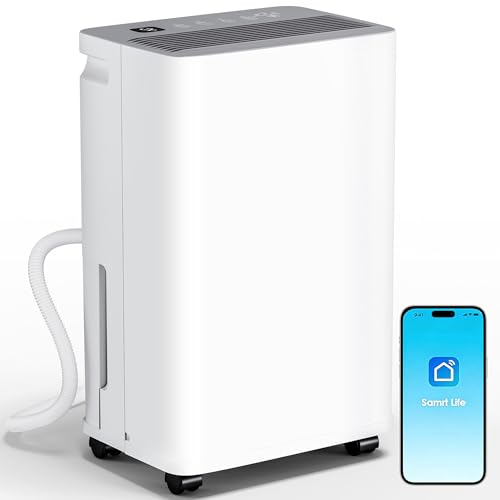
20-pint to 22-pint compact compressor dehumidifier with top-facing air exhaust
Rated at 20 to 22 pints under Department of Energy (DOE) guidelines, this compact chassis fits tight footprints under 400 square feet. Top-discharge airflow accelerates localized moisture drying after showers without blowing cool air directly across beds or seating. Integrated carry handles simplify moving the unit between laundry rooms and closets.
 Frigidaire 22-Pint Portable Dehumidifier with Wi-Fi and Energy Star Certification for Small/Medium Rooms, Bedrooms & Bathrooms, Custom Humidity Control, Auto Shut Off, WhiteFrigidaire
 Tenergy Sorbi 1000ml Air Dehumidifier w/Purifying Function, True HEPA Filter, Auto Shutoff, Touch Control Adjustable Air Speed, Ultra-Quiet, Ideal for Closets & BathroomsTenergy
50-pint low-temperature dehumidifier with hot gas bypass defrost cycle
Standard units ice over below 65 degrees Fahrenheit, but active hot gas bypass cycles keep the evaporator clear down to 40 degrees Fahrenheit based on Department of Energy (DOE) cold-climate metrics. The refrigeration circuit extracts moisture in unheated garages, workshops, and stone foundations where conventional passive defrost cycles stall.
Prices are not shown here because they change daily and we will not display a stale one. Links open on Amazon, where the current price and availability are live.
Common questions
What size dehumidifier do I need for a 1,000-square-foot basement?
A 1,000-square-foot basement requires a 50-pint dehumidifier under current Department of Energy (DOE) standards. If the foundation shows wet patches or visible condensation, that high-capacity rating provides the necessary extraction reserve. Choosing 50 pints allows the compressor to cycle off periodically, which saves electricity compared to a smaller unit running continuously.
Why do new dehumidifier pint ratings look lower than older models?
In 2019, the Department of Energy (DOE) updated testing standards from 80 degrees Fahrenheit down to 65 degrees Fahrenheit at 60 percent relative humidity. Because cooler air holds less water vapor, equipment removes fewer pints of water during test periods. An old 70-pint machine is identical in physical capacity to a modern 50-pint machine.
Can I leave a dehumidifier running all the time?
You can leave the machine plugged in continuously as long as you set the built-in humidistat to a target level. The Environmental Protection Agency (EPA) recommends maintaining indoor relative humidity between 30 percent and 50 percent. The internal humidistat cycles the compressor off automatically once room air reaches your selected target.
Do I need a built-in pump on a dehumidifier?
You need an internal pump only if you must move wastewater upward into a sink, washing machine standpipe, or window exit. If your room features a floor drain or sump pit at ground level, a simple gravity hose handles drainage without an electric pump. Internal collection buckets require daily manual emptying and shut the machine off when full.
What happens if a dehumidifier is too small for the room?
An undersized machine runs continuously without ever dropping the air to your target relative humidity. Continuous operation drives up electric bills, generates excess motor heat, and wears out internal compressor components prematurely. The Environmental Protection Agency (EPA) warns that mold spores continue to germinate if indoor relative humidity remains above 60 percent.
At what temperature does a dehumidifier stop working?
According to Department of Energy (DOE) appliance guidance, standard compressor dehumidifiers begin frosting their coils when ambient temperatures drop below 65 degrees Fahrenheit, and units without active defrost freeze solid below 50 degrees Fahrenheit. Spaces colder than 45 degrees Fahrenheit require desiccant wheel technology rather than refrigerant coils, according to Department of Energy (DOE) refrigeration benchmarks.