A sediment filter removes suspended dirt, rust, and sand before water reaches appliances. It stops physical grit from grinding down plumbing valves and clogging expensive downstream cartridges. Water utilities and private wells deliver water with varying amounts of insoluble solids. These mineral specks, pipe scale flakes, and silt grains travel through distribution pipes until an obstruction catches them. Without a dedicated sediment filter at the service entrance, your water heater, washing machine valves, and sink aerators act as that obstruction.
Grit destroys plumbing hardware. When sand lodges in a ceramic disc faucet, the seal scores and drips constantly. When silt enters a water heater tank, it settles onto heating elements and creates an insulating blanket that accelerates tank failure. The damage happens quietly over months. A basic mechanical stage catches these particles at the property boundary where cleaning or replacing a cartridge takes minutes.
Standards set by NSF International (NSF) and the American National Standards Institute (ANSI) define mechanical filtration performance. Specifically, NSF/ANSI Standard 42 establishes evaluation protocols for particulate reduction in drinking water treatment systems. The standard verifies that a cartridge traps a specified percentage of particles within a targeted size range without leaching harmful chemical binders into the water stream.
Micron Ratings Determine What Suspended Grit Gets Stopped
A micron rating defines the diameter of the smallest particle that a filter medium can physically trap. Manufacturers describe particle retention using either nominal or absolute ratings. A nominal rating indicates that the medium traps roughly 85 percent of particles at that stated dimension. Irregular channels let some larger particles slip through under pressure surges. An absolute rating means the filter captures at least 99.9 percent of particles of that size under standardized test conditions. For household pre-filtration, nominal ratings provide reliable protection against plumbing abrasion.
Selecting the right pore rating involves balancing capture efficiency against water flow. A tight pore size restricts flow. When you install a 1-micron filter directly on a main service line without coarse stages ahead of it, the cartridge fouls within weeks. For most municipal connections, a 5-micron rating captures pipe scale without strangling shower pressure. Private wells with loose sandy soil often require a coarse 50-micron stage before stepping down to 5 microns.
| Particle Type | Typical Size in Microns | Required Filter Rating |
|---|---|---|
| Coarse sand | 50 to 100 microns | 50-micron screen or spin-down separator |
| Fine sand and grit | 20 to 50 microns | 20-micron surface or depth cartridge |
| Pipe scale and rust flakes | 5 to 20 microns | 5-micron depth cartridge |
| Fine silt and clay | 1 to 5 microns | 1-micron dual-gradient cartridge |
Melt-Blown Polypropylene Handles Depth While Pleated Fabric Maximizes Flow
Depth cartridges trap particles across the full thickness of their walls, whereas surface cartridges capture debris exclusively on an outer face. Spun or melt-blown polypropylene cartridges represent the workhorse of depth filtration. Manufacturers blow molten plastic fibers into a dense cylinder that features tighter pores near the core and looser fibers on the exterior. This graded density allows large debris to settle in outer layers while finer silt travels inward before lodging. Depth filters hold large volumes of varied grit before losing pressure. You discard them when full.
Pleated cartridges use folded sheets of polyester or cellulose wrapped around a rigid plastic core. Folding creates an expansive surface area within a compact housing. High surface area translates to minimal pressure drop across high water flow demands. Pleated cartridges excel when water carries uniform sand grains rather than sticky clay. Because debris rests on an exposed outer sheet, you can often pull the cartridge, hose off heavy grit, and reinstall it once or twice before disposal.
- Melt-blown polypropylene resists chemical degradation and prevents bacterial growth on synthetic fibers.
- Pleated polyester delivers the lowest initial pressure loss for homes requiring peak flow rates above 15 gallons per minute.
- String-wound cartridges offer economical pre-filtration but can experience particle bypass if pressure spikes spread the yarn.
Standard Filter Housings Prevent Costly Proprietary Replacements
Standard water filter housings use universal dimensions that accept drop-in replacement cartridges from any manufacturer. Proprietary twist-lock filter designs lock you into buying high-priced branded cartridges. Standard cylindrical sumps eliminate that lock-in. A heavy-duty blue or opaque plastic housing mounts to wall studs with a steel bracket, sealing the cartridge inside with a rubber O-ring and threaded collar.
Housings come in two primary diameters and two standard lengths. Slim housings measure 2.5 inches in diameter and handle point-of-use duties under sinks or inside motor homes. Whole-house applications require large-diameter housings measuring 4.5 inches across, commonly called Big Blue housings. A 10-inch by 4.5-inch housing supports modest flow, while a 20-inch by 4.5-inch housing handles busy households with multiple simultaneous bathrooms.
Clear plastic sumps allow quick visual inspection of dirt accumulation, but they degrade under direct sunlight and can support algae growth indoors under persistent ambient light. Install opaque blue or black housings for permanent whole-house service, especially in basements or utility rooms with daylight.
Dissolved Contaminants Require Dedicated Chemical and Membrane Treatment
A sediment filter cannot remove dissolved minerals, chemicals, heavy metals, or microscopic pathogens. Physical sieves only stop particles that remain suspended in water. Dissolved minerals pass straight through. Calcium and magnesium ions that cause scale pass through unhindered. If you want to eliminate scale buildup on fixtures, you must install an ion-exchange water softener to extract dissolved rock.
Similarly, chlorine, industrial solvents, and synthetic per- and polyfluoroalkyl substances (PFAS) require activated carbon adsorption. Lead and dissolved heavy metals require specialized kinetic degradation fluxion media or reverse osmosis membranes. The Centers for Disease Control and Prevention (CDC) emphasizes that mechanical sediment filters do not disinfect water and cannot remove viruses or bacteria.
Run a comprehensive water test kit before building your plumbing train to verify whether your problems stem from insoluble grit or dissolved chemicals. An expensive reverse osmosis system will foul in months if coarse grit cuts its delicate synthetic membranes.
Pressure Drop Signals When a Cartridge Reaches Total Exhaustion
A noticeable decrease in household water pressure provides the most reliable indication that a filter cartridge has filled with trapped grit. Flow rate drops as pores fill. When silt bridges the gaps between fibers, water must squeeze through increasingly tight channels. Most households notice this restriction first at top-floor showers or when two faucets run simultaneously. Pushing a blinded cartridge beyond its capacity can cause depth media to channel or collapse under plumbing pressure, dumping accumulated debris into downstream pipes.
Replacing cartridges on a strict calendar often leads to waste or plumbing neglect. A household on a clean municipal main might run a large cartridge for nine months before pressure dips. A home on a shallow private well might plug a cartridge in six weeks after heavy rain. Reading our guidance on how often to change your filter outlines how gallon usage dictates maintenance intervals.
Install dual pressure gauges on either side of the housing. When the difference between the inlet pressure and the outlet pressure exceeds 10 to 15 pounds per square inch (PSI), replace the cartridge. Leaving a damp filter cartridge in place past twelve months creates sanitation risks even if pressure remains adequate, as trapped organic matter can support biofilm formation.
Spin-Down Separators Clear Heavy Sand Before Fine Cartridges Clog
A spin-down separator uses centrifugal motion and gravity to shed heavy grit before raw water reaches fine filter cartridges. Fine filter media blind rapidly when exposed to coarse well sand. Sand settles by gravity. A spin-down separator houses a reusable stainless steel screen inside a clear plastic bowl. Incoming water enters tangentially, spinning around the chamber so heavy particles drop toward the bottom reservoir while clear water exits the top.
Flushing out the collected sediment takes seconds. You open a ball valve at the bottom of the bowl for five seconds, allowing water pressure to purge the trapped sand through a small drain tube. Homes drawing from private aquifers should consult our overview on well water filter configurations to establish an orderly pre-filtration sequence. Placing a spin-down separator ahead of your primary cartridge extends the lifespan of expensive disposable elements by months.
How to Position a Sediment Filter in a Complete Plumbing Train
A whole house sediment filter belongs as the very first mechanical fixture immediately following the main water shutoff valve. Every downstream water treatment stage benefits from clean, grit-free water. Installing a sediment stage ahead of carbon filters keeps porous carbon blocks from coating in mud. Placing it before an ion-exchange softener prevents sand from abrading delicate internal control valves. The Environmental Protection Agency (EPA) notes that physical sediment can shield bacteria from ultraviolet disinfection systems, making pre-filtration essential ahead of UV chambers.
Plumbing the stage correctly requires isolation valves and an intentional bypass pipe. A three-valve bypass manifold allows you to isolate the filter housing during cartridge changes while keeping water flowing to the home if a maintenance task runs long. When designing a complete whole house water filter installation, always provide at least two feet of vertical clearance below the housing to permit unscrewing the sump.
- Shut off the main municipal water supply valve and open lowest household faucets to relieve plumbing pressure.
- Splice into the incoming cold water line after the meter and build a three-valve bypass manifold using brass ball valves.
- Anchor a steel mounting bracket securely into wall framing studs to support the weight of a water-filled housing.
- Thread pressure gauges into the inlet and outlet ports of the housing cap using polytetrafluoroethylene tape.
- Lubricate the housing O-ring with food-grade silicone grease, drop in the cartridge, and hand-tighten the sump.
- Crack the inlet valve slowly while depressing the red pressure-relief button until all air escapes the chamber.
Install dual pressure gauges on your plumbing line to monitor differential pressure and determine the exact replacement schedule for your sediment filter.
What to Buy for This
Each entry below is a specification rather than a single model, because stock and pricing on this equipment change constantly. The products shown are what currently matches that specification. Match the spec, then buy whatever meets it.
20-Inch by 4.5-Inch Big Blue Filter Housing with 5-Micron Melt-Blown Polypropylene Cartridge
A high-capacity depth cartridge captures rust flakes and municipal pipe scale with minimal pressure drop across high household flow demands.


Spin-Down Sediment Filter with 50-Mesh Stainless Steel Screen and Manual Purge Valve
Centrifugal action sheds heavy sand grains into a cleanable bottom sump without requiring cartridge replacements after heavy rains.


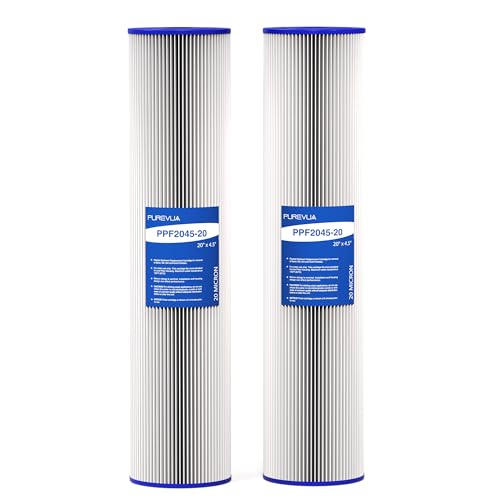
20-Inch by 4.5-Inch Pleated Polyester Sediment Cartridge Rated at 20 Microns
Washable pleated polyester maximizes surface area to maintain flow rates up to 20 gallons per minute in homes running multiple fixtures simultaneously.

10-Inch by 2.5-Inch Standard Housing with 5-Micron Spun Polypropylene Filter
Compact universal sizing protects under-sink drinking water stages and refrigerator lines without taking up excessive cabinet floor space.


Prices are not shown here because they change daily and we will not display a stale one. Links open on Amazon, where the current price and availability are live.
Common questions
Can a sediment filter make hard water soft?
No, a sediment filter cannot remove the dissolved calcium and magnesium minerals that make water hard. It only captures physical, undissolved particles like sand, silt, and rust flakes. To treat hardness, you need an ion-exchange water softener that swaps mineral ions for sodium or potassium.
How do you know when to replace a sediment filter?
A drop in household water pressure is the clearest indicator that a sediment cartridge is full. When the pressure differential across the housing exceeds 10 to 15 pounds per square inch, the pores have filled with debris. You should also replace any cartridge that has been in service for twelve months to prevent microbial growth.
Can you wash and reuse a sediment filter cartridge?
Only pleated polyester or stainless steel screen cartridges can be rinsed and reused. Melt-blown and spun polypropylene depth cartridges trap particles deep inside their fiber matrix, making thorough cleaning impossible. Forcing water backward through a depth cartridge damages the fiber structure and causes particle bypass.
What micron size is best for whole house filtration?
A 5-micron cartridge offers the best balance between particulate capture and water flow for most homes on municipal supplies. It stops visible silt and rust without causing a noticeable drop in shower pressure. Homes on sandy well water should start with a 50-micron pre-filter before stepping down to a 5-micron stage.
Does a sediment filter reduce water pressure?
A properly sized, clean sediment filter causes a negligible pressure loss of less than two pounds per square inch. Significant pressure loss occurs only when the cartridge becomes clogged with debris or if you select an undersized housing for your home's water demand. Choosing a 4.5-inch diameter cartridge preserves flow rates for high-demand plumbing.