An air purifier for nursery spaces protects infant lungs from airborne particles and chemical fumes. The machine should run quietly while clearing the room several times each hour. Infants breathe faster than adults. The World Health Organization (WHO) reports that children breathe twice as much air per pound of body weight as adults do. That physical reality makes clean indoor air important during early development.
A small purifier struggling on high speed produces sharp fan whine. That noise disrupts infant sleep. The better approach is buying a unit rated for a larger space. Running that larger fan on its quietest setting moves enough air while keeping the room peaceful.
This equipment is not suitable for fixing active water intrusion or existing wall mold. If your home has roof leaks or wet drywall, repair the building envelope first. What would change this is an existing central HVAC system equipped with a high-efficiency media filter that runs continuously. When a central system cannot deliver four fresh air changes per hour to the bedroom, a dedicated room unit fills the gap.
Oversizing the Fan Keeps Decibels Below Infant Sleep Thresholds
Running a larger air cleaner at its lowest fan speed delivers adequate clean air without exceeding safe sleep decibel limits. Sound matters in a baby room. The American Academy of Pediatrics (AAP) recommends that background noise in infant environments remain below 50 A-weighted decibels (dBA) to avoid auditory stress and sleep disruption. Most air cleaners meet that standard only on their first or second fan speeds.
On high speed, small purifiers frequently generate 55 to 65 dBA according to manufacturer acoustic disclosures. That volume resembles a loud conversation. It easily wakes a light sleeper. When you place a unit right at its rated room capacity, you must run the motor on high to achieve rated cleaning performance. That leaves you choosing between noisy air cleaning and quiet, dirty air.
Oversizing solves the dilemma. Under Association of Home Appliance Manufacturers (AHAM) test guidelines, a unit rated for 300 square feet cleans a 120-square-foot room effectively on its lowest setting. On low speed, quality fans operate between 22 and 32 dBA based on manufacturer laboratory ratings. That volume sounds like rustling leaves. It stays well under the threshold recommended by pediatricians while gently circulating fresh air.
Sizing an Air Purifier for Nursery Bedrooms Requires Real Airflow Numbers
Clean air delivery rate measures the precise volume of filtered air an appliance delivers each minute. You should ignore advertised square footage numbers on product packaging. Manufacturers often calculate room size coverage based on only one or two air exchanges per hour. For healthy respiratory environments, the Environmental Protection Agency (EPA) recommends achieving at least 4 to 5 air changes per hour (ACH).
To calculate required airflow, look for clean air delivery rate (CADR) numbers certified by the Association of Home Appliance Manufacturers (AHAM). The Association of Home Appliance Manufacturers (AHAM) applies a standard rule where an air cleaner smoke CADR rating should equal at least two-thirds of the room area in square feet. For a standard 120-square-foot nursery with eight-foot ceilings, that formula calls for a minimum smoke CADR of 80 cubic feet per minute (CFM) under Association of Home Appliance Manufacturers (AHAM) guidelines.
Because you will run the unit on low speed, double that baseline target. Aim for a smoke CADR of at least 160 CFM on maximum speed based on standard oversizing practices. That overhead ensures that dropping the fan to its quiet lowest setting still produces the 80 CFM needed for consistent room filtration. Learn more about matching room dimensions to performance ratings in our guide to air purifier CADR ratings and our walkthrough on sizing an air purifier for any room.
| Operating Setting | Relative Airflow | Sound Output Disclosed by Manufacturers | Nursery Sleep Suitability |
|---|---|---|---|
| High Speed | 100% of Certified CADR | 55 to 65 dBA | Too loud for sleep. Use for rapid room clearing before bedtime |
| Medium Speed | 50% to 65% of Certified CADR | 38 to 48 dBA | Borderline volume. Acceptable for daytime play periods |
| Low or Sleep Speed | 25% to 40% of Certified CADR | 22 to 30 dBA | Ideal for sleep. Whisper quiet with minimal auditory impact |
True HEPA Captures Fine Particulates Without Producing Secondary Ozone
Mechanical fibrous filters capture microscopic airborne particles without producing harmful chemical byproducts. The filtration mechanism relies on physical interception, impaction, and diffusion. Under United States Department of Energy (DOE) standards, a certified high-efficiency particulate air (HEPA) filter captures at least 99.97 percent of particles down to 0.3 microns in size. This includes dust mite debris, pet dander, mold spores, and combustion particles from wildfire smoke. You can read our detailed breakdown of HEPA filter specifications to see what the rating guarantees.
Infant respiratory pathways are narrow. Their bronchial tissues react strongly to chemical oxidants. You must avoid purifiers that rely on electronic ionization, bipolar ionization, or plasma generators.
The California Air Resources Board (CARB) certifies air cleaners to ensure ozone emissions stay below 0.050 parts per million (ppm). Even small traces of ozone can irritate vulnerable infant lungs. Mechanical HEPA filters emit zero ozone. They contain no energized plates or ionizing needles. Air simply passes through dense pleated fabric, leaving clean air behind.
Activated Carbon Pellets Remove Volatile Chemicals from New Furniture
Granular activated carbon media adsorbs hazardous gaseous compounds that pass directly through particulate filters. Nurseries frequently contain higher concentrations of synthetic chemicals than other rooms in the home. Fresh paint, new crib mattresses, glues in engineered wood changing tables, and synthetic area rugs all release vapors into the room.
The Consumer Product Safety Commission (CPSC) cautions that pressed wood furniture releases formaldehyde gas, a volatile organic compound (VOC) that irritates eyes and respiratory tracts. Standard HEPA material cannot trap gas molecules. Vapors travel straight through the fibrous mesh.
Only activated carbon binds these compounds through molecular adsorption. Check the filter structure before purchasing. Inexpensive replacement filters use a thin polyester mat sprayed with carbon dust. That thin scrim contains under two ounces of carbon and saturates within two weeks according to filter media engineering benchmarks. Air cleaning equipment standards recommend looking for a filter canister holding at least one to two pounds of pelletized activated carbon. Our guide on furniture and carpet off-gassing outlines how long new materials emit vapors.
Display Lights and Electronic Noise Disrupt Infant Sleep Cycles
Unfiltered display panels and loud operational beeps disrupt infant sleep routines during nighttime nursery use. Modern appliances feature digital control boards covered in light-emitting diode (LED) indicator lights. Blue light from illuminated display screens suppresses melatonin production. In a dark nursery, an unshielded air quality sensor light can illuminate the entire ceiling.
Look for a unit offering a dedicated sleep mode that turns off all panel illumination. If the machine lacks an automatic display shutoff, you will need to cover the lights with opaque electrical tape.
Audible button feedback causes similar headaches. When you adjust the fan speed in the dark, a piercing electronic chime can startle a sleeping baby. Choose models that allow you to mute button sounds entirely, or select units with simple mechanical dials. Mechanical dial switches make almost no sound when toggled between settings.
Humidifiers and Purifiers Solve Completely Different Air Quality Problems
An air purifier removes solid particles and chemical gases, whereas a humidifier increases moisture levels in dry indoor air. Parents often confuse these two appliances when trying to relieve infant nasal congestion. An air cleaner uses a fan and dry media filters to pull contaminants out of the air. It adds no moisture to the room.
Conversely, a humidifier dispenses water vapor to raise relative humidity. Running both units in the same room is common, but they require careful management.
The Environmental Protection Agency (EPA) warns that ultrasonic humidifiers disperse dissolved minerals from tap water into the air as fine white dust. That mineral dust registers as particulate pollution on room sensors and can irritate a baby's lungs. If you run both appliances, use distilled water in an ultrasonic humidifier, or switch to an evaporative model that leaves minerals behind in a paper wick. See our comparison of air purifiers vs humidifiers and our review of humidifier mechanisms to understand the tradeoffs.
Placement Near the Crib Creates Chilling Drafts and Cord Hazards
Positioning an air purifier at least five feet away from the crib protects babies from cold air streams while satisfying safety distances. Proper placement requires balancing room circulation against infant physical safety. Purifiers draw air in and expel clean air at high velocity. That discharged air feels significantly cooler than ambient room temperature due to convective heat loss.
Directing a continuous draft of air into a crib can chill an infant during sleep. Point the exhaust airflow toward an open area or an adjacent wall to promote gentle air exchange throughout the room. Never blow air across the mattress surface.
Electrical cords present a severe physical hazard. Keep the machine across the room. Secure the power cord firmly against baseboards using protective cord covers. Ensure the intake grilles sit at least six inches away from walls and drapery so the fan motor does not overheat.
The Consumer Product Safety Commission (CPSC) mandates keeping electrical cords at least three feet away from all cribs and playpens to prevent strangulation. Never drape an air purifier cord over a crib railing or run it under a nursery rug where foot traffic can damage the wire insulation.
Checking Replacement Filter Availability Prevents Long-Term Maintenance Lapses
Calculating filter replacement intervals and media availability ensures continuous protection without surprise maintenance delays. A clogged filter restricts airflow. When airflow drops, air changes per hour decline, and particulate concentrations rise.
Most manufacturers specify replacing the main HEPA cartridge every 6 to 12 months based on normal residential use. Heavy dust loading or continuous smoke events can shorten that interval to 3 or 4 months. Check that the manufacturer sells genuine replacement filters reliably before you commit to a specific chassis.
Routine pre-filter cleaning preserves airflow through the inner media. Vacuum or rinse the outer mesh screen every 2 to 4 weeks according to appliance maintenance instructions. Doing so removes large hair and fiber clumps that would otherwise choke the delicate HEPA pleats. Measure your room dimensions and calculate your required airflow volume before purchasing an air purifier for nursery rooms.
What to Buy for This
Each entry below is a specification rather than a single model, because stock and pricing on this equipment change constantly. The products shown are what currently matches that specification. Match the spec, then buy whatever meets it.
A mechanical HEPA air purifier with a certified smoke CADR of at least 150 CFM, a dedicated night mode that turns off all indicator lights, and low-speed sound output below 26 dBA.
Oversizing the unit for a typical 120-square-foot bedroom allows the fan to operate on its lowest setting while still delivering five clean air changes per hour under standard ceilings. The complete display blackout prevents light disruption during sleep.
 Aircillin Air Purifiers for Home Bedroom Up to 908 Sq Ft, Air Purifiers with HEPA Filter Aromatherapy,Turbo Boost Button, Sleep Mode, WhiteAircillin
 Air Purifiers for Home Large Room up to 1200ft², LUNINO H13 True HEPA Air Purifier for Bedroom with Fragrance Function, Air Quality Sensor, Sleep Mode, Air Cleaner for Pet Dander, Odor, Dust, SmokeLUNINO
A dual-stage air cleaner featuring a certified HEPA filter combined with at least two pounds of granular pelletized activated carbon media in a sealed canister.
New cribs, glues, and fresh paint release formaldehyde and other chemical vapors that thin carbon sheets cannot adsorb. The heavy carbon bed binds volatile organic compounds over several months of continuous operation.


A large-capacity console air cleaner with a smoke CADR of at least 250 CFM, mechanical switch controls, and brushless direct current motor design.
Larger rooms require substantial air movement to circulate filtered air into remote corners. The efficient brushless motor maintains whisper-quiet airflow below 30 dBA across large floor plans without high electrical draw.

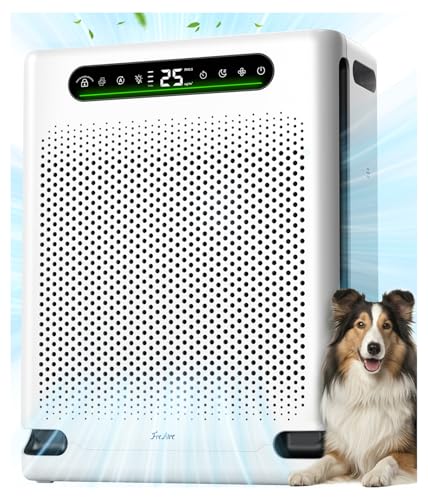
Prices are not shown here because they change daily and we will not display a stale one. Links open on Amazon, where the current price and availability are live.
Common questions
Can you leave an air purifier running continuously in a nursery?
Yes, running an air purifier continuously provides the most stable air quality. Continuous operation prevents particulate levels from rebounding when outdoor dust or indoor activities release fresh particles. Running the unit constantly on low speed also maintains consistent white noise that helps mask sudden household sounds.
Does an air purifier help with infant congestion?
An air purifier reduces congestion caused by airborne irritants like pollen, pet dander, and fine dust. It removes physical particulate triggers that inflame nasal passages. However, it will not resolve congestion caused by viral colds, dry indoor air, or anatomical narrowness. If congestion persists, consult your pediatrician for an accurate medical evaluation.
Are ionizing air cleaners safe for a baby room?
No, you should never use an ionizing air purifier in an infant bedroom. Electronic ionizers and plasma generators create trace amounts of ozone gas as an operating byproduct. The California Air Resources Board (CARB) regulates consumer ozone emissions, but even minimal ozone exposure can irritate sensitive infant respiratory tracts. Stick entirely to mechanical HEPA and carbon filtration.
How close should the air purifier be to the crib?
Keep the air cleaner at least five to six feet away from the crib. The Consumer Product Safety Commission (CPSC) requires keeping all electrical cords at least three feet away from cribs to avoid strangulation hazards. Placing the unit several feet away also prevents cool discharge air from blowing directly onto your sleeping child.
How often should you replace filters in a nursery air purifier?
Replace the primary HEPA filter every 6 to 12 months according to the manufacturer schedule. If your unit includes a separate activated carbon canister, replace it every 6 months to maintain volatile chemical adsorption. Vacuum or rinse the washable mesh pre-filter every 2 to 4 weeks according to appliance maintenance instructions to keep larger dust from choking airflow through the fine inner media.