The right dehumidifier size depends on floor area and how damp the space feels. Most residential rooms require a unit rated between 20 and 50 pints per day based on Association of Home Appliance Manufacturers (AHAM) test guidelines. The Environmental Protection Agency (EPA) recommends maintaining indoor relative humidity (RH) between 30 percent and 50 percent to prevent mold growth.
Moisture load varies with room use. A laundry room or basement pulls moisture from damp masonry walls and wet clothes. If you notice persistent damp smells or see condensation on windows, you need to calculate daily pint removal before purchasing equipment.
Buying an undersized unit leaves humidity high. Buying an oversized machine wastes power and cycles on and off too quickly to pull moisture effectively. Checking your space with an accurate hygrometer gives you the baseline data needed to match equipment capacity to your room.
The 2019 Department of Energy Standards Changed Capacity Ratings
The Department of Energy (DOE) testing standard reduced official daily pint ratings across all residential dehumidifiers in 2019. Before 2019, manufacturers tested portable machines at 80 degrees Fahrenheit and 60 percent relative humidity (RH) under guidelines from the Association of Home Appliance Manufacturers (AHAM). The Department of Energy (DOE) updated testing rules to 65 degrees Fahrenheit and 60 percent relative humidity (RH) to reflect cooler basement conditions.
Cooler air holds less moisture. Because testing at 65 degrees provides less moisture for coils to condense under Department of Energy (DOE) test criteria, portable machines received lower pint numbers without losing physical capacity. According to the Department of Energy (DOE) standards, an older 70-pint machine matches the performance of a 50-pint unit sold after 2019.
Under current Department of Energy (DOE) labels, older 50-pint units now carry ratings of 30 or 35 pints per day (PPD). The same Department of Energy (DOE) rules reclassified older 30-pint models to 20 or 22 pints per day (PPD). Comparing modern ratings against older advice requires adjusting for this regulatory shift.
| Pre-2019 Rating (80 Degrees F) | Current DOE Rating (65 Degrees F) | Typical Space Application |
|---|---|---|
| 30 Pints Per Day | 20 to 22 Pints Per Day | Small bedrooms and offices up to 500 square feet |
| 50 Pints Per Day | 30 to 35 Pints Per Day | Medium living areas and damp spaces up to 1,000 square feet |
| 70 Pints Per Day | 50 Pints Per Day | Large open basements and wet areas up to 1,500 square feet |
Square Footage Combined With Moisture Severity Determines Capacity
Calculating the capacity you need begins by measuring the floor area and categorizing the moisture condition. The Association of Home Appliance Manufacturers (AHAM) defines four indoor moisture levels ranging from moderately damp to extremely wet. A moderately damp room smells musty only during humid weather, while an extremely wet room has visible floor sweating or seepage.
Floor space establishes the air volume. According to Association of Home Appliance Manufacturers (AHAM) sizing tables, a 500 square foot room with moderate dampness requires 20 pints of removal daily. Those same Association of Home Appliance Manufacturers (AHAM) tables indicate that a 500 square foot area requires 30 pints daily if water seeps through walls or pools on floors.
For areas between 1,000 and 1,500 square feet, Association of Home Appliance Manufacturers (AHAM) standards recommend 30 to 50 pints per day depending on moisture severity. Moisture enters through open doors, foundation walls, and unvented shower steam. If you learn how to lower the humidity in a room through ventilation fixes, your equipment capacity requirement drops.
| Room Condition | Up to 500 Sq Ft | 500 to 1,000 Sq Ft | 1,000 to 1,500 Sq Ft |
|---|---|---|---|
| Moderately Damp (musty odor in humid weather) | 20 Pints | 30 Pints | 40 Pints |
| Very Damp (constant musty odor, damp spots) | 25 Pints | 35 Pints | 45 Pints |
| Wet (water beads on walls, damp floor) | 30 Pints | 40 Pints | 50 Pints |
| Extremely Wet (standing water, floor sweating) | 35 Pints | 45 Pints | 50+ Pints |
Cooler Basements Require Larger Coils and Auto Defrost Controls
Operating a dehumidifier in cold air reduces its moisture removal rate and causes evaporator coils to freeze. Refrigerant coils must stay colder than the surrounding dew point to condense water vapor into liquid droplets. When ambient air drops below 65 degrees Fahrenheit, coil temperatures dip below freezing and form frost layers under standard Association of Home Appliance Manufacturers (AHAM) operating curves.
Frost blocks airflow. Without active defrost controls, ice insulates the coil and stops moisture collection completely. According to the Department of Energy (DOE), standard portable units lose up to half their rated capacity below 60 degrees Fahrenheit.
Selecting a specialized basement dehumidifier with hot-gas bypass or automatic defrost protects performance in cold seasons. Building science guidelines from the Department of Energy (DOE) recommend sizing up by 10 to 15 pints to compensate for capacity lost in unheated rooms. The Department of Energy (DOE) notes that maintaining temperatures above 60 degrees Fahrenheit helps standard compressors run efficiently.
Standard residential dehumidifiers stop removing moisture when room temperatures drop below 60 degrees Fahrenheit. If your space stays cold, look for units equipped with an automatic defrost cycle or low-temperature operation rated down to 41 degrees Fahrenheit.
Water Removal Calculations Follow Air Changes per Hour
Engineering standards determine dehumidification needs by calculating room volume and required air circulation rates. The American Society of Heating, Refrigerating and Air-Conditioning Engineers (ASHRAE) uses air changes per hour (ACH) to measure air turnover in enclosed spaces. To control indoor moisture, the American Society of Heating, Refrigerating and Air-Conditioning Engineers (ASHRAE) guidelines specify between three and six air changes per hour (ACH) depending on moisture load.
Calculate volume by multiplying floor area by ceiling height. Under American Society of Heating, Refrigerating and Air-Conditioning Engineers (ASHRAE) volume calculations, a 1,000 square foot basement with an eight-foot ceiling contains 8,000 cubic feet of air. At an American Society of Heating, Refrigerating and Air-Conditioning Engineers (ASHRAE) circulation rate of four air changes per hour (ACH), a unit must circulate 32,000 cubic feet of air every 60 minutes.
Divide that hourly volume by 60 minutes to find required continuous airflow. That 8,000 cubic foot space requires a blower pushing roughly 533 cubic feet per minute (CFM) according to American Society of Heating, Refrigerating and Air-Conditioning Engineers (ASHRAE) ventilation formulas. Fan capacity matters just as much as refrigeration coil size when drying large or partitioned rooms.
Choosing the Right Dehumidifier Size Prevents Short Cycling
Choosing the right dehumidifier size prevents premature compressor wear and avoids sustained indoor moisture spikes. An undersized compressor runs continuously without reaching the 50 percent relative humidity (RH) target recommended by the Environmental Protection Agency (EPA). Continuous operation wears out mechanical relays and increases electricity bills without solving the moisture problem.
Oversizing creates the opposite issue. A massive unit strips moisture rapidly from the air immediately surrounding its intake sensor and shuts off. Rapid on-and-off cycling leaves distant corners damp and wears down internal compressor capacitors.
Properly matched units run in steady cycles lasting 20 to 30 minutes under Association of Home Appliance Manufacturers (AHAM) cycling benchmarks. Steady runtime pulls air evenly across the entire space and keeps relative humidity (RH) within the ideal humidity range. Check your room dimensions carefully before selecting equipment.
Active Water Infiltration Overwhelms Mechanical Removal Capacity
A portable dehumidifier cannot resolve active water leaks, exterior grading problems, or unsealed crawl spaces. Mechanical dehumidification removes airborne water vapor but cannot keep pace with liquid water entering through foundation cracks. According to the Environmental Protection Agency (EPA), drying liquid water intrusions requires fixing the source within 24 to 48 hours to prevent mold growth.
Equipment cannot fix structural failure. If bare dirt floors in your foundation pull ground water upward, look into crawl space encapsulation rather than buying larger appliances. Similarly, dirt crawl spaces often need a dedicated crawl space dehumidifier built with sealed housings and corrosion-resistant components.
The Environmental Protection Agency (EPA) advises extending roof downspouts at least five feet away from foundation walls to stop basement seepage. Stop liquid intrusion first before spending money on compressor capacity. If structural waterproofing stops ground moisture, your required daily pint capacity drops dramatically.
Continuous Drainage Methods Determine Real Daily Performance
A dehumidifier only removes moisture while its collection tank has room to hold water. According to Association of Home Appliance Manufacturers (AHAM) specifications, portable collection buckets hold between one and two gallons of water, equivalent to 8 to 16 pints. Under Department of Energy (DOE) test rates, a 50-pint machine operating in a very damp room fills a standard bucket in less than eight hours.
Full buckets trigger automatic shutoff switches. When the float switch engages, compressor operation stops until someone empties the reservoir. Leaving a machine unattended with a full reservoir allows indoor moisture levels to rebound throughout the day.
Continuous gravity hoses require a floor drain situated lower than the machine outlet. If your space lacks a floor drain, select a model with an integrated internal condensate pump capable of pushing water upward to a sink or window.
Reviewing our guide to the best dehumidifiers helps you match drainage mechanics to your room layout. Once you determine your floor area and dampness level, select the correct dehumidifier size before moisture damages drywall or framing.
Work out the dehumidifier capacity this space needs
Capacity is rated in pints of water removed per day. The two things that decide it are the floor area and how wet the space actually is. Temperature matters too, because a compressor unit loses capacity as the room gets colder.
An estimate for shopping, not a load calculation. Capacity ratings changed in 2019 when the US test condition moved from 80F to 65F, so an older 70-pint unit and a current 50-pint unit can remove a similar amount of water. Compare units by the same rating year, and if the space has bulk water entering it, no dehumidifier of any size is the fix.
What to Buy for This
Each entry below is a specification rather than a single model, because stock and pricing on this equipment change constantly. The products shown are what currently matches that specification. Match the spec, then buy whatever meets it.
A 20- to 22-pint portable dehumidifier with an adjustable humidistat and continuous gravity drain port
Removes sufficient daily moisture for rooms up to 500 square feet without drawing excessive electricity or causing rapid cycling in smaller rooms.


A 30- to 35-pint portable dehumidifier with automatic defrost controls and washable air filter
Handles moderate to heavy humidity in spaces up to 1,000 square feet while preventing coil frost when temperatures dip.

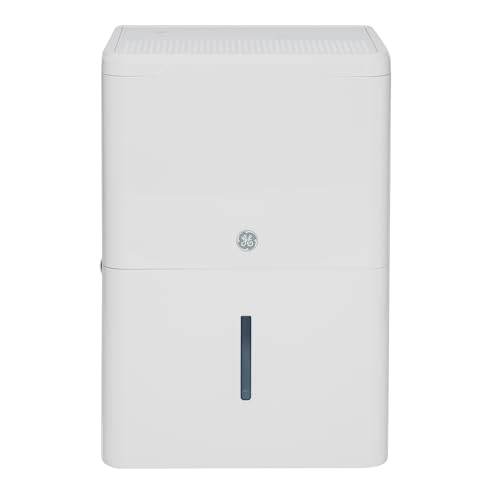
A 50-pint portable dehumidifier featuring an integrated condensate pump and digital relative humidity display
Delivers maximum residential removal capacity under current Department of Energy standards and pumps water vertically to an overhead drain or sink.


A 70- to 100-pint commercial-grade horizontal dehumidifier with hot-gas bypass defrost and hardwired duct collars
Maintains continuous moisture extraction at temperatures down to 40 degrees Fahrenheit where standard residential compressors freeze up.


Prices are not shown here because they change daily and we will not display a stale one. Links open on Amazon, where the current price and availability are live.
Common questions
What size dehumidifier do I need for a 1,000 square foot space?
A 1,000 square foot space requires a 30- to 35-pint dehumidifier under current Department of Energy (DOE) standards for moderate dampness. If the space has wet walls or sweating floors, choose a 50-pint unit instead. Units sized below 30 pints will run continuously in a space of this size without reaching target humidity.
What happens if a dehumidifier is too large for the room?
An oversized dehumidifier short-cycles by drying the air around its sensor too quickly and shutting down before circulating air from distant corners. This rapid on-and-off cycling causes higher electrical spikes and accelerates mechanical wear on the compressor. Sizing the machine accurately ensures longer, continuous runtimes that dry the entire room evenly.
Why did dehumidifier pint ratings change after 2019?
The Department of Energy (DOE) updated testing standards in 2019 from 80 degrees Fahrenheit down to 65 degrees Fahrenheit at 60 percent relative humidity (RH). Because cooler air holds less moisture, portable dehumidifiers pull fewer pints per day during testing. Modern 50-pint units remove the same volume of water as older models labeled 70 pints.
Does ceiling height affect the required dehumidifier size?
Yes, ceiling height changes the total volume of air your equipment must circulate. Sizing charts from the Association of Home Appliance Manufacturers (AHAM) assume standard eight-foot ceilings. If your room has ten-foot or twelve-foot ceilings, multiply your square footage by 1.25 or 1.5 to find your effective room size before selecting a pint rating.
Can one dehumidifier dry multiple connected rooms?
A single portable dehumidifier can only dry multiple rooms if interior doors remain open and airflow circulates freely between them. Closed doors isolate moisture loads, leaving unconditioned rooms damp regardless of equipment capacity. For divided layouts with persistent moisture, placing two smaller units or installing a whole-house system provides better humidity balance.
What relative humidity level should I set on my dehumidifier?
The Environmental Protection Agency (EPA) recommends setting your dehumidifier between 30 percent and 50 percent relative humidity (RH). Settings above 50 percent allow dust mites and mold spores to multiply on organic building materials. Settings below 30 percent waste electricity and can cause wooden furniture or flooring to crack.