An air conditioner removes moisture only when cooling the air down to its setpoint. A dehumidifier targets water vapor directly and leaves the room at its original temperature. Both appliances use the same compression cooling loop. They pull air across cold metal coils to condense liquid water out of the air stream. The mechanical divergence lies in where the captured heat goes. An air conditioner vents heat outside the house. A dehumidifier returns that heat right back into the living space. Choosing between a dehumidifier vs air conditioner comes down to matching the machine to your room temperature.
Sensible cooling lowers the temperature registered by a standard thermometer. Latent cooling removes the invisible water vapor suspended in the air. An air conditioner prioritizes sensible cooling. Its mechanical controls focus on air temperature rather than humidity levels. When the room reaches the thermostat target, the refrigeration compressor turns off. Any leftover humidity remains trapped in the living space. A dedicated dehumidifier operates on a humidistat that tracks relative humidity instead of degrees.
The Environmental Protection Agency (EPA) recommends maintaining an ideal humidity range between 30 percent and 50 percent. According to the Centers for Disease Control and Prevention (CDC), moisture levels exceeding 60 percent encourage rapid mold spore germination and dust mite proliferation. High humidity also makes warm rooms feel hotter because sweat cannot evaporate from human skin. Keeping moisture within safe boundaries protects building materials and respiratory health. Knowing whether to buy cooling or moisture extraction depends entirely on room temperature and seasonal weather patterns.
Both Machines Share the Same Refrigeration Cycle
Compressor-based cooling systems rely on four primary hardware components. These are the compressor, condenser coil, expansion valve, and evaporator coil. Refrigerant loops continuously through these parts. The compressor pressurizes cool refrigerant gas into a hot, high-pressure vapor. That vapor moves into the condenser coil. Air blowing over the condenser strips heat away, turning the vapor into warm liquid. The phase change drives the system.
Liquid refrigerant then shoots through an expansion valve into low pressure. Its temperature drops instantly below freezing. The frigid fluid enters the evaporator coil directly in the room air stream. A fan draws humid air across the cold aluminum fins. Moisture condenses against the chilled metal. Water drips into a collection pan. The warmed refrigerant boils back into vapor and returns to the compressor to repeat the cycle.
Condenser Coil Placement Determines Net Room Temperature
Condenser location governs whether a room cools down or warms up. An air conditioner is a split system. Its evaporator sits indoors, but its condenser sits outside the house or vents through an exterior exhaust hose. Heat drawn from the room gets dumped straight into the outdoor air. The building loses thermal energy. Room temperature falls as a result.
A dehumidifier houses both coils inside one cabinet. Room air passes over the cold evaporator first, losing water vapor to condensation. That cold air passes immediately over the hot condenser coil mounted directly behind it. The condenser returns the extracted heat right back into the room. The compressor motor also adds its own electrical heat to the discharge air. According to the Department of Energy (DOE), this electrical draw converts directly into sensible room heat. A running dehumidifier will warm room air by 3 to 5 degrees Fahrenheit. It cannot chill a space.
Thermostats Shut Off Cooling Long Before Moisture Clears
Thermostats measure sensible air temperature, not airborne water vapor. When indoor air hits the thermostat setpoint, the cooling compressor shuts down. Moisture extraction stops at that exact second. Any water vapor left in the air remains in the room. Oversized equipment makes this problem worse. An oversized air conditioner cools a room too fast and shuts off after ten minutes. The evaporator coil never gets enough continuous runtime to drain substantial moisture.
Relative humidity climbs as room temperature drops. Air turns cold and clammy. A digital hygrometer will show humidity spiking even as the room gets colder. A dedicated dehumidifier avoids this failure mode because its humidistat tracks relative humidity percentages instead of temperature. It continues pulling water until the air reaches your target dryness.
An oversized air conditioner drops room temperature so fast that the cooling cycle lasts only eight to twelve minutes. Moisture removal requires sustained coil contact time. Short cycling leaves relative humidity high while turning room surfaces cold, creating ideal condensation conditions along floorboards and baseboards.
Low Room Temperatures Cause Air Conditioner Coils to Freeze
Residential air conditioners struggle when room temperatures sit below 70 degrees Fahrenheit. Cold indoor air causes evaporator coil pressures to fall sharply. When coil metal drops below 32 degrees Fahrenheit, condensed moisture freezes into solid frost. Ice blocks the airflow. The refrigeration loop fails completely.
Basements naturally remain between 55 and 65 degrees Fahrenheit through the summer months. Relative humidity in these cool rooms often exceeds 70 percent due to soil moisture vapor transmission through concrete walls. High basement humidity creates musty odors and rots stored goods. An air conditioner running in a 60-degree basement will freeze its coils and chill the room into an unlivable cold cellar. Basements require dedicated dehumidifiers built with hot-gas bypass or automatic defrost cycles. Under Department of Energy (DOE) test standard Appendix X1, dehumidifiers undergo certified performance testing at 65 degrees Fahrenheit dry-bulb temperature and 60 percent relative humidity. This standard confirms the unit can extract moisture without freezing in cool basement air.
Standard consumer air conditioners lack low-ambient controls and hot-gas defrost circuits. Running cooling equipment in rooms under 65 degrees Fahrenheit damages compressor valves when liquid refrigerant migrates back through the suction line without boiling off completely.
Operating Limits of a Dehumidifier vs Air Conditioner
Operating thresholds separate air conditioners from dehumidifiers in daily household use. An air conditioner is the right tool when hot outdoor weather drives indoor temperatures and humidity up together. A dehumidifier is the right tool when the air feels wet but the room is already cool. Neither machine replaces the other. You need cooling for comfort during heat waves. You need dehumidification to stop mold when temperatures are mild.
The Association of Home Appliance Manufacturers (AHAM) verifies water extraction rates in pints per 24-hour cycle. Proper equipment selection depends on sizing a dehumidifier to the specific room square footage and moisture load. Match the machine to the thermometer reading. If room air registers 80 degrees Fahrenheit, cooling is your priority. If room air registers 66 degrees Fahrenheit with musty smells, moisture extraction is your priority.
| Operating Factor | Air Conditioner | Dehumidifier |
|---|---|---|
| Primary control sensor | Thermostat measuring air temperature in degrees | Humidistat measuring relative humidity percentage |
| Net room temperature effect | Lowers room temperature by venting sensible heat outdoors | Raises room temperature by 3 to 5 degrees Fahrenheit from motor heat |
| Minimum operating temperature | Roughly 65 to 70 degrees Fahrenheit before coil icing begins | Down to 40 degrees Fahrenheit on units equipped with auto-defrost |
| Condenser heat rejection | Outdoor air or window exhaust duct | Directly into the room being dehumidified |
| Moisture removal capacity standard | Part of sensible heat ratio rating under AHRI standards | Liters per day tested under Department of Energy Appendix X1 |
| Water disposal method | Gravity drip outside building or condensate pan over outdoor coil | Removable bucket, continuous gravity hose, or integrated pump |
Sensible Heat Ratios Dictate Which Machine Solves the Problem
The Sensible Heat Ratio (SHR) measures how an air conditioner divides its cooling energy. Sensible cooling drops the temperature shown on a thermometer. Latent cooling condenses water vapor out of the air stream. Standard residential air conditioners operate with a Sensible Heat Ratio between 0.70 and 0.80 according to the American Society of Heating, Refrigerating and Air-Conditioning Engineers (ASHRAE). This means 70 to 80 percent of the machine energy cools the air, while only 20 to 30 percent dries the air.
Low sensible heat loads create serious comfort problems in humid climates. On a rainy 72-degree day, a house needs heavy dehumidification with minimal temperature drop. An air conditioner running on such days overcools the living space before extracting enough moisture. A dehumidifier operates with an effective Sensible Heat Ratio of zero. It strips latent moisture and returns sensible heat, keeping the house warm and dry. Installing a dedicated whole house dehumidifier alongside an air handler allows you to manage humidity independently of cooling cycles.
Exterior Drainage and Ventilation Fix Moisture at the Source
Stopping moisture at the building boundary prevents high indoor humidity without running compressors. Dehumidifiers and air conditioners consume steady electric power to correct indoor air. Calculate your expected dehumidifier running costs before relying on continuous mechanical extraction. Water vapor often enters through unmanaged surface runoff, wet crawl spaces, and bathroom steam. Fixing these entry points reduces the workload on mechanical equipment.
Everyday household habits release considerable water into the air. According to the Environmental Protection Agency (EPA), normal cooking, bathing, and washing add two to three gallons of water vapor to an indoor environment every single day. Bathroom exhaust fans must vent directly outside to clear this vapor load before it spreads into wall assemblies. Learning how to lower humidity in a room through passive measures saves electricity and stops mold growth before buying new appliances.
- Extend roof downspouts at least six feet away from foundation walls to stop rainwater from saturating basement masonry.
- Slope exterior grade away from foundation perimeters at a pitch of one inch per foot across the first ten feet.
- Cover exposed dirt floors in crawl spaces with an impermeable polyethylene vapor barrier measuring at least six mils thick.
- Place a digital hygrometer in the room to measure relative humidity before deciding whether a dehumidifier vs air conditioner solves your moisture problem.
What to Buy for This
Each entry below is a specification rather than a single model, because stock and pricing on this equipment change constantly. The products shown are what currently matches that specification. Match the spec, then buy whatever meets it.
50-pint portable dehumidifier with auto-defrost sensor and internal condensate pump
Maintains continuous water extraction down to 41 degrees Fahrenheit without coil freeze-up, discharging liquid through a vertical hose into an overhead drain.
 DuraComfort 50 Pint Dehumidifier for Basement, Large Room and Home, with Drain Hose, Auto Defrost, Auto Shutoff, Humidity Control, 24H Timer, Portable Dehumidifier for High-Humidity SpacesDuraComfort
 Amazon Basics 50-Pint Large Dehumidifier with Pump, New Energy Star Certified, Humidity Control, Auto-Defrost, Timer, Overflow Protection for Rooms up to 4000 SFT, WhiteAmazon Basics
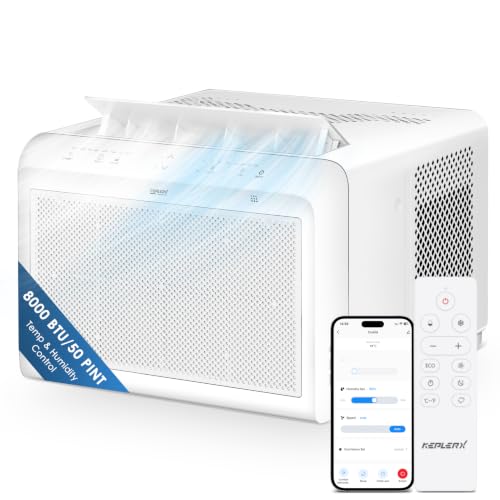
Inverter-driven variable-speed window air conditioner
Modulates compressor speed down to match low sensible heat loads, extending cycle runtimes to continuously condense water vapor without overcooling the room.

Ducted whole house dehumidifier rated for 70 to 100 pints per day
Operates independently of the central air conditioner to pull moisture from return ductwork during mild, rainy seasons when the cooling system rarely runs.
 AprilAire E070W Smart Wi-Fi Crawl Space Dehumidifier, 70-Pint Commercial Whole-House Dehumidifier for Basement, Crawlspace & Home up to 2,200 Sq. Ft. with Pump, Drain Hose, Hanging Kit, MERV 11 FilterAprilaire
 Waykar 70 Pint Energy Star Crawl Space Dehumidifier with Pump & Drain Hose for Basements, Commercial & Water Damage Spaces up to 5000 Sq. Ft., Compact, Strong Dehumidification, 5-Year Quality CoverageWaykar
Prices are not shown here because they change daily and we will not display a stale one. Links open on Amazon, where the current price and availability are live.
Common questions
Can an air conditioner replace a dehumidifier in a basement?
No. Standard air conditioners cannot operate effectively in basement temperatures below 65 degrees Fahrenheit. The evaporator coils will freeze into a solid block of ice, cutting off airflow and risking compressor damage. Cool basements require a dedicated dehumidifier equipped with auto-defrost sensors and low-temperature refrigerant circuits.
Why does the house feel cold and clammy when the air conditioner runs?
Cold and clammy air occurs when an air conditioning system is oversized for the cooling load. The oversized compressor cools the air rapidly to reach the thermostat setpoint and shuts off before the coils can condense and drain the moisture. Relative humidity climbs as air temperature falls, leaving the living space uncomfortably wet.
Does running a dehumidifier make the room warmer?
Yes. A dehumidifier releases both the heat captured from condensing water vapor and the thermal heat produced by its electric motor back into the room. This mechanical process typically raises room temperature by 3 to 5 degrees Fahrenheit during continuous operation according to the Department of Energy (DOE).
Which appliance uses more electricity to remove moisture?
An air conditioner consumes significantly more electricity overall because it runs larger blower fans and a higher-wattage compressor designed to move sensible heat out of the house. However, running an air conditioner when cooling is not required wastes energy while making occupants cold. A dehumidifier uses less overall wattage while targeting latent moisture directly.
Can you run a dehumidifier and an air conditioner at the same time?
Yes. Operating both appliances simultaneously works well in hot, exceptionally humid weather. The air conditioner handles sensible heat reduction to lower room temperature, while the dehumidifier removes excess moisture that the cooling system misses during off-cycles. Keep the dehumidifier away from the air conditioner thermostat so its warm exhaust does not trigger false cooling cycles.
What indoor humidity level should you target during summer?
Target an indoor relative humidity level between 30 percent and 50 percent according to the Environmental Protection Agency (EPA). Never allow indoor humidity to exceed 60 percent for extended periods. Sustained moisture levels above 60 percent create favorable conditions for mold growth, dust mite reproduction, and indoor allergen buildup according to the Centers for Disease Control and Prevention (CDC).