A humidifier adds moisture to dry rooms, while a dehumidifier removes excess indoor water. Choosing between a humidifier vs dehumidifier depends entirely on the current relative humidity inside your home. The target range for healthy indoor living sits between 30 and 50 percent relative humidity, according to the Environmental Protection Agency (EPA). You cannot guess this number by feel.
Indoor air changes constantly with outdoor weather shifts and structural air leakage. Winter heating strips air of moisture, causing chapped skin, nosebleeds, and dry throats. Summer weather brings outdoor humidity inside, creating damp basements, sticky surfaces, and musty odors. A single house frequently faces both problems at different points in the year.
Buying mechanical equipment without testing creates secondary hazards. Running a humidifier in an already damp room accelerates mold growth on drywall and trim. Operating a dehumidifier when relative humidity is already low wastes electricity and worsens respiratory irritation. You need objective baseline data before ordering any appliance.
A Hygrometer Reading Decides Which Appliance You Need
A digital hygrometer gives you the exact moisture percentage needed to choose the right appliance. Indoor air changes as weather patterns shift. You cannot evaluate moisture levels accurately by skin feel alone. The readout on a digital hygrometer displays relative humidity (RH), which measures the moisture content of air relative to its total holding capacity at that specific temperature.
Relative humidity changes as room temperature fluctuates, even when the absolute volume of water vapor stays identical. Warm air expands and holds more moisture, which lowers the percentage reading on your screen. When the room cools down at night, relative humidity climbs automatically. Taking readings at both midday and early morning establishes your true environmental baseline.
Readings below 30 percent mean your indoor air is excessively dry and will benefit from a humidifier. Readings above 50 percent indicate elevated moisture that demands a dehumidifier. The ideal humidity in a house sits firmly between 30 and 50 percent, as established by the Environmental Protection Agency (EPA). When your hygrometer rests inside this safe band, your home does not require either machine.
Neither appliance serves a home that already sits between 30 and 50 percent relative humidity, and occupants in balanced homes should spend nothing on mechanical moisture gear. A sudden outdoor temperature plunge or an unaddressed foundation leak will shift indoor readings overnight, flipping the recommendation from one machine to the other.
Place your hygrometer on an interior shelf at breathing height. Keep the instrument away from exterior doors, drafty windows, heating vents, and direct bathroom steam. Allow twenty minutes for the sensor to stabilize before recording baseline data.
Cold Outdoor Air Drops Indoor Moisture During Winter
Cold winter air holds very little moisture, which causes indoor humidity to plunge when heating systems run. Freezing air has a low saturation point. When cold outdoor air penetrates wall framing through natural building infiltration, your heating system warms it up to room temperature. Heating the air expands its volume without introducing any new water vapor. Relative humidity drops sharply as a result.
Indoor levels regularly drop below 20 percent in cold climates during January and February. This intense dryness leads to dry air in the house, which produces familiar winter complaints. Skin dries out, lips crack, and nasal membranes become irritated. The Centers for Disease Control and Prevention (CDC) explains that dried mucous membranes lose their ability to trap airborne pathogens effectively.
Low indoor humidity accelerates moisture evaporation from all exposed porous materials. Hardwood flooring, antique furniture, and architectural millwork release water into dry room air, causing wood fibers to contract. Noticeable floor squeaks, gaps between baseboards, and sticking interior doors frequently trace back to winter moisture loss. Maintaining 35 to 45 percent humidity cushions structural woodwork against seasonal expansion cycles.
Warm Weather and Ground Contact Create Damp Rooms
Warm outdoor air carries heavy moisture loads that condense against cool indoor surfaces during summer months. Warm air holds substantial water vapor. When warm summer air enters basements, crawl spaces, or air-conditioned living rooms, it encounters cool foundation walls and cold floor slabs. Cooling the air reduces its capacity to hold water. Relative humidity near those cool surfaces surges toward saturation.
This process causes persistent dampness, clammy air, and condensation on windows. The Environmental Protection Agency (EPA) notes that mold colonies develop on damp drywall, carpet backing, and framing lumber within 24 to 48 hours when relative humidity exceeds 60 percent. Dust mites also reproduce rapidly at levels above 50 percent. Musty smells are metabolic gases released by actively growing mold colonies.
Condensation forms when warm air contacts surfaces sitting at or below the ambient dew point temperature. In basements, uninsulated masonry walls and concrete floor slabs remain chilled by surrounding subsoil throughout the summer. When incoming summer air at 75 degrees Fahrenheit and 65 percent relative humidity touches a 58-degree basement wall, water droplets immediately bead up on the cold masonry. A dehumidifier extracts that water vapor before air reaches its local condensation threshold.
Humidifier vs Dehumidifier Operating Costs Differ Significantly
Dehumidifiers use substantially more electricity than humidifiers because they run mechanical refrigeration compressors. Power consumption varies by appliance type. A typical cool-mist evaporative humidifier uses a small fan that draws between 15 and 40 watts of electrical power. Ultrasonic humidifiers use ceramic nebulizers that operate on similarly low wattage. Only steam humidifiers consume high power, using heating elements that draw over 1,000 watts to boil water into vapor.
Conversely, portable dehumidifiers operate a full refrigeration circuit. The compressor and fan motor combine to draw between 300 and 600 watts during active moisture removal. Running a compressor unit continuously throughout a humid summer impacts your dehumidifier running cost significantly. You can minimize power consumption by selecting a unit equipped with an onboard digital humidistat that cycles the compressor off the moment the room reaches your target threshold.
Compressor dehumidifiers function by chilling an internal aluminum coil using pressurized refrigerant. Incoming humid air strikes the cold evaporator coil, causing water droplets to condense into a collector pan. The chilled air then passes over the warm condenser coil, which reheats the air slightly before exhausting it back into the room. This thermodynamic cycle consumes continuous electrical power to run the compressor pump and motor. In cold spaces below 60 degrees Fahrenheit, compressor coils can freeze over with frost, requiring specialized low-temperature sensors or desiccant dehumidification systems.
Running the Wrong Appliance Makes Indoor Air Quality Worse
Operating a humidifier or dehumidifier when moisture levels are already out of balance introduces serious indoor environmental risks. Adding humidity to an already damp room accelerates biological contamination. Mold spores germinate rapidly on organic building materials once relative humidity passes the 60 percent threshold identified by the Environmental Protection Agency (EPA). Bacterial colonies and dust mite populations expand simultaneously.
Biological contaminants require specific moisture thresholds to survive and multiply. The American Society of Heating, Refrigerating and Air-Conditioning Engineers (ASHRAE) notes that maintaining indoor relative humidity below 60 percent inhibits mold germination and dust mite populations. Dust mites cannot drink liquid water. They absorb atmospheric moisture directly through their bodies. Lowering indoor humidity below 50 percent desiccates mite colonies within weeks. On the other end, air that drops below 30 percent dries out nasal cilia, reducing your body's ability to clear airborne dust.
Conversely, running a dehumidifier in a room that is already dry strips essential moisture from your body. Dry air accelerates water loss through perspiration and respiration. Sinus passages become inflamed and dry, leaving you vulnerable to common respiratory pathogens. Excessive dryness also damages home finishes. You should review how to lower humidity in a room naturally through ventilation before running mechanical gear when conditions sit near the borderline.
Evaporative and Ultrasonic Humidifiers Introduce Different Maintenance Demands
Humidifiers require disciplined cleaning routines and appropriate water choices to avoid dispersing airborne contaminants. Different humidifier designs disperse moisture through distinct physical processes. Evaporative units use a wicking filter to draw water from a reservoir while a fan moves ambient air across the moist paper. These units are naturally self-limiting because water evaporates more slowly as surrounding air approaches saturation.
However, evaporative wicks trap waterborne minerals and require periodic replacement as mineral scale stiffens the fibers. Ultrasonic humidifiers use a high-frequency vibrating diaphragm to atomize liquid water into a fine visible fog. They run almost silently. The hazard with ultrasonic designs is that they aerosolize every mineral dissolved in the water supply. Filling an ultrasonic unit with mineral-rich tap water produces a fine white calcium dust that settles on furniture and enters lung tissue.
The Consumer Product Safety Commission (CPSC) warns that dirty humidifiers can disperse bacteria and mold into the air alongside water mist. Empty standing water daily, clean basins weekly with vinegar, and use distilled water in ultrasonic machines to protect indoor air. Our evaluation of the best humidifier details these filtration and sanitation differences across room configurations.
Compressor Dehumidifiers Require Adequate Capacity and Drainage
Selecting an effective dehumidifier requires sizing water extraction capacity to your room conditions and establishing a dependable drainage path. Extraction capacity is rated in pints per 24-hour period under test standards managed by the Department of Energy (DOE). Modern testing measures water removal at 65 degrees Fahrenheit and 60 percent relative humidity. A 20-pint or 30-pint unit manages moderately damp bedrooms and upstairs living rooms.
Damp crawl spaces and unconditioned basements require 50-pint portable units to keep pace with continuous ground moisture evaporation. Drainage logistics dictate how consistently the machine operates. Most portable units feature an internal collection bucket that holds roughly one to two gallons of condensate. The unit shuts off when this reservoir fills. Moisture levels climb again while the bucket sits full of water.
Sizing errors remain the leading cause of dehumidifier failure in residential basements. Placing an undersized unit in an 800-square-foot damp basement forces the compressor to run continuously without ever reaching the safe 50 percent threshold. Connecting a gravity drain hose or choosing a unit with an internal pump ensures uninterrupted moisture removal. Consulting our breakdown of the best dehumidifier clarifies which sizing specifications match typical home layouts.
Structural Air and Water Leaks Demand Attention Before Buying Equipment
Mechanical air treatment cannot compensate for severe building enclosure failures that continually introduce or exhaust moisture. Appliances treat room air. They do not repair leaky foundations or unsealed building assemblies. If liquid water seeps through basement masonry during heavy rain, a portable dehumidifier will run endlessly without drying the concrete. You must grade soil away from exterior foundation walls and clear roof gutters to route surface water far from the footing.
Similarly, if your house suffers from severe winter dryness, major air leakage through unsealed ceiling penetrations is driving the problem. Warm, humid indoor air rises and escapes into the attic via the stack effect. This air movement draws cold, dry outdoor air inward through lower window frames and sill plates. Air sealing attic bypasses keeps humidified air inside your living space where you need it.
Ventilation exhaust fans also play a vital role in moisture management before buying standalone appliances. In bathrooms and kitchens, localized activities release several pounds of moisture into the air during showers and cooking. Running bathroom exhaust fans during showers and for twenty minutes afterward vents humid air directly outside before it disperses into adjacent bedrooms. Inspecting exhaust duct terminations ensures that moisture generated inside exits the home permanently.
Comparing Core Specifications and Operating Differences
Comparing the core engineering and operating parameters of each appliance helps you select the correct tool for your moisture challenge. A humidifier targets air that has dried out below healthy comfort limits. A dehumidifier targets spaces where excess moisture threatens building durability and respiratory health. Review the operational criteria below before making an equipment investment.
Tracking your indoor relative humidity with a standalone hygrometer for forty-eight hours gives you the objective data needed to choose between a humidifier vs dehumidifier.
- Choose a humidifier if your digital hygrometer reads below 30 percent and family members experience dry skin, morning throat irritation, or frequent static shocks.
- Choose a dehumidifier if your digital hygrometer reads above 50 percent, basement rooms smell musty, or window panes collect interior condensation.
| Performance Factor | Humidifier | Dehumidifier |
|---|---|---|
| Operating Target | Raises relative humidity above 30 percent | Lowers relative humidity below 50 percent |
| Primary Season | Winter and early spring heating season | Summer and late spring cooling season |
| Mechanism | Evaporative wick or ultrasonic nebulizer | Refrigeration compressor and condenser coils |
| Typical Electrical Draw | 15 to 40 watts (evaporative or ultrasonic) | 300 to 600 watts (compressor-based) |
| Maintenance Focus | Wick replacement and tank disinfection | Bucket emptying and air filter washing |
| Health Target | Eases dry sinuses and skin irritation | Suppresses mold growth and dust mite colonies |
What to Buy for This
Each entry below is a specification rather than a single model, because stock and pricing on this equipment change constantly. The products shown are what currently matches that specification. Match the spec, then buy whatever meets it.
Evaporative cool-mist humidifier with paper wick filter and adjustable digital humidistat
An evaporative wick prevents mineral dust from blowing into the room and naturally regulates moisture output to avoid over-saturating cool bedroom air.
 Crane Evaporative Humidifier, Wick Filter, Dishwasher Safe Tank, UV Light, No White Dust, Whisper Quiet, Bedroom Nursery Office, 1.9L Tank, Up To 250 SQ FTCrane
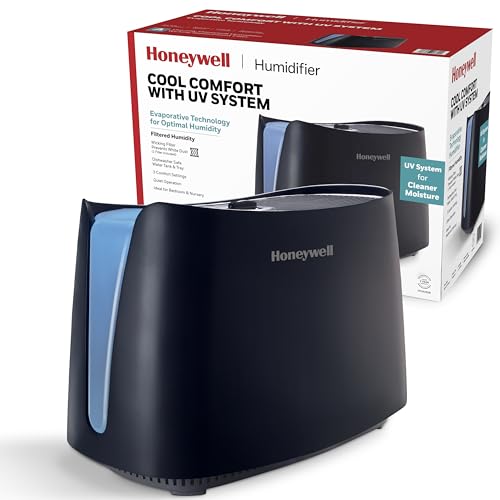 Honeywell Cool Moisture Humidifiers for Bedroom, Medium Rooms, 1.1 Gallon, Invisible Moisture Humidifier for Baby, Kids, Quiet, Easy to Clean, UV Technology, Black, HCM350BHoneywell
50-pint compressor dehumidifier with built-in condensate pump and continuous drain connection
An internal pump lifts water out through a window or into an overhead utility drain so the unit runs without shutting off when a collection bucket fills.


Large-capacity evaporative console humidifier with multi-speed fan and dual water tanks
High-volume reservoirs provide enough daily moisture output to balance multiple connected living spaces without requiring refills more than once per day.


Prices are not shown here because they change daily and we will not display a stale one. Links open on Amazon, where the current price and availability are live.
Common questions
Can you run a humidifier and a dehumidifier in the same house?
You can operate both units in the same house if they are located in different zones or run during different seasons. Many homes require a humidifier in living spaces during dry winter months and a dehumidifier in the basement during humid summers. Running both appliances simultaneously in the same room wastes electricity and forces the machines to work against each other.
What indoor relative humidity level should you target?
The Environmental Protection Agency (EPA) recommends maintaining indoor relative humidity between 30 percent and 50 percent. Keeping levels above 30 percent prevents dry mucous membranes, nosebleeds, and excessive skin dryness. Keeping levels below 50 percent prevents mold spore germination, wood rot, and dust mite proliferation.
Does an air conditioner eliminate the need for a dehumidifier?
An air conditioner removes water vapor from the air while cooling, but it only dehumidifies while the thermostat actively calls for cooling. During mild, humid spring days or in naturally cool basements, the air conditioner rarely runs long enough to lower humidity. A dedicated dehumidifier removes moisture independently of indoor temperature.
Can a humidifier cause mold growth in a home?
A humidifier will cause mold growth if it runs unchecked and pushes indoor relative humidity above 50 to 60 percent. When room air reaches high moisture levels, condensation forms on cold exterior wall surfaces, ceiling corners, and window glass. Mold spores can germinate on damp drywall paper within 24 to 48 hours.
How can you tell if air is dry or damp without a hygrometer?
Physical signs provide rough clues, though they cannot replace an objective gauge. Dry air produces static electricity shocks, cracked lips, itchy skin, and shrinking gaps between hardwood floor boards. Damp air produces musty basement odors, condensation beads on window glass, clammy bedsheets, and sticky cabinet doors.