Clean nursery air requires removing pollutant sources, exchanging stale air, and using passive mechanical filtration. That simple strategy protects infant health and improves nursery air quality faster than any electronic gadget. Infants breathe faster than adults. The Environmental Protection Agency (EPA) notes that children inhale more air per pound of body weight than adults do. Their narrow airways absorb contaminants quickly. Many parents buy ionizing purifiers, fragranced vaporizers, or complex electronic monitors under commercial pressure. Those devices create hazards. A safe nursery setup focuses strictly on what you leave out.
Infant sleeping spaces benefit from omission over additional appliances. Active electronics often inject ozone or aerosolized chemicals into quiet bedrooms. New furniture emits volatile gases. Synthetic crib mattresses release chemical compounds for weeks after unboxing. Closed doors trap exhaled breath. Carbon dioxide builds up across a twelve-hour infant sleep cycle. You can control these environmental hazards easily without purchasing expensive specialty gear.
A standard adult room tolerates slight environmental swings, as detailed in our guide to air quality where you spend eight hours a night. A nursery demands narrower boundaries. Dust and mineral particles irritate infant bronchioles. Clear benchmarks for ventilation, filtration, and moisture control protect infant lungs. You will learn which physical metrics require attention. You will also see which popular nursery appliances you should refuse to buy.
Infant Breathing Rates Increase Vulnerability to Fine Particles
Infants inhale roughly twice as much air relative to their body mass than adults, according to the Environmental Protection Agency (EPA). Newborns breathe 30 to 60 times per minute compared to 12 to 20 times for adults, according to the Centers for Disease Control and Prevention (CDC). That rate delivers contaminants deep into lung tissue. Narrow airways trap particles easily. Trapped particles trigger inflammation and restrict airflow.
Fine particulate matter under 2.5 micrometers in diameter poses severe physiological risks. The American Academy of Pediatrics (AAP) reports that early childhood exposure to fine particulates correlates with elevated rates of pediatric asthma and airway hyperreactivity. Dust mite allergens, pet dander, and outdoor combustion particles float in indoor air currents indefinitely. Babies sleep close to mattresses where settled dust continually resuspends. Keeping particle counts low protects developing lung architecture.
Managing Nursery Air Quality Begins with Source Control
Removing chemical off-gassing from furniture and textiles improves nursery air quality faster than running any filtration device. New cribs, gliders, and dressers constructed from engineered wood frequently release formaldehyde. Synthetic adhesives and foam mattresses off-gas complex Volatile Organic Compounds (VOCs) directly into the room. The Consumer Product Safety Commission (CPSC) cautions that pressed wood products release their highest concentrations of organic vapors during the first several months of use. Unboxing furniture weeks ahead eliminates that initial chemical surge. Solid wood avoids adhesives.
Textiles present a secondary source of airway irritants. Flame retardants, stain repellents, and synthetic dyes wash out over multiple laundry cycles. Wash all bedding, drapes, and clothing twice using fragrance-free detergent before placing them in the room. Avoid room sprays and synthetic deodorizers completely. Scented products release terpenes that react with ambient ozone to form secondary formaldehyde. If you wish to assess ambient organic vapor levels, you can review our assessment of what a consumer VOC sensor measures. Source removal costs nothing.
Ventilation Keeps Carbon Dioxide within Safe Thresholds
Fresh outdoor air exchange prevents carbon dioxide from accumulating in a closed nursery during overnight sleep. Exhaled breath raises ambient carbon dioxide levels rapidly in small, sealed bedrooms. ASHRAE Standard 62.2 recommends a minimum mechanical ventilation rate of roughly 7.5 cubic feet per minute per person plus 3 cubic feet per minute per 100 square feet of floor area. Shutting the nursery door tightly traps that air within hours. Stagnant air degrades sleep.
Elevated carbon dioxide impairs sleep quality and causes morning headaches. Ambient outdoor air contains roughly 420 parts per million of carbon dioxide, according to National Oceanic and Atmospheric Administration (NOAA) global monitoring data. A small nursery with a closed door often climbs past 1,500 parts per million before dawn. Leaving the nursery door cracked two inches allows hallway air to moderate that spike. Crack the exterior window slightly if household noise requires a shut door. You can track physical air exchange using tools outlined in our guide to carbon dioxide as a ventilation gauge. Fresh air dilutes exhaled gas.
Mechanical Filtration Beats Electronic Air Cleaners
Sealed High-Efficiency Particulate Air (HEPA) filters capture fine particles without generating harmful secondary byproducts like ozone. True HEPA filters capture at least 99.97 percent of airborne particles as small as 0.3 micrometers, according to Department of Energy (DOE) filtration standards. This physical mechanism removes pollen, mold spores, and combustion particles safely. The filter media traps contaminants permanently without altering room chemistry. No chemicals are added.
Electronic air cleaners present unacceptable risks in an infant bedroom. Ionizers, electrostatic precipitators, and plasma devices charge passing particles or release reactive chemical species. The California Air Resources Board (CARB) mandates that certified indoor air cleaners emit no more than 0.050 parts per million of ozone. Trace ozone irritates fragile infant lungs. Ozone also reacts with carpet fibers and surface oils to create secondary formaldehyde. Choose a purely mechanical unit using guidelines from our review of how to choose an air purifier that clears the room. A sealed housing forces all air through the filter.
Never operate air cleaners that rely on ozone, bipolar ionization, or photocatalytic oxidation in an infant room. These technologies react with organic compounds in dust to generate harmful chemical byproducts.
Relative Humidity Targets Prevent Mold and Airway Irritation
Maintaining indoor relative humidity between 30 percent and 50 percent stops mold growth while keeping infant nasal passages moist, according to the Environmental Protection Agency (EPA). Air that drops below 30 percent dries out delicate mucous membranes. Dry passages lose their defensive barrier. Conversely, humidity exceeding 50 percent enables house dust mites to multiply and creates conditions where mold colonies flourish. High moisture breeds fungus.
Infants cannot clear congested nasal passages easily. Congestion disrupts feeding. You must manage moisture with strict physical discipline. Measure ambient room moisture directly at crib height using an accurate stand-alone digital hygrometer. Never trust built-in humidifier gauges. Vapor pooling around the water tank distorts internal readings, causing machines to shut off prematurely.
| Relative Humidity Range | Physiological and Biological Impact | Recommended Room Action |
|---|---|---|
| Below 30 percent | Dry mucous membranes, cracked lips, increased viral transmission | Add evaporative cool mist to raise baseline moisture |
| 30 to 50 percent | Optimal comfort range, stable mucus barrier, mold dormancy | Maintain current ventilation and monitor with hygrometer |
| Above 50 percent | Dust mite reproduction accelerates, moisture condenses on cold glass | Increase fresh air exchange or introduce dehumidification |
| Above 60 percent | Active fungal spore germination and structural mold risk | Locate moisture sources and exhaust damp air immediately |
Ultrasonic Humidifiers Introduce Mineral Dust Hazards
Ultrasonic humidifiers aerosolize dissolved tap water minerals directly into breathable fine particulate matter. An internal metal diaphragm vibrates at ultrasonic frequencies to shatter water into micro-droplets. Every dissolved mineral enters the air stream. As those fine water droplets evaporate mid-air, they leave behind microscopic mineral dust. The dust stays airborne.
This airborne residue causes severe airway irritation in young children. The Environmental Protection Agency (EPA) notes that ultrasonic humidifiers disperse nearly all dissolved minerals from tap water directly into the ambient room air. If your tap water contains 200 parts per million of total dissolved solids, your infant breathes that pulverized rock dust all night. Parents often mistake this white powder for ordinary household dust. It is powdered rock. If supplemental moisture becomes necessary during dry winter heating, use an evaporative wick unit as detailed in our guide to why evaporative and ultrasonic humidifiers fail differently. Evaporative wicks trap minerals in the paper.
Air Quality Monitors Require Careful Interpretation
Low-cost consumer air sensors track directional ventilation trends instead of providing clinical-grade measurements. Consumer laser particle counters estimate mass concentrations by measuring light scattering across an optical chamber. These sensors detect dust surges well. They also register cooking smoke drifting from a distant kitchen. However, optical chambers cannot distinguish clean water droplets from dangerous fine combustion soot. Humidifier mist registers as toxic smoke.
Consumer chemical sensors present similar diagnostic limitations. Metal-oxide semiconductor chips track broad fluctuations in volatile compounds but cannot identify specific toxic chemicals. A sharp spike might represent harmless diaper cream or baby lotion. The sensor cannot tell the difference. Use monitors primarily to confirm that fresh outdoor air is entering the room. Learn how consumer sensors perform in our overview of which air quality sensors are worth paying for. Do not let minor sensor fluctuations create unnecessary panic.
Structural Moisture Failures Require Building Interventions
Standard nursery air management protocols do not protect infants against active structural water intrusion or persistent foundation dampness. Portable air purifiers and desktop humidifiers cannot overcome water seeping through crawl spaces or unsealed exterior walls. When foundation dampness goes unaddressed, humid basement air migrates upward through interior wall cavities into second-story bedrooms. This stack effect is explained in our guide to the whole indoor environment problem in one room and our section index covering indoor spaces. Equipment cannot fix leaking foundations.
Our advice changes if your home experiences active mold growth or severe outdoor wildfire smoke intrusions. When outdoor particulate levels spike into hazardous ranges, opening nursery windows introduces dangerous combustion soot. In that specific scenario, seal the windows, run mechanical HEPA filtration continuously, and tolerate elevated carbon dioxide levels until outdoor air clears. For chronic foundation dampness, stop buying portable room appliances. Hire a licensed contractor to seal the building envelope. Place a calibrated digital hygrometer at crib height tonight to verify your baseline nursery air quality before buying any equipment.
What to Buy for This
Each entry below is a specification rather than a single model, because stock and pricing on this equipment change constantly. The products shown are what currently matches that specification. Match the spec, then buy whatever meets it.
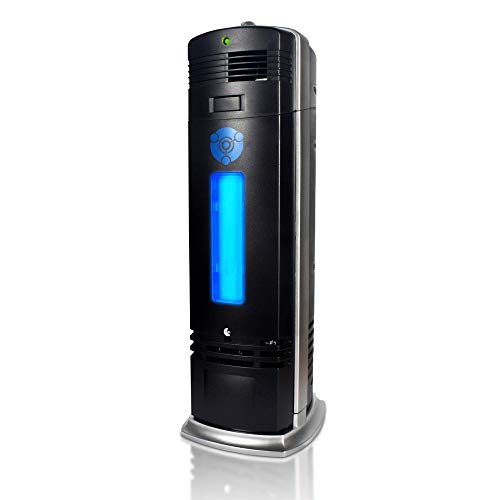
A sealed mechanical air purifier with a true HEPA filter and zero electronic ionization stages
Physical filtration captures airborne allergens and dust without emitting secondary ozone or reactive ions into an infant bedroom.

An evaporative cool-mist humidifier using an absorbent paper wick and an automatic shutoff humidistat
Evaporative wicks leave dissolved tap water minerals in the tray instead of aerosolizing them into breathable white dust.
 Crane Evaporative Humidifier, Wick Filter, Dishwasher Safe Tank, UV Light, No White Dust, Whisper Quiet, Bedroom Nursery Office, 1.9L Tank, Up To 250 SQ FTCrane
 DFD 4-Pack WF813 Humidifier Filter Compatible with Equate Eqwf813 Eq-2119-Ul,Replacement for ReliOn RCM-832,RCM-832N and ProCare PCWF813 Cool Mist Humidifiers Wick FiltersDFD
A stand-alone digital thermohygrometer with tenth-percent relative humidity resolution
Placing an independent gauge at crib height ensures the nursery stays strictly between 30 and 50 percent relative humidity.
 Pyle Indoor Digital Hygro-Thermometer - Thermometer and Humidity Gauge with Temperature Humidity Monitor, High & Low Records, Pocket-sized for Portability - Pyle PHHT15Pyle
 JOOKACE Indoor Camera with Temperature & Humidity Monitor, 4k Indoor WiFi Nanny Cam with Motion Detection, Night Vision, Live View by App, Security Camera for Home, Office, Greenhouse, GarageJOOKACE
Prices are not shown here because they change daily and we will not display a stale one. Links open on Amazon, where the current price and availability are live.
Common questions
Should you run an air purifier in a nursery all night?
Yes, running a true HEPA air purifier continuously on a low setting provides steady particle removal throughout sleep. Continuous airflow keeps dust and allergen levels low while providing gentle background noise. Ensure the purifier uses purely mechanical filtration and that any auxiliary ionizer functions remain permanently turned off.
Is an ultrasonic humidifier safe for an infant nursery?
Ultrasonic humidifiers are safe only if filled exclusively with distilled or demineralized water. Tap water contains dissolved minerals that vibrating ultrasonic diaphragms shatter into breathable microscopic dust. If supplying distilled water daily is impractical, choose an evaporative wick humidifier that naturally retains minerals in its paper filter.
What is the recommended humidity level for a nursery?
The Environmental Protection Agency (EPA) recommends maintaining indoor relative humidity between 30 percent and 50 percent. Dropping below 30 percent dries out delicate infant mucous membranes and impairs natural airway defenses. Exceeding 50 percent encourages dust mite growth and promotes mold development on cold perimeter walls.
Does a nursery bedroom door need to stay open at night?
Cracking the nursery door two to three inches prevents exhaled carbon dioxide from accumulating above 1,500 parts per million before morning. If household noise requires a shut door, open an exterior window a half inch or set the central heating and cooling fan to run continuously for ventilation.
How long should new nursery furniture off-gas before a baby sleeps in the room?
New cribs, dressers, and mattresses should off-gas in a well-ventilated spare room or garage for at least two to four weeks before use. The Consumer Product Safety Commission (CPSC) reports that engineered wood products release their highest concentrations of formaldehyde and chemical vapors immediately after unboxing.