A countertop water filter treats drinking water without modifying pipes or cabinet bases. Renters face lease agreements that forbid permanent plumbing alterations. These freestanding units sit near the sink, drawing municipal supply through a diverter valve or a top-fill reservoir.
They bridge the functional gap between slow pitchers and permanent installations. A water filter pitcher holds limited volume. A permanent under-sink water filter requires drilling through stone countertops and cutting supply lines. Countertop units balance continuous daily output with complete portability.
Selecting an effective unit requires matching the internal filtration media to your local tap contaminants. Some designs only improve taste. Others extract dissolved heavy metals, industrial solvents, and chemical residues. Understanding the mechanical differences protects both your health and your budget.
Faucet Diverters Deliver On-Demand Pressurized Flow
Faucet-connected diverters route pressurized tap water directly through an external housing using a small valve attached to your sink spout. You unscrew the existing aerator screen from the faucet tip. The diverter collar screws onto those exposed threads. When you pull the diverter pin, cold tap flow redirects through a flexible hose into the filtration chamber.
Water pressure forces liquid through the internal media and out an independent dispensing spout. Municipal water lines typically operate between 40 and 60 pounds per square inch according to the Environmental Protection Agency (EPA). This incoming pressure maintains an active output rate between 0.5 and 1.0 gallon per minute. You fill pots quickly. You never wait on gravity.
Spout compatibility remains the primary physical limitation for diverter installations. Standard diverters fit conventional spouts threaded for 55/64-inch female or 15/16-inch male aerator collars. Faucets with pull-out spray heads, flexible silicone necks, or rectangular spouts lack compatible threads. Forcing adapters onto plastic threads ruins fixtures. Inspect your kitchen spout before selecting a diverter unit.
Standalone Basins Operate Away from the Sink
Standalone countertop systems use manual pour-in reservoirs to purify water without connecting to a plumbing fixture. These units function anywhere an electrical outlet or level surface exists. You lift a pitcher to fill an upper chamber. That independence solves the problem of incompatible kitchen faucets.
Gravity-fed systems rely on hydrostatic weight to press water through dense ceramic or carbon elements. Flow moves slowly. A two-gallon upper reservoir requires between one and three hours to drain completely into the lower holding tank. You must plan your consumption ahead of time. Emptying the reservoir means waiting for the next filtration cycle.
Motorized countertop units add an internal electric pump to push reservoir water through dense filtration stages. The pump overcomes media resistance within seconds. You press a button on the front panel to dispense purified water into your glass. This mechanical assistance reduces wait times while keeping the machine independent of your plumbing lines.
Published Standards Verify Real Contaminant Reduction
Published contaminant reduction requires verified testing under protocols established by the National Sanitation Foundation (NSF) and the American National Standards Institute (ANSI). Marketing literature often uses vague phrases like laboratory tested. Those claims mean little without a specific standard number. An uncertified filter may clarify water without removing dissolved toxins.
The baseline standard is NSF/ANSI 42. It governs aesthetic qualities like chlorine in tap water, sulfur odors, and coarse cloudiness. Water treated under Standard 42 tastes crisp, but dissolved chemical hazards remain behind. Removing biological cysts and heavy metals demands certification under NSF/ANSI 53. For example, the EPA sets the lead action level in public drinking water at 15 parts per billion. A filter certified for lead reduction under Standard 53 drops high concentrations below that federal threshold.
Pesticides and industrial byproducts fall under NSF/ANSI 401 for emerging contaminants. Many modern municipal supplies carry micro-pollutants that older standards never evaluated. If your utility report shows industrial solvents or Per- and Polyfluoroalkyl Substances (PFAS), demand verified Standard 53 or Standard 58 performance. A specialized pfas water filter requires verified test data to confirm removal down to single-digit parts per trillion.
| Standard | Target Contaminants | Typical Media | Classification |
|---|---|---|---|
| NSF/ANSI 42 | Chlorine, taste, odor, coarse particulates | Granular activated carbon | Aesthetic |
| NSF/ANSI 53 | Lead, cysts, volatile organic chemicals | Compressed carbon block | Health effects |
| NSF/ANSI 58 | Total dissolved solids, nitrates, heavy metals | Reverse osmosis membrane | Health and aesthetic |
| NSF/ANSI 401 | Prescription drugs, flame retardants, pesticides | Advanced composite carbon | Emerging compounds |
Countertop Reverse Osmosis Separates Dissolved Minerals
Countertop Reverse Osmosis (RO) systems push water through a semipermeable membrane to strip dissolved inorganic minerals that carbon blocks miss. The synthetic polyamide membrane features microscopic pores measuring approximately 0.0001 microns. Water molecules squeeze through. Dissolved salts, nitrates, and heavy metals bounce away into a reject waste stream.
Wastewater generation represents the primary operational trade-off for membrane filtration. A built-in reverse osmosis system plumbed beneath a sink typically discards three to four gallons of brine for every purified gallon. Compact countertop versions use pressurized recirculation loops to improve that recovery ratio. Testing protocols under NSF/ANSI 58 document that efficient countertop pumps reduce reject ratios to approximately one gallon wasted per gallon purified. You must dump that concentrated reject basin manually after every batch cycle.
Membrane treatment strips beneficial alkaline minerals alongside hazardous contaminants. The process removes calcium and magnesium. This demineralization drops the mineral density, which can leave the water tasting flat. Certain models incorporate an auxiliary remineralization cartridge downstream of the membrane to restore basic bicarbonate minerals and raise water pH.
Dense Carbon Blocks Prevent Channeling and Contaminant Bypass
Extruded solid carbon blocks capture chemical pollutants more consistently than granular activated carbon because compressed structures prevent fluid channeling. In a loose granular cartridge, water creates pathways of least resistance through the shifting carbon flecks. Fluid rushes through those channels without touching active binding sites. Solid block media eliminates that bypass route.
Sub-micron carbon blocks force incoming water through a tight maze of activated pores. This structural density extends the contact time between liquid and carbon. Longer contact periods allow adsorption to capture Volatile Organic Compounds (VOCs), pesticide residues, and industrial solvents. When combined with specialized ion-exchange binders, a dense block binds dissolved lead in water through chemical absorption.
The mechanical density that stops chemical contaminants also causes sediment accumulation over time. Fine silt, pipe scale, and rust particles lodge in the outer pores of the block. Water flow slows down as those outer pores fill. Replacing cartridges according to gallon ratings detailed in our guide on how often to change water filter media prevents premature pressure loss.
Who Should Skip a Countertop Water Filter Setup
A countertop water filter is the wrong choice for large families, cramped prep spaces, and biologically compromised water supplies. Households with four or more people consume dozens of gallons daily for cooking and drinking. Bottlenecks happen quickly. Countertop systems struggle to sustain that continuous volume without constant manual refilling.
Counter space remains a limited asset in small apartment kitchens. A diverter canister or gravity tower claims six to ten inches of prep room next to the sink. Connecting hoses can drape across counters, catching on cutting boards and dish racks. Homeowners with authority to alter plumbing achieve cleaner aesthetics and higher flow rates with an under-sink installation.
Biological hazards require physical disinfection rather than standard consumer filtration. The Centers for Disease Control and Prevention (CDC) cautions that standard carbon and particulate filters cannot disinfect water containing pathogenic bacteria or viruses. If a private well tests positive for coliform bacteria, a countertop unit cannot make that water safe. You need an ultraviolet disinfection system or whole-house chlorination before addressing chemical tastes at the tap.
Biofilm and Stagnant Water Create Maintenance Hazards
Filter housings kept at ambient room temperature accumulate bacterial biofilm if internal media sits damp without regular flushing. Chlorine protects municipal water while travelling through city mains. Once your filter strips that disinfectant, the treated water inside the housing loses its biological protection. Stagnant, dechlorinated water warms quickly on a sunny kitchen counter.
Leaving a countertop unit unused during a vacation invites bacterial colonization across the carbon bed. Microorganisms feed on trapped organic particles. When returning home after three or more days away, flush the system thoroughly. Run cold tap water through the cartridge for at least three minutes before drinking. This purge clears stagnant fluid from the housing.
Physical maintenance extends beyond simple cartridge replacement. Wash external basins and diverter valves every time you install new filtration media. Inspect the small rubber o-rings inside the faucet diverter collar for mineral crusting and cracking. A degraded gasket allows unpurified tap water to leak down the faucet neck, pooling around the sink deck.
Testing Your Water Dictates the Proper Equipment Setup
Selecting the right countertop configuration depends entirely on identifying the specific chemical and mineral profile of your incoming tap water. A municipal report reveals whether your utility uses standard chlorine or persistent chloramines for sanitization. Standard activated carbon treats chlorine effectively. It fails against chloramines, which require catalytic carbon media with prolonged contact times.
Our equipment recommendation flips if laboratory sampling uncovers dissolved heavy metals or high salinity. A simple carbon diverter handles basic taste issues and volatile chemicals. If your plumbing leaches high copper or lead levels, you must upgrade to an NSF 53 certified block or an NSF 58 reverse osmosis unit. Conversely, clean municipal water with minimal dissolved solids needs nothing more than an economical single-stage carbon diverter.
Order a certified laboratory analysis through a water test kit to identify your plumbing risks. Review those laboratory contaminant figures before selecting your countertop water filter.
What to Buy for This
Each entry below is a specification rather than a single model, because stock and pricing on this equipment change constantly. The products shown are what currently matches that specification. Match the spec, then buy whatever meets it.
Single-stage countertop diverter system with 0.5-micron extruded carbon block certified to NSF/ANSI 42 and 53
Attaches to standard threaded aerators in minutes, removing lead and chlorine without taking up floor space or modifying pipes.


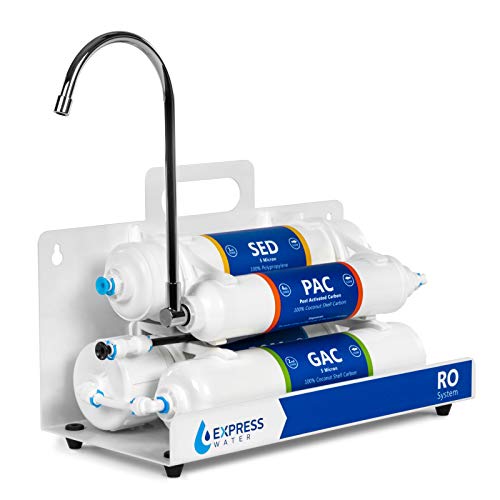
Four-stage countertop reverse osmosis system with internal booster pump and remineralization cartridge
Separates dissolved solids, nitrates, and fluoride without requiring under-sink drain line drilling or plumbing cuts.

Gravity-fed dual-chamber stainless steel system with cleanable microporous ceramic carbon elements
Requires no water pressure or electricity, operating entirely independently of your kitchen plumbing fixtures.


Prices are not shown here because they change daily and we will not display a stale one. Links open on Amazon, where the current price and availability are live.
Common questions
Can a countertop water filter connect to a pull-out spray faucet?
No, standard countertop diverter valves cannot attach to pull-out or pull-down spray faucets. These spray wands lack standard 55/64-inch aerator threads and feature internal check valves that fail under diverted backpressure. If your sink has a pull-out spray wand, select a standalone gravity-fed or pump-driven reservoir system instead.
Does a countertop water filter reduce water pressure at the sink?
A diverter system maintains normal kitchen sink flow until you pull the diverter pin to engage the filter. Once engaged, output drops to between 0.5 and 1.0 gallon per minute as water forces through the dense internal media. That lower rate is normal and necessary to provide sufficient contact time for contaminant adsorption.
How often should you replace a countertop water filter cartridge?
Most manufacturers recommend replacing solid carbon blocks every six to twelve months or after treating between 500 and 1,000 gallons. High sediment levels or heavy municipal chlorination will foul media faster than the calendar indicates. If water output drops significantly or tastes change, change the cartridge immediately regardless of elapsed time.
Do countertop water filters remove fluoride from tap water?
Standard carbon block filters do not remove fluoride. You must use a countertop reverse osmosis unit or specialized activated alumina media to extract dissolved fluoride ions. Verify that any system you consider holds certification under NSF/ANSI 58 for reverse osmosis fluoride reduction.
Can you run hot water through a countertop water filter?
No, running hot water through a carbon filter damages the media and can release previously trapped contaminants back into the stream. Heat expands carbon pores and degrades synthetic binders used in compressed blocks. Always run strictly cold water through the diverter valve to protect the internal elements.
Do countertop water filters remove minerals from drinking water?
Carbon-based countertop systems leave dissolved minerals like calcium and magnesium untouched while removing chemical contaminants. Only reverse osmosis systems and distillation units strip dissolved mineral salts from water. If you want mineral-free water, select a countertop reverse osmosis model certified to NSF/ANSI 58.