Standard pour-through pitchers cannot remove dissolved lead from drinking supplies.
Extracting lead in water requires an under-sink or countertop system certified to NSF International (NSF) and American National Standards Institute (ANSI) Standard 53 or 58. Lead enters tap water through corroding utility lines, brass fixtures, and lead-soldered copper joints inside private property. The Environmental Protection Agency (EPA) sets the maximum contaminant level goal for lead in drinking water at zero parts per billion (ppb). No safe blood level exists for children.
Boiling tap water evaporates pure moisture while leaving heavy metals behind, which increases the metal concentration in your pot. Municipal treatment plants monitor pipe corrosion at water mains, yet city testing cannot predict what happens inside your interior plumbing walls. Water standing still in older distribution pipes dissolves metal ions overnight. A laboratory water test kit confirms exact concentrations at your faucet. Filtration serves as an immediate protective barrier while you arrange plumbing repairs or utility line replacements.
Plumbing Materials Leach Lead in Water at the Tap
Lead dissolves into drinking water after treated municipal water leaves city mains and enters customer plumbing. Utilities maintain neutral water chemistry to limit corrosion. Corrosive water strips metal from utility service lines, indoor copper pipe joints, and brass faucets. Pipes remain the primary source. The Environmental Protection Agency reports that Congress banned plumbing materials containing more than eight percent lead in 1986. The Environmental Protection Agency lowered the allowable lead content for pipes, fittings, and fixtures to a weighted average of 0.25 percent in 2014.
Water absorbs heavy metals while sitting motionless in indoor plumbing lines overnight. Corrosion accelerates under hot temperatures. Running warm water dissolves metals much faster than cold supplies. The Centers for Disease Control and Prevention (CDC) warns that drawing hot water from the tap increases dissolved lead intake. Boiling does not destroy chemical elements. Instead, boiling water evaporates clean steam and concentrates the heavy metals left behind in your cooking pot.
| Era or Component | Regulatory Standard | Primary Metal Exposure Pathway |
|---|---|---|
| Pre-1986 Installations | Up to 100 percent lead service lines and 50 percent lead solder | Direct pipe dissolution into standing drinking water |
| 1986 to 2013 Standards | Maximum eight percent lead in pipes and 0.2 percent in solder | Galvanic corrosion at copper pipe joints and brass valves |
| Post-2014 Requirements | Weighted average of 0.25 percent lead across wetted surfaces | Trace surface leaching from newly installed brass components |
Standard Taste Filters Lack Heavy Metal Extraction Media
Basic carbon water pitchers certified solely for aesthetic taste reduction do not capture dissolved heavy metal ions. Most entry-level carafes use loose granulated activated carbon. Granulated carbon adsorbs chlorine molecules and organic compounds that cause foul smells. Dissolved lead slips straight through loose granules. NSF International Standard 42 covers only aesthetic impurities like taste, odor, and nominal particulate reduction. A pitcher bearing only an NSF 42 seal does not protect your health. Relying on it creates false security.
Targeting dissolved heavy metals demands specialized chemical media. Manufacturers must compress activated carbon into dense solid blocks or blend ion-exchange resin beads into the core. Ion exchange replaces dissolved lead ions with harmless sodium or potassium ions through electrostatic attraction. Dense blocks force water through microscopic pores that trap particulate metal flakes. A standard water filter pitcher without heavy metal media bypasses this filtration mechanism entirely.
Standard 53 Requires Documented Reduction Below Five Parts Per Billion
Filtration media certified under NSF International Standard 53 must reduce lead concentrations from an incoming challenge down to safe effluent thresholds. The test standard evaluates both dissolved and particulate forms of the metal. Dissolved lead passes through mechanical screens. It requires chemical binding. Particulate lead consists of tiny metal chips that break loose from pipe walls. NSF International Standard 53 challenges filters with influent water containing 150 parts per billion of lead. The unit must reduce that total concentration below five parts per billion across two distinct pH levels under the NSF International standard.
Water chemistry alters filtration effectiveness. Under NSF International test protocols, an acidic pH of 6.5 keeps lead dissolved as soluble ions. Under the same NSF International protocol, an alkaline pH of 8.5 causes the metal to precipitate into insoluble microscopic particles. NSF International mandates testing at both pH levels to verify the filter handles both dissolved and particulate phases. The protocol also tests the equipment up to 200 percent of its rated life to ensure media does not degrade according to NSF International guidelines. Uncertified filters skip these independent stress tests.
Manufacturers frequently print statements claiming their filters meet NSF standards without obtaining independent lab testing. Legitimate certification requires an official listing in public databases maintained by NSF International, the Water Quality Association, or the International Association of Plumbing and Mechanical Officials.
Whole House Filtration Systems Miss Interior Plumbing Corrosion
Whole house filtration tanks installed at the main water entry point cannot trap lead that leaches from interior household pipes downstream. Point-of-entry filters sit where the water pipe enters the foundation. They treat incoming municipal water. However, water must travel through dozens of feet of internal home plumbing before reaching your kitchen faucet. Older homes often contain copper pipes joined with lead solder. Many older brass valves also contain small amounts of lead. Water absorbs metals from those internal fixtures.
A whole house water filter leaves that downstream contamination untouched. Filtering at the main entry treats water before it ever contacts the corroding household plumbing. Installing a dedicated under sink water filter at the tap captures metals at the final point of consumption. This protects your drinking and cooking supply. Point-of-use units prevent freshly leached metals from reaching your glass.
Reverse Osmosis Membranes Separate Dissolved Heavy Metal Ions
Reverse osmosis systems rely on semi-permeable membranes that physically reject dissolved inorganic lead particles at the molecular level. Household water pressure pushes liquid through a synthetic composite sheet. Water molecules pass through tight pores. Heavy metal ions cannot squeeze through. The rejected contaminants wash down the drain in a concentrated reject stream. NSF International Standard 58 certifies reverse osmosis drinking water systems for health contaminant extraction. Under NSF International Standard 58, the system must reduce an incoming challenge of 150 parts per billion down to five parts per billion or less.
A certified reverse osmosis system strips almost all dissolved minerals from water. A handheld TDS meter tracks membrane integrity by reading total dissolved solids (TDS). However, a basic meter cannot identify specific metals. It only tracks total ionic conductivity. The Centers for Disease Control and Prevention confirms that reverse osmosis effectively removes lead alongside arsenic, copper, and nitrates. Most units include activated carbon pre-filters to remove chlorine and protect the delicate membrane.
First Draw Sampling Isolates Fixture and Solder Leaching
A laboratory water test provides the only reliable measurement of dissolved and particulate lead concentrations at a residential tap. You cannot see, smell, or taste dissolved metal. Clear water can carry dangerous concentrations. Testing requires a strict collection protocol. The Environmental Protection Agency lead sampling protocol specifies collecting a one-liter sample from a tap that has sat unused for at least six hours. This first draw captures water that stagnated against the faucet valve and nearby pipe solder.
Taking a second sample after running the tap reveals whether contamination comes from the service line. Let the water run cold. Running water for two to three minutes flushes the building interior pipes according to the Environmental Protection Agency. If lead remains high after a prolonged flush, the utility service pipe beneath the street likely contains lead. Evaluating your water profile helps determine if tap water is safe to drink without dedicated treatment.
- Select an interior cold water faucet used regularly for drinking and cooking.
- Ensure no plumbing fixtures or appliances run water anywhere in the house for at least six hours prior to sampling, as outlined by the Environmental Protection Agency.
- Fill the first laboratory sample bottle immediately upon turning on the cold tap without letting water run down the drain.
- Open the tap fully and run cold water for two full minutes to clear the interior house lines, following the Environmental Protection Agency flush guidance.
- Collect a second laboratory sample bottle to evaluate the water arriving from the exterior utility service line.
- Seal both bottles tightly and ship them immediately to an environmental laboratory certified by your state or the Environmental Protection Agency.
Plumbing Replacement Eliminates the Source When Filtration Lapses
Physical replacement of lead service lines and aging brass plumbing fixtures provides the permanent remedy for tap contamination. Filtration media has a finite operational lifespan. Solid carbon blocks and ion-exchange beads eventually saturate with captured heavy metal ions. Once the chemical binding sites fill completely, untreated metals break through into your drinking cup. Neglected filters stop working. Excavating old utility pipes and repiping interior copper joints with modern lead-free fittings removes the contamination hazard permanently.
Point-of-use filtration serves as a bridge solution while awaiting municipal infrastructure work or private contractor pipe replacement. A complete utility line replacement combined with interior repiping eliminates the need for ongoing filter cartridge maintenance. You can stop using specialized filters once consecutive laboratory tests confirm non-detectable concentrations. Point-of-use units do not serve properties where occupants drink from bathroom sinks or laundry taps without dedicated filtration. Complete repiping provides whole-building security. Collecting a certified laboratory test sample remains the necessary first step to identify whether private plumbing leaches lead in water before you invest in filtration equipment.
What to Buy for This
Each entry below is a specification rather than a single model, because stock and pricing on this equipment change constantly. The products shown are what currently matches that specification. Match the spec, then buy whatever meets it.
Under-sink solid carbon block filtration system certified under NSF/ANSI 53 for dissolved and particulate lead reduction
It plumbs directly to cold water lines, delivers continuous flow for cooking and drinking, and binds dissolved lead without producing wastewater.
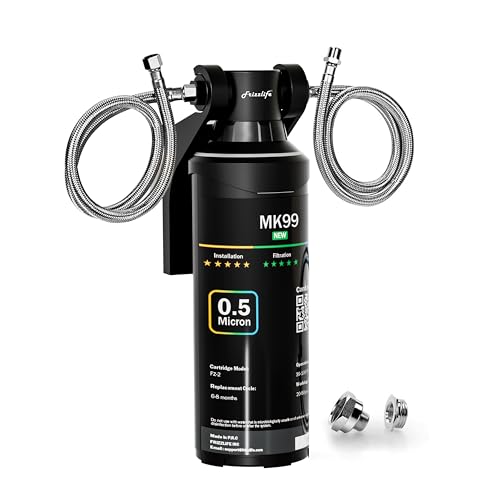 Frizzlife Under Sink Water Filter System-NSF/ANSI 53&42 Certified High Capacity Direct Connect Under Counter Drinking Water Filtration System-0.5 Micron Reduces Lead, Chlorine, Bad Taste & Odor, BlackFRIZZLIFE
 Frizzlife SW10 Under Sink Water Filter System, NSF/ANSI 53&42 Certified, Reduces 99.99% Lead, Chlorine, Bad Taste & Odor, Direct Connect Water Filter, 8K Gallons High Capacity, 0.5 Micron, USA TechFRIZZLIFE
Under-sink multi-stage reverse osmosis system certified under NSF/ANSI 58 for lead reduction
The semi-permeable membrane strips dissolved lead ions alongside other heavy metals and nitrates, providing the lowest total contaminant floor.
 iSpring RCC7AK-BN NSF Certified, 75 GPD, Alkaline 6-Stage Reverse Osmosis System, pH+ Remineralization RO Water Filter System Under Sink Patented Top-Mounted Faucet Design for Easy InstallationiSpring
 iSpring RCC7AKF3 Value Pack, Alkaline 6-Stage Under Sink Reverse Osmosis Water Filter System, Patented Easy-Mount Faucet for Effortless Installation, Additional 3 Pre-Filters IncludediSpring
Pour-through gravity water pitcher certified under NSF/ANSI 53 for lead reduction
It requires no plumbing modifications, operates on any countertop, and uses ion-exchange media formulated specifically to trap heavy metals.


Prices are not shown here because they change daily and we will not display a stale one. Links open on Amazon, where the current price and availability are live.
Common questions
Can boiling tap water remove lead?
Boiling tap water does not remove lead and concentrates the metal. Water evaporates as clean steam while heavy metal ions remain in the pot, increasing the contamination ratio per cup. The Environmental Protection Agency advises using cold, filtered tap water or bottled water for cooking and infant formula.
Does a standard refrigerator filter remove lead?
Most factory refrigerator filters do not remove lead because they are only certified to NSF International Standard 42 for taste and odor. To extract dissolved metals, a refrigerator cartridge must state explicit certification under NSF International Standard 53. Check your refrigerator manual or filter casing for an official NSF 53 mark before relying on it.
Can lead be absorbed through the skin while showering?
Human skin does not absorb lead from bathing or showering water according to the Centers for Disease Control and Prevention. The primary health risk comes from ingesting water through drinking, brushing teeth, or cooking foods that absorb boiling water. Whole-house lead filtration is therefore unnecessary solely for bathing safety.
Why does lead appear in tap water if the city water report shows none?
Municipal water reports measure water quality when it leaves the central treatment plant and at designated utility monitoring stations. Lead enters drinking water downstream as municipal supplies flow through private service lines, interior copper pipe solder, and older brass fixtures. Testing at your individual kitchen tap reveals what your private home plumbing contributes.
How long should you flush a tap to clear lead?
The Environmental Protection Agency recommends running cold tap water for two full minutes before drinking if the faucet has sat unused for several hours. This flushes stagnant water from the interior home pipes and brings in fresher water from the main. However, flushing does not replace certified filtration if your service line contains lead.