Standard filters miss tiny particles, but sub-micron filtration and reverse osmosis reliably capture them. Tiny synthetic fragments enter distribution systems through surface runoff, degrading industrial waste, and shedding synthetic textiles. Drinking water often carries them directly to your tap.
Plastic pollution in municipal drinking supplies has become an urgent consumer concern. People want to know if municipal treatment eliminates these synthetic particles. Municipal facilities remove larger solids effectively. However, municipal plants rarely capture microscopic fibers. The World Health Organization (WHO) reported in 2019 that conventional water treatment can remove over 90 percent of plastic particles when chemical coagulation and sand filtration are used correctly. Smaller fragments still escape into finished tap water.
You cannot see these particles in a glass of water. Most household plumbing cannot catch them without dense barrier media. Targeting microplastics in water requires matching the pore rating of your filter to the specific size of the particles you want to stop.
Particle Size Determines What Passes Through Your Plumbing
Water filtration efficiency depends directly on the physical size of the plastic particles relative to the pore openings of the filter media. The National Oceanic and Atmospheric Administration (NOAA) defines microplastics as synthetic polymers smaller than 5 millimeters across. Nanoplastics are even smaller fragments measuring below 1 micrometer. A micrometer is one thousandth of a millimeter.
For perspective, a human red blood cell measures roughly 7 micrometers across, based on data published by the National Institutes of Health (NIH). Synthetic textile fibers shed during laundry cycles often measure between 10 and 100 micrometers in length. Pore sizes in home filters vary wildly across categories.
Large fragments settle out or catch on basic screen filters. Sub-micron fragments travel freely through coarse media. If your filter has 20-micron openings, an 8-micron polyester fragment flows straight into your drinking glass. Physical exclusion is the main mechanism here. Chemical absorption does not trap inert plastic particles.
The National Oceanic and Atmospheric Administration states that microplastics range from 5 millimeters down to 1 micrometer. Below 1 micrometer, particles are classified as nanoplastics, which require membrane separation to trap.
Why Microplastics in Water Escape Common Pitcher Filters
Standard gravity pitchers allow microscopic particles to pass because their internal media consists of loose carbon granules designed for taste rather than fine mechanical straining. Pour-through pitchers rely entirely on gravity to pull water through a cartridge. Gravity provides minimal water pressure. Because pressure is low, the filter media cannot be packed tightly. A dense barrier would slow water flow to a crawl.
Most pitcher cartridges use loose granulated activated carbon (GAC) mixed with ion-exchange resin beads. Water channels loosely between these individual granules. The gaps between carbon granules often exceed 20 to 50 micrometers. Small synthetic fragments pass through these channels without resistance. Our water filter pitcher guide explains how gravity limits contaminant removal.
Pitchers excel at chlorine reduction under the NSF/ANSI 42 standard established by the National Sanitation Foundation (NSF International) and the American National Standards Institute (ANSI). They do not create a certified microscopic sieve. Some newer specialty pitchers use hollow-fiber membrane cartridges. These specialty models filter down to 0.2 micrometers. They run much slower than standard carbon pitchers. If you keep a basic carbon pitcher in your refrigerator, understand that it leaves microscopic particles in your cup.
Solid Carbon Blocks Provide a Physical Barrier Down to Half a Micron
Extruded solid carbon blocks trap microplastics mechanically by forcing water under pressure through microscopic pores that measure as small as 0.5 micrometers. Unlike loose carbon, an extruded carbon block compresses powdered carbon into a rigid cylinder. Water line pressure forces water through the dense wall.
Particles larger than the pores get caught on the outer surface or within the interior matrix. This process is known as depth filtration. Many under-sink systems use a carbon block rated at an absolute 0.5-micron threshold. An absolute rating means the filter stops virtually all particles at that stated dimension. A nominal rating means it stops only a percentage of them.
Always look for an absolute micron rating on manufacturer specifications. You can explore dedicated systems in our under-sink water filter analysis. The NSF/ANSI 53 standard, overseen by NSF International, validates particulate reduction claims down to 0.5 micrometers under Particulate Class I protocols. A certified 0.5-micron block stops microfibers, paint flakes, and suspended plastic dust. It will not, however, stop dissolved chemical plasticizers.
- Mechanical sieving catches particles directly at the outer surface of the block.
- Tortuous path depth filtration traps jagged microfibers inside winding carbon channels.
- High line pressure maintains adequate water flow through pores that would stall a gravity filter.
Reverse Osmosis Blocks Dissolved Molecules and Nanoplastics
Reverse osmosis provides the tightest filtration barrier available by forcing water molecules across a semi-permeable membrane with pores measuring roughly 0.0001 micrometers. A reverse osmosis membrane rejects almost everything larger than a water molecule. This includes minerals, heavy metals, synthetic polymers, and nanoplastics.
The Environmental Protection Agency (EPA) recognizes reverse osmosis as an effective method for removing extremely fine suspended and dissolved solids from drinking supplies. Pore sizes in these thin-film composite membranes are measured in angstroms rather than microns. One angstrom is one ten-thousandth of a micrometer. At that scale, physical exclusion of plastic fragments is virtually absolute.
There is one trade-off worth watching in these systems. Reverse osmosis systems store purified water in a pressurized holding tank. Many holding tanks contain a flexible butyl rubber bladder and plastic internal liners. The tubing between the filters and your faucet is polyethylene plastic. While the membrane strips incoming plastics, post-membrane components should be food-grade and well-rinsed. Choose systems with certified food-grade tubing and stainless steel dedicated faucets.
Whole House Systems Protect Fixtures Rather Than Drinking Cups
Point-of-entry whole-house filters use coarse sediment cartridges to protect plumbing and valves from large debris, but they do not filter down to the microscopic levels needed for drinking water. Whole-house systems treat all water entering your home. Flow rate is the main constraint for whole-house units. A standard household needs 7 to 12 gallons of water per minute to run showers, toilets, and laundry simultaneously.
Forcing that volume through a 0.5-micron filter would require immense commercial pumping equipment. Because of this pressure limitation, standard residential whole-house cartridges run at 5 to 20 microns. A 5-micron spun polypropylene cartridge captures visible grit, rust flakes, and large synthetic lint. It will not capture the sub-micron plastic debris identified in research.
Our whole house water filter overview clarifies where point-of-entry filtration stops working. Using a whole-house unit as a pre-filter protects downstream plumbing. You must still rely on a point-of-use filter at the kitchen sink for drinking water. Pairing a coarse sediment filter at the main supply with an under-sink block produces the cleanest setup.
Testing Limitations Mean Homeowners Cannot Easily Screen Tap Water
Standard consumer test kits cannot measure microplastics because identifying synthetic polymers requires specialized laboratory equipment such as micro-Raman spectroscopy or Fourier-transform infrared spectroscopy. No consumer test strip exists for plastic particles. A meter that tests total dissolved solids (TDS) measures electrical conductivity from dissolved mineral ions. Plastic particles do not conduct electricity. Therefore, a TDS meter will not show whether your water contains plastic.
Most residential labs do not offer consumer plastic screening. You can review standard contaminant testing options in our water test kit guide. Municipal water suppliers provide an annual Consumer Confidence Report mandated by the EPA under the Safe Drinking Water Act. These annual reports detail regulated contaminants like lead, nitrates, and disinfection byproducts. They do not report microplastics.
The EPA has not set a formal testing standard or Maximum Contaminant Level (MCL) for synthetic plastic particles in municipal water. Until federal testing standards exist, assuming presence in surface-derived tap supplies is the prudent baseline.
Distillation Removes Plastics but Presents Daily Convenience Drawbacks
Water distillers effectively isolate microplastics by evaporating water into steam and leaving solid plastic residues behind in the boiling chamber. Distillation relies on phase changes rather than porous filtration media. Water boils at 212 degrees Fahrenheit at sea level. Common polymers like polyethylene and polypropylene melt at higher temperatures and do not vaporize with water steam.
The steam rises into a condensing coil, cooling back into liquid form. All non-volatile contaminants remain in the boiling tank. This process removes virtually all synthetic plastic fragments. Our distilled vs filtered water comparison outlines the energy use and maintenance demands of thermal distillation.
Distillation is slow. A typical countertop distiller takes roughly four hours to produce one single gallon of water. Distillers also consume steady electrical power during the boiling cycle. The boiling chamber requires frequent cleaning to scrape away baked-on mineral scale and residue. For high-volume drinking water, a pressurized under-sink filter remains far more practical.
Comparing Treatment Technologies by Pore Size and Particle Retention
Selecting the right equipment comes down to matching pore size to your plumbing setup. Do not rely on basic gravity filtration if microscopic particle reduction is your goal. If you rent and cannot modify your plumbing, a dense ceramic countertop filter provides excellent physical exclusion without pipe alterations. For permanent home installations, an under-sink carbon block or reverse osmosis unit offers the most reliable mechanical barrier. Verify the manufacturer holds independent testing under NSF/ANSI standards before purchasing.
Inspect your kitchen plumbing today to determine whether an under-sink reverse osmosis setup or a countertop 0.5-micron ceramic system is the right configuration to address microplastics in water.
| Filter Type | Typical Pore Size | Microplastic Reduction | Primary Operational Limitation |
|---|---|---|---|
| Standard Gravity Pitcher | 20 to 50 microns | Minimal (catches large fibers only) | Gravity flow cannot push through dense media |
| Whole-House Sediment Filter | 5 to 20 microns | Low (captures visible flakes and grit) | High flow demand prevents sub-micron pore sizing |
| Solid Carbon Block | 0.5 to 1 micron | High (captures fine particles and fibers) | Requires line pressure and regular cartridge swaps |
| Countertop Ceramic Filter | 0.2 to 0.5 microns | High (effective depth filtration) | Slow flow rate and requires periodic scrubbing |
| Reverse Osmosis System | 0.0001 microns | Near total (blocks nanoplastics and ions) | Produces waste water and requires storage tank |
| Thermal Distiller | No pores (phase change) | Near total (plastics remain in boiler) | High electricity use and produces one gallon per cycle |
What to Buy for This
Each entry below is a specification rather than a single model, because stock and pricing on this equipment change constantly. The products shown are what currently matches that specification. Match the spec, then buy whatever meets it.
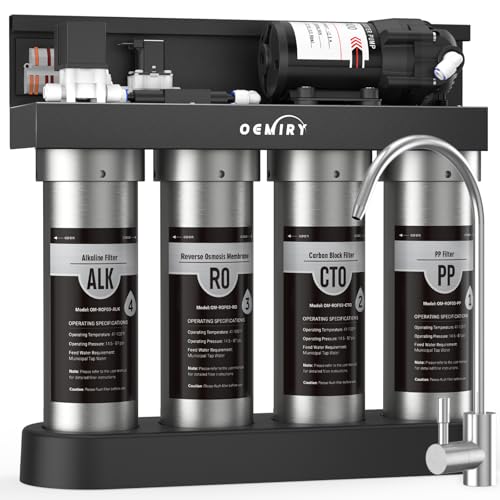
Multi-stage under-sink reverse osmosis system with a 0.5-micron carbon pre-filter, thin-film composite membrane, and lead-free stainless steel faucet
The composite membrane provides pore diameters near 0.0001 micrometers, which mechanically excludes both microplastics and sub-micron nanoplastics from the final dispense stream.

Countertop gravity-fed filtration chamber equipped with dual micro-porous ceramic filter candles rated at an absolute 0.5-micron pore size
The rigid ceramic shell acts as a physical depth filter to trap plastic microfibers and sediment without requiring under-sink pipe cuts or pressurized drain lines.


Heavy-duty 20-inch whole-house filter housing with a 5-micron spun polypropylene depth cartridge
Traps macro-scale plastic fibers, sand, and visible pipe scale before water enters water heaters and household plumbing, protecting downstream fixtures from coarse sediment.


Prices are not shown here because they change daily and we will not display a stale one. Links open on Amazon, where the current price and availability are live.
Common questions
Does boiling tap water remove plastic particles?
Boiling tap water does not destroy or vaporize synthetic plastic fragments because polymers have higher melting and decomposition points than the boiling temperature of water. A study published in Environmental Science and Technology Letters in 2024 by researchers at Jinan University showed that boiling hard water can cause calcium carbonate to precipitate and trap some plastic particles, but the particles remain in the pot unless poured through a fine filter.
Can a refrigerator water filter remove plastic fibers?
Most refrigerator water filters rely on basic carbon blocks or granulated media that target chlorine taste and odor under the NSF/ANSI 42 standard established by NSF International. Unless the refrigerator cartridge is specifically certified under NSF/ANSI 53 for Particulate Class I reduction down to 0.5 micrometers, fine plastic particles will pass through the dispenser into your glass.
Does the Environmental Protection Agency regulate plastic particles in drinking water?
The Environmental Protection Agency (EPA) currently has no federal regulations, monitoring requirements, or Maximum Contaminant Levels (MCL) for microplastics in public drinking water systems under the Safe Drinking Water Act. Municipal water utilities test and report only the specific chemical, biological, and radiological contaminants mandated by current federal guidelines.
Can plastic filter housings shed particles into filtered water?
Filter housings manufactured from certified food-grade polypropylene or polycarbonate are rigid molded plastics designed to resist erosion under continuous hydraulic pressure. While friction on uncleaned threads can theoretically release minor fragments during maintenance, quality housings certified under NSF/ANSI standards release negligible particulates compared to the volumes entering from raw tap water.
How do synthetic plastic fragments enter municipal drinking water supplies?
Microplastics enter lakes, rivers, and aquifers through atmospheric fallout, municipal stormwater runoff carrying synthetic tire dust, and treated wastewater discharge containing millions of synthetic textile fibers shed during home laundry cycles. Because conventional wastewater treatment plants are designed primarily to settle biological sludge rather than retain sub-micron particles, microscopic polymers flow downstream into drinking water reservoirs.
Is bottled water cleaner than filtered tap water regarding microplastics?
Research published in the Proceedings of the National Academy of Sciences (PNAS) in 2024 revealed that bottled water samples contained between 110,000 and 370,000 plastic particles per liter, roughly 90 percent of which were nanoplastics. The study identified that the plastic packaging itself, along with the mechanical bottling and cap-screwing process, contributes significant particle shedding directly into the bottled liquid.